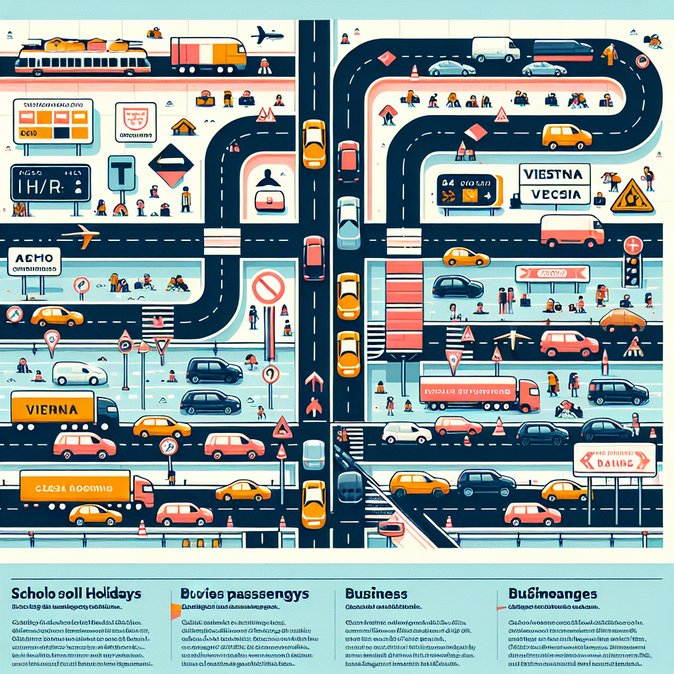
Austria’s semester holidays do not officially start until Monday, 2 February, but with pupils in Vienna and Lower Austria receiving their report cards on 30 January, the getaway rush has already begun. The motoring club ÖAMTC warns of heavy congestion from late Friday afternoon on all major exits of the capital, especially the A2 towards the southern ski resorts and the A1 westbound into Germany. The Local cites additional pressure from school breaks in parts of Germany and the Czech Republic, making some cross-border routes particularly vulnerable. (thelocal.at)
Peak bottlenecks are expected on Saturday morning along the Tauernautobahn (A10) towards Salzburg and the Brenner corridor (A13/A12) into Italy, where wait times at toll stations can exceed 60 minutes. Motorway operator ASFINAG has re-activated ‘dynamic lane reversal’ at the Steinhäusl interchange and placed additional staff at the Kufstein border checkpoint in coordination with Bavarian police.
If your weekend plans involve hopping across multiple borders, handling visa requirements at the last minute can be just as stressful as sitting in traffic. VisaHQ’s Austria portal (https://www.visahq.com/austria/) helps travellers and corporate mobility teams quickly verify entry rules, obtain e-visas and even arrange courier passport renewals, saving valuable time that might otherwise be lost in motorway queues.
![Semester-Break Getaway Triggers Cross-Border Traffic Surge—ÖAMTC Advises Extra Planning Time]()
For business travellers the advice is clear: allow at least an extra hour for airport transfers or cross-border road journeys. Companies running weekend assignment starts should consider rail alternatives; ÖBB reports spare capacity on Nightjet services to Zurich and Hamburg. Courier firms have been told to reschedule time-critical deliveries or switch to airfreight if possible.
Despite the anticipated jams, no special border controls are planned beyond the routine checks Austria maintains on its Slovak and Czech frontiers. Nevertheless, drivers should carry a passport or national ID and ensure vignette toll stickers or digital registrations are valid. The ÖAMTC also reminds travellers that winter-tyre rules remain in force until 15 April, and chains are mandatory on the B179 Fernpass if signposted.
Looking ahead, traffic is expected to ease by Tuesday evening, only to spike again on 6 February when Bavaria begins its own holiday week. Mobility managers should therefore monitor ÖAMTC live maps and advise staff accordingly.
Peak bottlenecks are expected on Saturday morning along the Tauernautobahn (A10) towards Salzburg and the Brenner corridor (A13/A12) into Italy, where wait times at toll stations can exceed 60 minutes. Motorway operator ASFINAG has re-activated ‘dynamic lane reversal’ at the Steinhäusl interchange and placed additional staff at the Kufstein border checkpoint in coordination with Bavarian police.
If your weekend plans involve hopping across multiple borders, handling visa requirements at the last minute can be just as stressful as sitting in traffic. VisaHQ’s Austria portal (https://www.visahq.com/austria/) helps travellers and corporate mobility teams quickly verify entry rules, obtain e-visas and even arrange courier passport renewals, saving valuable time that might otherwise be lost in motorway queues.

For business travellers the advice is clear: allow at least an extra hour for airport transfers or cross-border road journeys. Companies running weekend assignment starts should consider rail alternatives; ÖBB reports spare capacity on Nightjet services to Zurich and Hamburg. Courier firms have been told to reschedule time-critical deliveries or switch to airfreight if possible.
Despite the anticipated jams, no special border controls are planned beyond the routine checks Austria maintains on its Slovak and Czech frontiers. Nevertheless, drivers should carry a passport or national ID and ensure vignette toll stickers or digital registrations are valid. The ÖAMTC also reminds travellers that winter-tyre rules remain in force until 15 April, and chains are mandatory on the B179 Fernpass if signposted.
Looking ahead, traffic is expected to ease by Tuesday evening, only to spike again on 6 February when Bavaria begins its own holiday week. Mobility managers should therefore monitor ÖAMTC live maps and advise staff accordingly.