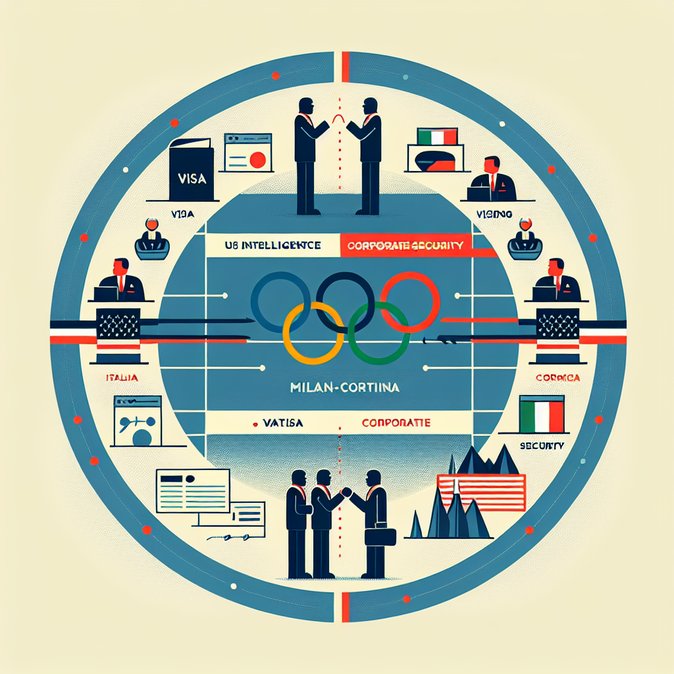
Italy’s political establishment and civil-society groups are at loggerheads with Washington after a U.S. spokesperson confirmed that agents from Immigration & Customs Enforcement (ICE)—specifically its Homeland Security Investigations branch—will take part in security preparations for the Milan-Cortina Winter Olympics.
Although ICE insists the agents will be confined to a joint operations room inside the U.S. Consulate in Milan and have no policing powers on Italian soil, the 28 January confirmation sparked immediate criticism. Milan Mayor Giuseppe Sala called the agency “a militia that kills”, referencing two recent fatal shootings by ICE officers in Minneapolis. MEP Alessandro Zan demanded that Prime Minister Giorgia Meloni “stop taking orders from Trump”, while even coalition MP Massimiliano Salini argued the presence was unnecessary.
For mobility planners and individual travellers alike, ensuring documentation is in order has never been more crucial. VisaHQ’s Italy portal (https://www.visahq.com/italy/) streamlines the process of securing visas, residency permits, and ancillary travel documents, offering real-time status updates and expert guidance that can mitigate last-minute disruptions—especially useful when heightened security protocols accompany global events like the Winter Olympics.
![Italian backlash grows as U.S. ICE unit confirmed for Milano-Cortina 2026 security]()
Interior-ministry officials attempted to calm the storm, stating that all public-order powers remain exclusively under Italian authorities and that ICE’s role is limited to intelligence support for U.S. dignitaries—among them Vice-President JD Vance and Secretary of State Marco Rubio—who will attend the opening ceremony on 6 February.
Why it matters for mobility managers: corporate security teams planning Olympic-year travel and hospitality programmes must now track two overlapping risk vectors—industrial-relations unrest and a heightened political debate over foreign security forces. Any escalation could translate into ad-hoc protests, tighter accreditation vetting, or last-minute changes to restricted zones around Olympic venues and key hotels.
The episode also underscores a broader trend: foreign law-enforcement footprints in Italy are coming under sharper scrutiny from both local politicians and EU privacy regulators—a factor global companies should evaluate when moving staff, VIPs or sensitive data across borders.
Although ICE insists the agents will be confined to a joint operations room inside the U.S. Consulate in Milan and have no policing powers on Italian soil, the 28 January confirmation sparked immediate criticism. Milan Mayor Giuseppe Sala called the agency “a militia that kills”, referencing two recent fatal shootings by ICE officers in Minneapolis. MEP Alessandro Zan demanded that Prime Minister Giorgia Meloni “stop taking orders from Trump”, while even coalition MP Massimiliano Salini argued the presence was unnecessary.
For mobility planners and individual travellers alike, ensuring documentation is in order has never been more crucial. VisaHQ’s Italy portal (https://www.visahq.com/italy/) streamlines the process of securing visas, residency permits, and ancillary travel documents, offering real-time status updates and expert guidance that can mitigate last-minute disruptions—especially useful when heightened security protocols accompany global events like the Winter Olympics.

Interior-ministry officials attempted to calm the storm, stating that all public-order powers remain exclusively under Italian authorities and that ICE’s role is limited to intelligence support for U.S. dignitaries—among them Vice-President JD Vance and Secretary of State Marco Rubio—who will attend the opening ceremony on 6 February.
Why it matters for mobility managers: corporate security teams planning Olympic-year travel and hospitality programmes must now track two overlapping risk vectors—industrial-relations unrest and a heightened political debate over foreign security forces. Any escalation could translate into ad-hoc protests, tighter accreditation vetting, or last-minute changes to restricted zones around Olympic venues and key hotels.
The episode also underscores a broader trend: foreign law-enforcement footprints in Italy are coming under sharper scrutiny from both local politicians and EU privacy regulators—a factor global companies should evaluate when moving staff, VIPs or sensitive data across borders.