
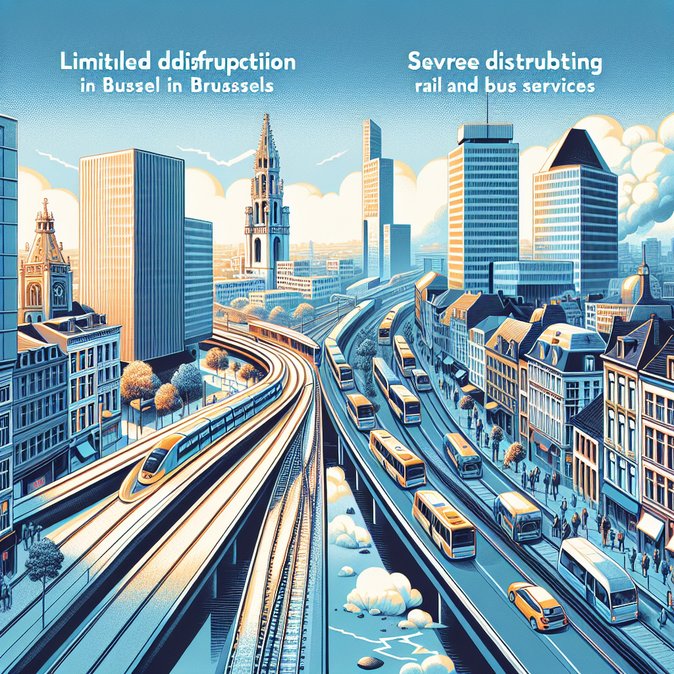
Belgium entered day three of a five-day national rail strike on 28 January 2026, and the picture for travellers is mixed. In Brussels, the contingency timetable put in place by national operator SNCB/NMBS is largely holding: around three out of four InterCity (IC) services and two-thirds of local and suburban (L/S) trains are running, keeping the capital’s main rail hubs—Midi, Central and Nord—reasonably fluid. Commuter surveys by Brussels Mobility indicate many office workers have shifted meetings online or scheduled tele-work days to avoid potential chaos, limiting road congestion around the inner ring. Rail-replacement taxis have not been widely required in the Brussels-Capital Region so far.
The situation is markedly tougher in Wallonia, where the rail walk-out coincides with an indefinite strike by TEC bus and tram staff. Key industrial centres such as Charleroi, Mons and Liège are seeing gaps of several hours between trains and, in many towns, no public bus services at all. Local media have reported a surge in ad-hoc car-pooling groups and taxi demand—costs that many employers may have to reimburse under Belgium’s commuter-expense rules.
International links are only partially spared. Eurostar, Thalys/Eurostar Continental, ICE and TGV InOui have maintained most rotations, but rail planners show cancellations on the Brussels–Amsterdam and Brussels–Rotterdam EuroCity routes, and Nightjet’s Brussels–Vienna service will originate in Cologne tonight. Travel managers moving staff between Belgian and Dutch or German hubs should verify train numbers and, where possible, ticket travellers on unaffected frequencies.
![Third Day of Belgium’s Five-Day Rail Strike Brings Uneven Disruption for Business Travellers]()
For travellers whose onward plans now involve unexpected rerouting or extended stays, VisaHQ can streamline any urgent visa or travel-document formalities. Their Belgium portal (https://www.visahq.com/belgium/) offers quick online applications and live support, helping business and leisure visitors adjust paperwork smoothly despite the strike-induced schedule changes.
The unions—ACOD Spoor/CGSP Cheminots, ACV Transcom and others—are protesting the government’s plan to scrap life-long statutory status for new SNCB and Infrabel hires from June 2026, as well as proposed pension and staffing reforms. Talks have stalled; if no compromise emerges by Friday evening, observers warn of rolling stoppages in February.
Practical advice for employers: (1) authorise remote work where roles allow; (2) remind travellers to consult the SNCB app no later than 17:00 for next-day strike timetables; (3) pre-book Eurostar or Thalys services if cross-border travel is critical; (4) keep receipts for alternative transport—under Belgian law, staff are entitled to reimbursement when public transport fails for reasons beyond their control.
The situation is markedly tougher in Wallonia, where the rail walk-out coincides with an indefinite strike by TEC bus and tram staff. Key industrial centres such as Charleroi, Mons and Liège are seeing gaps of several hours between trains and, in many towns, no public bus services at all. Local media have reported a surge in ad-hoc car-pooling groups and taxi demand—costs that many employers may have to reimburse under Belgium’s commuter-expense rules.
International links are only partially spared. Eurostar, Thalys/Eurostar Continental, ICE and TGV InOui have maintained most rotations, but rail planners show cancellations on the Brussels–Amsterdam and Brussels–Rotterdam EuroCity routes, and Nightjet’s Brussels–Vienna service will originate in Cologne tonight. Travel managers moving staff between Belgian and Dutch or German hubs should verify train numbers and, where possible, ticket travellers on unaffected frequencies.
For travellers whose onward plans now involve unexpected rerouting or extended stays, VisaHQ can streamline any urgent visa or travel-document formalities. Their Belgium portal (https://www.visahq.com/belgium/) offers quick online applications and live support, helping business and leisure visitors adjust paperwork smoothly despite the strike-induced schedule changes.
The unions—ACOD Spoor/CGSP Cheminots, ACV Transcom and others—are protesting the government’s plan to scrap life-long statutory status for new SNCB and Infrabel hires from June 2026, as well as proposed pension and staffing reforms. Talks have stalled; if no compromise emerges by Friday evening, observers warn of rolling stoppages in February.
Practical advice for employers: (1) authorise remote work where roles allow; (2) remind travellers to consult the SNCB app no later than 17:00 for next-day strike timetables; (3) pre-book Eurostar or Thalys services if cross-border travel is critical; (4) keep receipts for alternative transport—under Belgian law, staff are entitled to reimbursement when public transport fails for reasons beyond their control.