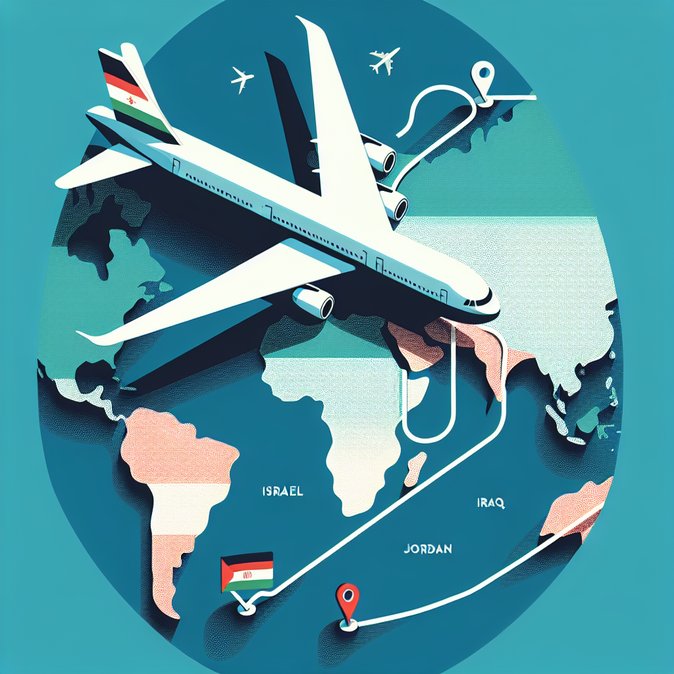
A fresh European Union Aviation Safety Agency (EASA) Conflict-Zone Bulletin has led Lufthansa, Swiss and Austrian Airlines to suspend night-stop flights to Tel Aviv and Amman and to extend their Tehran suspension until at least 29 March 2026. The German group is also rerouting services over the Gulf to avoid Iranian and Iraqi airspace, adding up to 90 minutes flying time on some Asian sectors.
Condé Nast Traveler reports that Air France, KLM, British Airways, United, Air Canada and Wizz Air have taken similar steps following the deployment of a US naval strike group to the Gulf, raising the risk of civil-aircraft mis-identification. Gulf mega-carriers continue to operate but are flying long detours.
![Lufthansa joins wave of carriers scaling back Middle-East schedules amid airspace-risk warnings]()
Amid these fast-moving route changes, travellers may suddenly find themselves transiting through unexpected countries—each with its own entry rules. VisaHQ’s Germany portal (https://www.visahq.com/germany/) gives corporate travel teams and individual passengers an instant view of visa requirements, can rush-process applications when itineraries shift at the last minute, and offers live updates on documentation changes, limiting disruption at the gate.
German corporates with regional projects face immediate schedule volatility, longer duty days and potential duty-of-care dilemmas for crews staying overnight in higher-risk areas. Travel managers are advised to activate crisis-communication protocols and ensure travellers are booked on daytime departures where possible. The Foreign Office has not issued a blanket travel ban but is urging “extreme vigilance”.
Given that EASA’s bulletin runs through mid-February—just ahead of the spring trade-fair season in Germany—the disruption may hit inbound visitor flows to Hannover Messe and ITB Berlin. Airlines are offering penalty-free rebookings, but seats on alternative routings are already tight.
Condé Nast Traveler reports that Air France, KLM, British Airways, United, Air Canada and Wizz Air have taken similar steps following the deployment of a US naval strike group to the Gulf, raising the risk of civil-aircraft mis-identification. Gulf mega-carriers continue to operate but are flying long detours.

Amid these fast-moving route changes, travellers may suddenly find themselves transiting through unexpected countries—each with its own entry rules. VisaHQ’s Germany portal (https://www.visahq.com/germany/) gives corporate travel teams and individual passengers an instant view of visa requirements, can rush-process applications when itineraries shift at the last minute, and offers live updates on documentation changes, limiting disruption at the gate.
German corporates with regional projects face immediate schedule volatility, longer duty days and potential duty-of-care dilemmas for crews staying overnight in higher-risk areas. Travel managers are advised to activate crisis-communication protocols and ensure travellers are booked on daytime departures where possible. The Foreign Office has not issued a blanket travel ban but is urging “extreme vigilance”.
Given that EASA’s bulletin runs through mid-February—just ahead of the spring trade-fair season in Germany—the disruption may hit inbound visitor flows to Hannover Messe and ITB Berlin. Airlines are offering penalty-free rebookings, but seats on alternative routings are already tight.