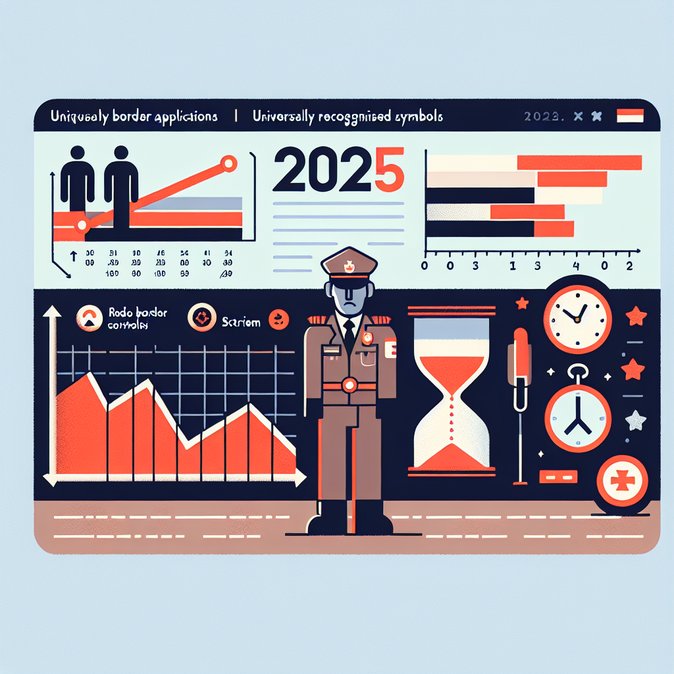
Austria’s annual migration balance sheet, presented in Vienna on 23 January and published internationally on 25 January, confirms a dramatic shift in the country’s migration profile. According to Interior Minister Gerhard Karner, first-time asylum claims fell to 6,849 in 2025 and total applications (including births and follow-on claims) dropped 36 % to 16,284. At the same time, the Federal Office for Immigration and Asylum (BFA) removed 14,156 people from Austrian territory – the highest number since records began.
Behind the headline figures lie three inter-locking policy levers that matter for global-mobility managers. First, the ministry expanded “zero-tolerance” policing along Austria’s Schengen borders with Hungary, Slovenia, Czechia and Slovakia, coupling spot checks with mobile patrols deeper inside the frontier zone. Second, family-reunification visas for recognised refugees remain largely suspended, slashing inflows that in 2023 had reached 3,400 people in the last quarter alone. Third, the BFA has re-deployed case-workers from reception centres to document-verification teams, lengthening security screening for all third-country nationals—including skilled workers arriving under the Red-White-Red Card programme.
For employers, the practical implications are already visible. Relocation providers report longer lead times for police-clearance certificates and a higher incidence of supplementary document requests, particularly for candidates from Afghanistan, Syria, Türkiye and India. Companies that rely on short-notice assignments into Austria should therefore budget extra processing days in Q1-Q2 2026 and prepare contingency plans for employees whose travel histories trigger additional scrutiny.
![Austria Ends 2025 with 36 % Fewer Asylum Applications and a Record 14,156 Deportations]()
To keep pace with such procedural shifts, many HR teams and individual travelers use VisaHQ as a one-stop resource for Austrian visa and residence formalities. Through its portal (https://www.visahq.com/austria/), VisaHQ provides real-time checklists, application tracking and liaison services with Austrian consulates, helping organisations secure Red-White-Red Cards, business visas and police documents faster and with fewer errors.
Strategically, Karner signalled that Austria will lobby like-minded EU states—Germany, Denmark, the Netherlands and Greece—to pilot “return centres” in non-EU countries where asylum procedures would take place before claimants reach EU soil. If Brussels endorses the concept after the new Migration Pact enters into force on 12 June 2026, the geography of business immigration to Austria could change once again, with more screening shifted upstream and away from Austrian borders.
Finally, HR teams should note that almost half (48 %) of last year’s deportees were convicted criminals. The Interior Ministry has promised to prioritise removals of offenders again in 2026, arguing that visible enforcement is essential for public support of legal migration channels. Firms employing non-EU staff should expect background-check questions on even minor police records and be ready to brief transferees about Austria’s increasingly stringent character-assessment rules.
Behind the headline figures lie three inter-locking policy levers that matter for global-mobility managers. First, the ministry expanded “zero-tolerance” policing along Austria’s Schengen borders with Hungary, Slovenia, Czechia and Slovakia, coupling spot checks with mobile patrols deeper inside the frontier zone. Second, family-reunification visas for recognised refugees remain largely suspended, slashing inflows that in 2023 had reached 3,400 people in the last quarter alone. Third, the BFA has re-deployed case-workers from reception centres to document-verification teams, lengthening security screening for all third-country nationals—including skilled workers arriving under the Red-White-Red Card programme.
For employers, the practical implications are already visible. Relocation providers report longer lead times for police-clearance certificates and a higher incidence of supplementary document requests, particularly for candidates from Afghanistan, Syria, Türkiye and India. Companies that rely on short-notice assignments into Austria should therefore budget extra processing days in Q1-Q2 2026 and prepare contingency plans for employees whose travel histories trigger additional scrutiny.

To keep pace with such procedural shifts, many HR teams and individual travelers use VisaHQ as a one-stop resource for Austrian visa and residence formalities. Through its portal (https://www.visahq.com/austria/), VisaHQ provides real-time checklists, application tracking and liaison services with Austrian consulates, helping organisations secure Red-White-Red Cards, business visas and police documents faster and with fewer errors.
Strategically, Karner signalled that Austria will lobby like-minded EU states—Germany, Denmark, the Netherlands and Greece—to pilot “return centres” in non-EU countries where asylum procedures would take place before claimants reach EU soil. If Brussels endorses the concept after the new Migration Pact enters into force on 12 June 2026, the geography of business immigration to Austria could change once again, with more screening shifted upstream and away from Austrian borders.
Finally, HR teams should note that almost half (48 %) of last year’s deportees were convicted criminals. The Interior Ministry has promised to prioritise removals of offenders again in 2026, arguing that visible enforcement is essential for public support of legal migration channels. Firms employing non-EU staff should expect background-check questions on even minor police records and be ready to brief transferees about Austria’s increasingly stringent character-assessment rules.