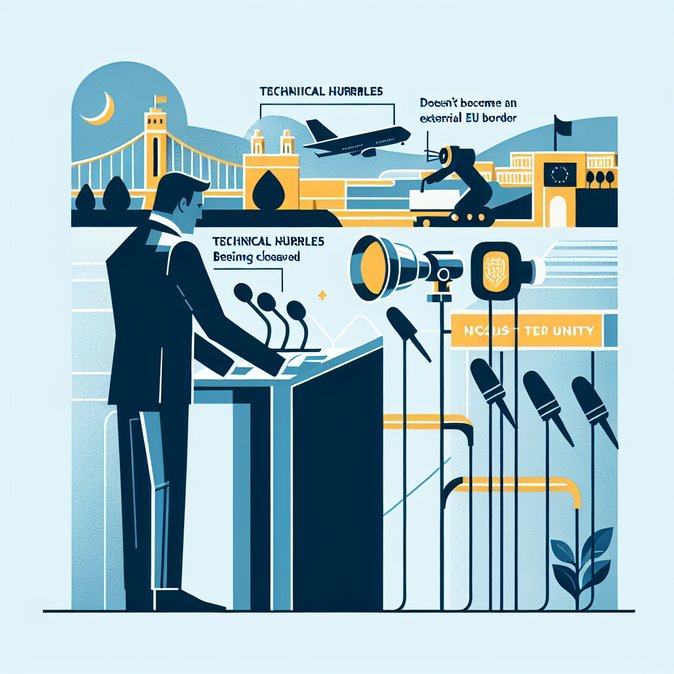
Speaking to journalists after the informal EU JHA Council in Nicosia, European Commissioner for Home Affairs and Migration Magnus Brunner delivered his clearest statement yet that Cyprus could join the Schengen area in 2026 despite its unique ‘Green Line’ situation. Brunner praised Nicosia’s technical progress—from biometric e-gates at both international airports to real-time links to the Schengen Information System—and said the forthcoming evaluation report would ‘reflect the exceptional realities on the island without lowering security standards’.
Cyprus remains the only EU member state (apart from opt-out Ireland) that is outside Schengen, largely because of the UN-patrolled buffer zone separating the Republic from the north. Critics worry accession could unintentionally transform the Green Line into a hard external border. Deputy Migration Minister Nikolas Ioannides rejected that view, stressing that the Green Line Regulation already allows Cyprus to carry out proportionate checks without altering its legal status.
![Commissioner Brunner insists Green Line won’t block Cyprus’ path to Schengen membership]()
If you are planning travel, relocation or business operations in Cyprus, VisaHQ can simplify the process of securing the necessary visas and permits ahead of any Schengen transition. Their country-specific portal (https://www.visahq.com/cyprus/) provides real-time guidance on entry requirements, facilitates online applications, and supports corporate clients managing multiple passports—helping you stay compliant now and when Schengen rules eventually apply.
Brunner also fielded questions on returns to Syria and Afghanistan, noting “changing circumstances” in parts of Syria and vowing closer cooperation with countries of origin. He revealed that €620 million has been earmarked for return and reintegration programmes in 2026-27, with Frontex facilitating nearly 10,000 voluntary returns across the Union last year.
For multinational companies using Cyprus as a regional hub, Schengen accession would remove passport checks on flights to continental Europe, reduce posted-worker notification times and simplify the dispatch of technicians under the ICT Directive. However, firms should plan for a transition period in which the Green Line will see more, not fewer, spot checks as authorities try to reassure fellow Member States that secondary movements are under control.
Cyprus remains the only EU member state (apart from opt-out Ireland) that is outside Schengen, largely because of the UN-patrolled buffer zone separating the Republic from the north. Critics worry accession could unintentionally transform the Green Line into a hard external border. Deputy Migration Minister Nikolas Ioannides rejected that view, stressing that the Green Line Regulation already allows Cyprus to carry out proportionate checks without altering its legal status.

If you are planning travel, relocation or business operations in Cyprus, VisaHQ can simplify the process of securing the necessary visas and permits ahead of any Schengen transition. Their country-specific portal (https://www.visahq.com/cyprus/) provides real-time guidance on entry requirements, facilitates online applications, and supports corporate clients managing multiple passports—helping you stay compliant now and when Schengen rules eventually apply.
Brunner also fielded questions on returns to Syria and Afghanistan, noting “changing circumstances” in parts of Syria and vowing closer cooperation with countries of origin. He revealed that €620 million has been earmarked for return and reintegration programmes in 2026-27, with Frontex facilitating nearly 10,000 voluntary returns across the Union last year.
For multinational companies using Cyprus as a regional hub, Schengen accession would remove passport checks on flights to continental Europe, reduce posted-worker notification times and simplify the dispatch of technicians under the ICT Directive. However, firms should plan for a transition period in which the Green Line will see more, not fewer, spot checks as authorities try to reassure fellow Member States that secondary movements are under control.