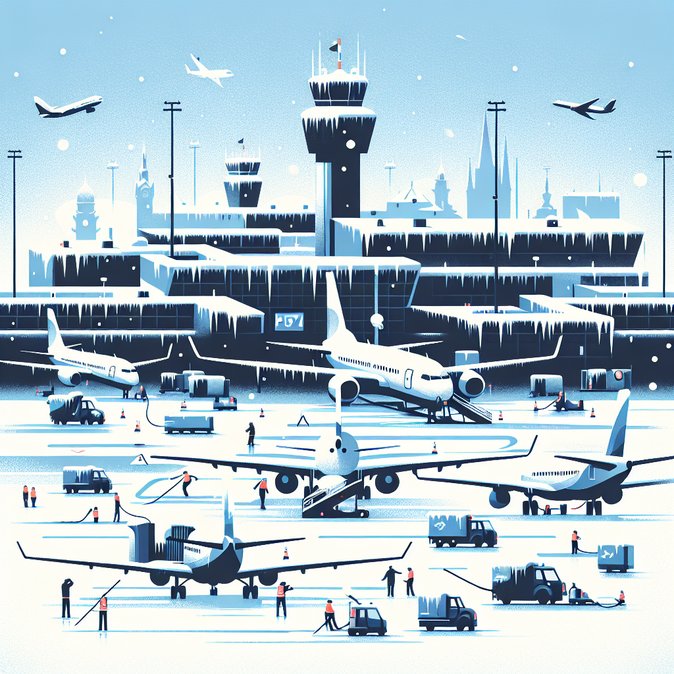
A blast of Arctic air sweeping across Central Europe on 22 January created a glaze of ice on Prague’s runways and aprons, causing knock-on delays that lasted into the late evening bank of long-haul departures. Real-time data show Smartwings flight QS 1223 from Marsa Alam landed 78 minutes behind schedule, while Neos service NO 460 to Punta Cana left 44 minutes late and Brussels Airlines SN 2811 arrived 40 minutes overdue.(flightstats.com) Meteorological readings taken at 06:00 CET recorded 18 °F with 93 % humidity – ideal conditions for black ice.(timeanddate.com)
Although Prague Airport avoided outright closure (unlike Vienna, which suspended operations for two hours earlier in the week), de-icing queues stretched to 25 aircraft at the morning peak. Airlines gave priority to intra-Schengen rotations to keep slot-controlled networks moving, leaving several leisure flights to the Red Sea and Canary Islands waiting on the remote stands.
Should icy conditions force travellers to adjust itineraries or visa appointments, VisaHQ’s online platform for the Czech Republic (https://www.visahq.com/czech-republic/) can quickly rearrange documentation timelines, offer express processing options, and track application status in real time—helping both corporate mobility teams and individual passengers stay compliant when winter weather disrupts plans.
![Freezing weather triggers rolling flight delays at Prague Václav Havel Airport]()
For business travellers and assignment coordinators the disruption highlights a seasonal risk that can up-end carefully choreographed immigration appointments at Prague’s Foreigners Residence Centres, many of which are still working through the first-month backlog created by the new digital Foreigner Account system. HR teams are advised to pad itineraries by at least half a day when moving key staff through Prague between now and late February, when average runway temperatures typically stabilise above freezing.
The airport authority says it has now replenished glycol reserves and activated an additional de-icing pad near Taxiway F, which should raise hourly throughput by six aircraft during future cold snaps. Car-hire firms at Terminal 1 report no vehicle shortages but recommend snow tyres for any cross-border drives to Germany or Austria, where motorway authorities enforced speed reductions to 80 km/h during the storm.
Looking ahead, meteorologists predict scattered snow showers for 24 January but no repeat of Thursday’s freezing rain, suggesting schedules will normalise over the weekend.
Although Prague Airport avoided outright closure (unlike Vienna, which suspended operations for two hours earlier in the week), de-icing queues stretched to 25 aircraft at the morning peak. Airlines gave priority to intra-Schengen rotations to keep slot-controlled networks moving, leaving several leisure flights to the Red Sea and Canary Islands waiting on the remote stands.
Should icy conditions force travellers to adjust itineraries or visa appointments, VisaHQ’s online platform for the Czech Republic (https://www.visahq.com/czech-republic/) can quickly rearrange documentation timelines, offer express processing options, and track application status in real time—helping both corporate mobility teams and individual passengers stay compliant when winter weather disrupts plans.

For business travellers and assignment coordinators the disruption highlights a seasonal risk that can up-end carefully choreographed immigration appointments at Prague’s Foreigners Residence Centres, many of which are still working through the first-month backlog created by the new digital Foreigner Account system. HR teams are advised to pad itineraries by at least half a day when moving key staff through Prague between now and late February, when average runway temperatures typically stabilise above freezing.
The airport authority says it has now replenished glycol reserves and activated an additional de-icing pad near Taxiway F, which should raise hourly throughput by six aircraft during future cold snaps. Car-hire firms at Terminal 1 report no vehicle shortages but recommend snow tyres for any cross-border drives to Germany or Austria, where motorway authorities enforced speed reductions to 80 km/h during the storm.
Looking ahead, meteorologists predict scattered snow showers for 24 January but no repeat of Thursday’s freezing rain, suggesting schedules will normalise over the weekend.