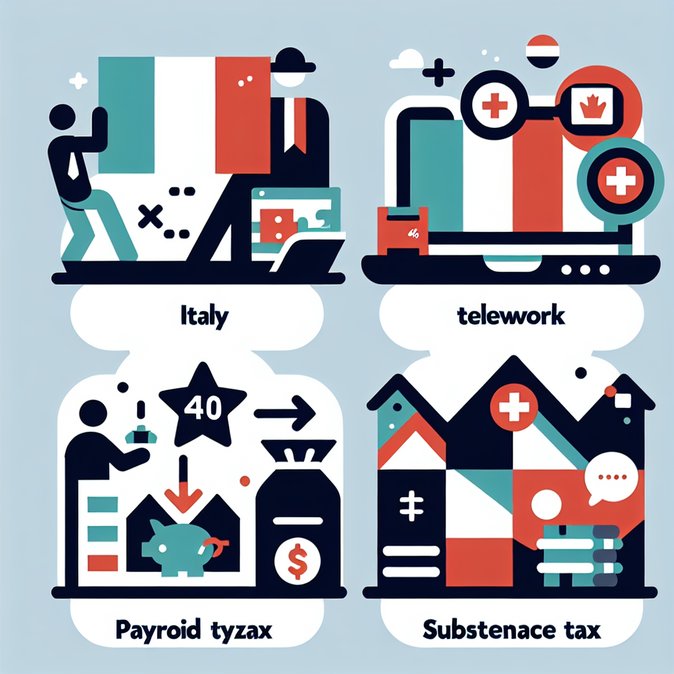
Italy has formally ratified the pending protocol to its 2020 frontier-workers agreement with Switzerland, publishing Law 217/2025 in the Official Gazette on 21 January 2026. The protocol – signed in May 2024 but awaiting parliamentary approval – modernises a decades-old tax regime that struggled to keep pace with hybrid work.
Key changes include:
• A definition of ‘telework’ that caps remote work performed in the country of residence (Italy or Switzerland) at 40 % of total working time before tax liability shifts.
• An automatic exchange of payroll data between Italian and Swiss tax authorities from 2027, easing compliance checks.
• A simplified substitute-tax option for new Italian frontier workers, set at 25 % of Swiss income tax paid, eliminating double-tax paperwork.
![Italy Ratifies Telework Protocol with Switzerland, Clarifying Tax for Frontier Workers]()
While the new protocol focuses on tax and social-security rules, cross-border employees and their HR departments often confront ancillary immigration questions—especially when assignments extend beyond the 90/180-day Schengen allowance. VisaHQ’s Italy portal (https://www.visahq.com/italy/) allows travellers and companies to check real-time visa requirements, generate invitation letters, and outsource consular filings, streamlining the paperwork that sits alongside the new tax obligations.
The protocol will enter into force once both countries exchange ratification instruments – expected mid-2026 – and will replace the temporary Covid-era telework accord due to lapse this year.
For the 80,000-plus Italians who cross the border daily (and the growing cohort who now work partly from home), the agreement brings welcome certainty on where social-security and income-tax obligations fall. Employers must now adapt time-tracking systems, update assignment contracts and secure A1 certificates for staff who exceed the 40 % threshold. Advisers recommend mapping employee work-patterns early in 2026 to avoid unexpected payroll corrections once the protocol is live.
Key changes include:
• A definition of ‘telework’ that caps remote work performed in the country of residence (Italy or Switzerland) at 40 % of total working time before tax liability shifts.
• An automatic exchange of payroll data between Italian and Swiss tax authorities from 2027, easing compliance checks.
• A simplified substitute-tax option for new Italian frontier workers, set at 25 % of Swiss income tax paid, eliminating double-tax paperwork.

While the new protocol focuses on tax and social-security rules, cross-border employees and their HR departments often confront ancillary immigration questions—especially when assignments extend beyond the 90/180-day Schengen allowance. VisaHQ’s Italy portal (https://www.visahq.com/italy/) allows travellers and companies to check real-time visa requirements, generate invitation letters, and outsource consular filings, streamlining the paperwork that sits alongside the new tax obligations.
The protocol will enter into force once both countries exchange ratification instruments – expected mid-2026 – and will replace the temporary Covid-era telework accord due to lapse this year.
For the 80,000-plus Italians who cross the border daily (and the growing cohort who now work partly from home), the agreement brings welcome certainty on where social-security and income-tax obligations fall. Employers must now adapt time-tracking systems, update assignment contracts and secure A1 certificates for staff who exceed the 40 % threshold. Advisers recommend mapping employee work-patterns early in 2026 to avoid unexpected payroll corrections once the protocol is live.