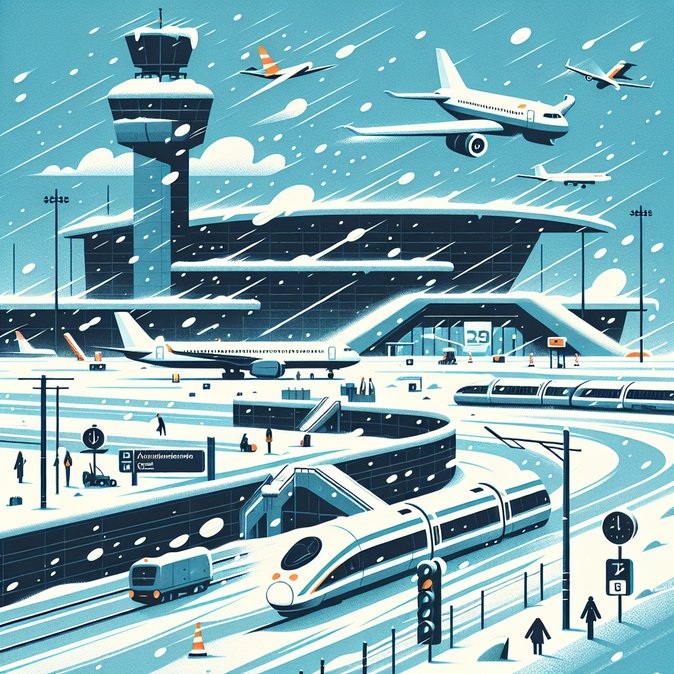
A fresh blast of snow and high winds cascading across central Europe on 21 January triggered a ripple of operational problems that was still being felt in German airspace on the morning of 22 January. According to real-time analytics firm AirHelp, 1,028 commercial flights were delayed and a further 35 were cancelled on 21 January, hitting every major network carrier, including Lufthansa, Air France, KLM, British Airways and Iberia. Frankfurt Airport—the continent’s largest cargo gateway and Lufthansa’s main long-haul base—logged the highest number of schedule changes, followed closely by Munich and Berlin-Brandenburg. Long-haul services to North America and Asia were especially vulnerable because crews were already approaching duty-time limits after earlier de-icing queues.
Ground-handling teams in Frankfurt reported de-icing wait-times of up to 90 minutes at peak, forcing Lufthansa to swap wide-body aircraft on some rotations and consolidate passenger loads. The German carrier re-booked hundreds of travellers onto Deutsche Bahn rail services under its Air-Rail intermodal guarantee—an increasingly valuable contingency as carriers wrestle with extreme-weather frequency in Europe. Corporate travel managers were advised to build at least a half-day buffer into inward itineraries that require same-day onward connections or meetings.
Under EU Regulation 261/2004, the snowstorm itself qualifies as an ‘extraordinary circumstance’, so financial compensation is unlikely. Nevertheless, travellers stuck overnight are still entitled to meals, hotel rooms and re-routing. AirHelp urged companies to remind mobile employees to keep boarding passes and expense receipts so that out-of-pocket costs can be recovered.
![More than 1,000 flights disrupted across Europe as winter weather snarls German hubs]()
While airlines work through the backlog, it’s also vital for travellers to confirm that their documentation is current before making fresh arrangements. VisaHQ’s dedicated Germany page (https://www.visahq.com/germany/) streamlines Schengen visa applications, passport renewals and other travel-document services in one place, helping both corporate mobility teams and individual passengers stay compliant and avoid last-minute administrative snags during weather-related disruptions.
For global-mobility teams, the episode underscores two broader trends: first, that Germany’s hub-and-spoke model magnifies the knock-on effect of local weather, and second, that reliable rail alternatives around Frankfurt, Munich and Berlin increasingly form part of duty-of-care planning. Companies with time-critical shipments should also note that cargo backlogs can take 48–72 hours to clear once runways are fully operational.
Most airlines expect to operate normal schedules by the morning of 23 January, but airports are warning of residual gate changes and minor delays while crews and aircraft return to proper rotations. Travellers should monitor airline apps and sign up for text alerts to stay ahead of further adjustments.
Ground-handling teams in Frankfurt reported de-icing wait-times of up to 90 minutes at peak, forcing Lufthansa to swap wide-body aircraft on some rotations and consolidate passenger loads. The German carrier re-booked hundreds of travellers onto Deutsche Bahn rail services under its Air-Rail intermodal guarantee—an increasingly valuable contingency as carriers wrestle with extreme-weather frequency in Europe. Corporate travel managers were advised to build at least a half-day buffer into inward itineraries that require same-day onward connections or meetings.
Under EU Regulation 261/2004, the snowstorm itself qualifies as an ‘extraordinary circumstance’, so financial compensation is unlikely. Nevertheless, travellers stuck overnight are still entitled to meals, hotel rooms and re-routing. AirHelp urged companies to remind mobile employees to keep boarding passes and expense receipts so that out-of-pocket costs can be recovered.

While airlines work through the backlog, it’s also vital for travellers to confirm that their documentation is current before making fresh arrangements. VisaHQ’s dedicated Germany page (https://www.visahq.com/germany/) streamlines Schengen visa applications, passport renewals and other travel-document services in one place, helping both corporate mobility teams and individual passengers stay compliant and avoid last-minute administrative snags during weather-related disruptions.
For global-mobility teams, the episode underscores two broader trends: first, that Germany’s hub-and-spoke model magnifies the knock-on effect of local weather, and second, that reliable rail alternatives around Frankfurt, Munich and Berlin increasingly form part of duty-of-care planning. Companies with time-critical shipments should also note that cargo backlogs can take 48–72 hours to clear once runways are fully operational.
Most airlines expect to operate normal schedules by the morning of 23 January, but airports are warning of residual gate changes and minor delays while crews and aircraft return to proper rotations. Travellers should monitor airline apps and sign up for text alerts to stay ahead of further adjustments.