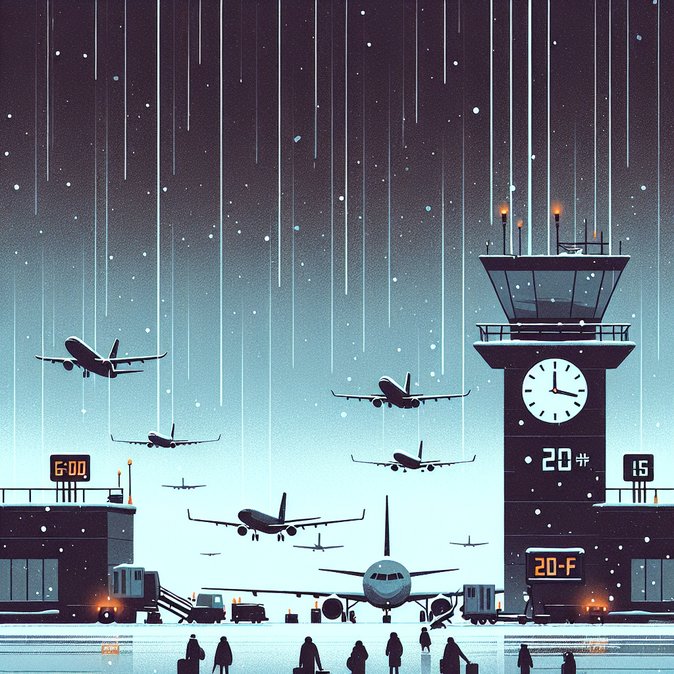
Business and leisure travellers moving through Finland’s main international gateway faced an unexpectedly slow start to the day on Wednesday, 21 January, as a band of light snow and freezing drizzle pushed Helsinki-Vantaa Airport (HEL) into instrument-flight-rules (IFR) operations for much of the morning. According to live operational data, visibility dropped to roughly 4 km with a 600-foot cloud ceiling from 06:00 until at least 13:00 local time. Runway friction measurements remained within safe limits, but the combination of de-icing cycles, reduced taxi speeds and sequencing gaps imposed by air-traffic control added up to delays averaging 25-45 minutes on short-haul European sectors and up to one hour on some long-haul departures.
Finnair, the airport’s largest carrier, proactively cancelled three feeder services to regional hubs in order to free up slots for intercontinental waves. Iberia’s codeshare flight IB/AY 1654 from Barcelona, for example, pushed back on time but waited on the de-icing pad for almost 40 minutes before take-off, illustrating the knock-on effects that ripple through tight winter schedules. Ground-handling companies told local media that every narrow-body aircraft required approximately 15 minutes of combined Type I and Type IV fluid treatment, compared with a normal cycle of 6-8 minutes in dry conditions.
Although no formal weather warning was issued, airport company Finavia posted social-media updates advising passengers to arrive “at least three hours” before non-Schengen flights and to monitor airline notifications. The advice is particularly pertinent for business travellers connecting to the United States or Asia, who must clear both outbound passport control and the EU’s new Entry/Exit System biometric kiosks—a process that already lengthens dwell time during peak waves. Taxi queues and public transport were also slower than usual, as light snow made sections of Ring III slippery despite overnight salting.
![Light snow and low visibility disrupt flights at Helsinki-Vantaa Airport on 21 January]()
For travellers whose rerouted or delayed itineraries suddenly require additional transit permissions or fresh visa documentation, VisaHQ can streamline the process. Its digital platform (https://www.visahq.com/finland/) offers on-the-spot eligibility checks, expedited processing and live support for a wide range of countries—handy when a missed connection at HEL forces an unexpected stopover or alternative routing.
From a global-mobility perspective, the episode is a reminder that Finland’s otherwise efficient hub remains vulnerable to rapid weather swings typical of the Gulf of Finland micro-climate. Companies with time-critical itineraries—especially those routing talent into Helsinki for same-day onward travel to regional offices—should build extra slack into winter connections through mid-February, when climatological records show the highest probability of similar IFR conditions. Travel managers are also encouraged to ensure that employees have airline apps enabled for real-time rebooking and that chauffeurs or ride-hail providers monitor the airport’s live arrival boards.
The operational pinch comes as Finland prepares for its peak Lapland charter season around the winter school holidays. Finavia’s contingency plan includes flexible staffing of de-icing rigs and the activation of a remote hard-stand bussing area to keep contact-gate turnover times within slot tolerances. If current forecasts hold, conditions are expected to improve by late evening as the snow band moves east, returning Helsinki-Vantaa to visual-meteorological-conditions (VMC) operations in time for the late-night Asian bank of departures.
Finnair, the airport’s largest carrier, proactively cancelled three feeder services to regional hubs in order to free up slots for intercontinental waves. Iberia’s codeshare flight IB/AY 1654 from Barcelona, for example, pushed back on time but waited on the de-icing pad for almost 40 minutes before take-off, illustrating the knock-on effects that ripple through tight winter schedules. Ground-handling companies told local media that every narrow-body aircraft required approximately 15 minutes of combined Type I and Type IV fluid treatment, compared with a normal cycle of 6-8 minutes in dry conditions.
Although no formal weather warning was issued, airport company Finavia posted social-media updates advising passengers to arrive “at least three hours” before non-Schengen flights and to monitor airline notifications. The advice is particularly pertinent for business travellers connecting to the United States or Asia, who must clear both outbound passport control and the EU’s new Entry/Exit System biometric kiosks—a process that already lengthens dwell time during peak waves. Taxi queues and public transport were also slower than usual, as light snow made sections of Ring III slippery despite overnight salting.

For travellers whose rerouted or delayed itineraries suddenly require additional transit permissions or fresh visa documentation, VisaHQ can streamline the process. Its digital platform (https://www.visahq.com/finland/) offers on-the-spot eligibility checks, expedited processing and live support for a wide range of countries—handy when a missed connection at HEL forces an unexpected stopover or alternative routing.
From a global-mobility perspective, the episode is a reminder that Finland’s otherwise efficient hub remains vulnerable to rapid weather swings typical of the Gulf of Finland micro-climate. Companies with time-critical itineraries—especially those routing talent into Helsinki for same-day onward travel to regional offices—should build extra slack into winter connections through mid-February, when climatological records show the highest probability of similar IFR conditions. Travel managers are also encouraged to ensure that employees have airline apps enabled for real-time rebooking and that chauffeurs or ride-hail providers monitor the airport’s live arrival boards.
The operational pinch comes as Finland prepares for its peak Lapland charter season around the winter school holidays. Finavia’s contingency plan includes flexible staffing of de-icing rigs and the activation of a remote hard-stand bussing area to keep contact-gate turnover times within slot tolerances. If current forecasts hold, conditions are expected to improve by late evening as the snow band moves east, returning Helsinki-Vantaa to visual-meteorological-conditions (VMC) operations in time for the late-night Asian bank of departures.