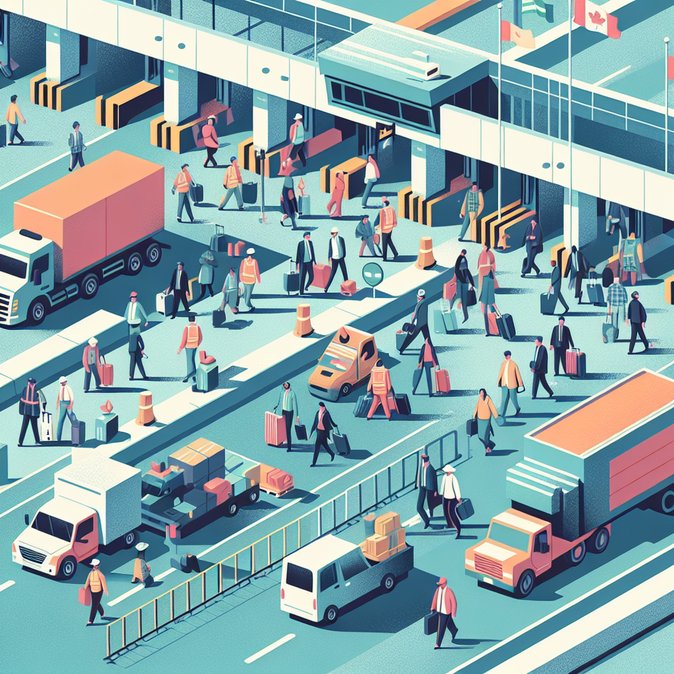
Members of the UN-facilitated Technical Committee on Crossings visited the Agios Dometios/Metehan checkpoint on 19 January to inspect finishing works on a €3 million expansion designed to double vehicle-processing capacity at the busiest crossing between the island’s divided communities. Project managers from UNDP Cyprus reported that paving, booth installation and landscaping are on schedule for completion by the end of January, pending final staffing agreements from both sides. (colombia.unmissions.org)
Once operational, the widened lanes and upgraded inspection technology are expected to cut average wait times from 30 minutes to under 10, a boon for the estimated 13,000 commuters who cross daily for work, study or commerce. Freight carriers moving goods under the Green-Line Regulation also anticipate smoother passage, reducing logistics costs for companies that operate on both sides of the divide.
For travelers who may still require formal entry documentation—especially those arriving from third countries—VisaHQ can simplify the process of obtaining the correct Cyprus visa. The platform’s dedicated page (https://www.visahq.com/cyprus/) provides step-by-step application guidance, document checklists and express courier options, ensuring visitors have the right paperwork in hand well before they reach the upgraded checkpoint.
![UN-Backed Upgrade of Agios Dometios/Metehan Crossing Set to Ease Green-Line Traffic]()
The project is financed through the EU Aid Programme for the Turkish Cypriot community and forms part of broader confidence-building measures ahead of Cyprus’ EU Council presidency. Border-management specialists note that while the crossing remains outside the EU’s Schengen framework, the upgrade will align inspection protocols more closely with EU entry/exit standards—important for any future Schengen accession talks.
For global-mobility managers the practical impact is twofold: employees who live in the north but work in the Republic can expect shorter commutes, and international assignees will find it easier to attend meetings across the divide. Companies should, however, update travel policies to reflect new traffic patterns once the checkpoint reopens and continue to brief staff on insurance coverage, as standard EU policies may not apply north of the Green Line.
The committee emphasised that operational efficiency will depend on adequate staffing and coordination between police, customs and veterinary services—issues that have historically limited throughput at other crossings. A joint simulation drill is planned before the formal ribbon-cutting to ensure systems interoperability.
Once operational, the widened lanes and upgraded inspection technology are expected to cut average wait times from 30 minutes to under 10, a boon for the estimated 13,000 commuters who cross daily for work, study or commerce. Freight carriers moving goods under the Green-Line Regulation also anticipate smoother passage, reducing logistics costs for companies that operate on both sides of the divide.
For travelers who may still require formal entry documentation—especially those arriving from third countries—VisaHQ can simplify the process of obtaining the correct Cyprus visa. The platform’s dedicated page (https://www.visahq.com/cyprus/) provides step-by-step application guidance, document checklists and express courier options, ensuring visitors have the right paperwork in hand well before they reach the upgraded checkpoint.

The project is financed through the EU Aid Programme for the Turkish Cypriot community and forms part of broader confidence-building measures ahead of Cyprus’ EU Council presidency. Border-management specialists note that while the crossing remains outside the EU’s Schengen framework, the upgrade will align inspection protocols more closely with EU entry/exit standards—important for any future Schengen accession talks.
For global-mobility managers the practical impact is twofold: employees who live in the north but work in the Republic can expect shorter commutes, and international assignees will find it easier to attend meetings across the divide. Companies should, however, update travel policies to reflect new traffic patterns once the checkpoint reopens and continue to brief staff on insurance coverage, as standard EU policies may not apply north of the Green Line.
The committee emphasised that operational efficiency will depend on adequate staffing and coordination between police, customs and veterinary services—issues that have historically limited throughput at other crossings. A joint simulation drill is planned before the formal ribbon-cutting to ensure systems interoperability.