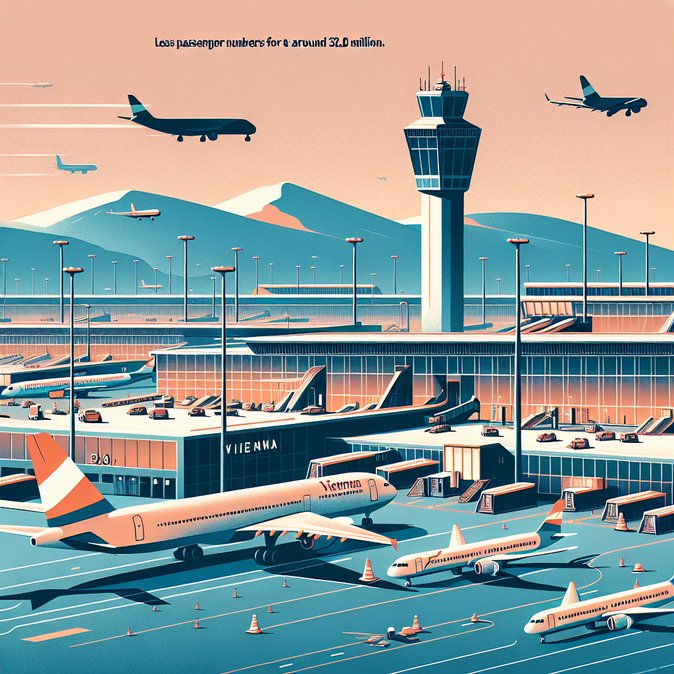
Flughafen Wien AG, operator of Austria’s largest airport, has issued a rare downward forecast, telling investors on 20 January that passenger throughput is likely to fall from last year’s record 32.6 million to about 30 million in 2026. The caution comes as home-carrier Austrian Airlines retires three ageing Boeing 767s and cuts frequencies on under-performing European city pairs, while low-cost carrier Ryanair redeploys two aircraft to Eastern Europe and Wizz Air exits Vienna entirely.
Chief financial officer Günther Ofner said the lower volume, coupled with a statutory 4.6 % reduction in passenger fees from 1 January, would knock revenue by roughly €30 million and shrink group EBITDA to €415 million. A cost-saving programme—frozen head-count, renegotiated service contracts and delayed non-critical capex—should keep net profit near the €210 million mark, he added. Capital expenditure will actually rise to €330 million as the airport presses ahead with a new central security hall designed around the EU Entry/Exit System and with Phase 2 of its Midfield Terminal renovation.
![Vienna Airport Warns of 2026 Passenger Dip to 30 Million as Airlines Trim Capacity]()
For international flyers juggling tighter schedules, having the right travel documents remains essential. VisaHQ can simplify the process with a fast, fully online visa application service for Austria and onward destinations; check the latest requirements or start an application at https://www.visahq.com/austria/
For business travellers and mobility planners the message is mixed. Fewer aircraft and tighter schedules could limit same-day connections to Central-Eastern Europe, but leaner operations may also ease chronic congestion at peak waves. Vienna will remain one of Europe’s most punctual hubs, Ofner insisted, pointing to on-time-performance data that still leads the Lufthansa Group. The airport also confirmed that it will keep a price-capped rail voucher scheme with ÖBB for disrupted passengers—a key contingency given January’s weather-related closures.
Policy-makers are watching closely. The passenger-fee formula is set in federal law, but the transport ministry hinted last week that it may review Austria’s separate air-transport tax after Ryanair’s latest capacity pull-back. Travel-management companies should prepare clients for higher fares in restricted business-class inventories and advise EU-national assignees to book early to secure Vienna connections. (kurier.at)
Chief financial officer Günther Ofner said the lower volume, coupled with a statutory 4.6 % reduction in passenger fees from 1 January, would knock revenue by roughly €30 million and shrink group EBITDA to €415 million. A cost-saving programme—frozen head-count, renegotiated service contracts and delayed non-critical capex—should keep net profit near the €210 million mark, he added. Capital expenditure will actually rise to €330 million as the airport presses ahead with a new central security hall designed around the EU Entry/Exit System and with Phase 2 of its Midfield Terminal renovation.
For international flyers juggling tighter schedules, having the right travel documents remains essential. VisaHQ can simplify the process with a fast, fully online visa application service for Austria and onward destinations; check the latest requirements or start an application at https://www.visahq.com/austria/
For business travellers and mobility planners the message is mixed. Fewer aircraft and tighter schedules could limit same-day connections to Central-Eastern Europe, but leaner operations may also ease chronic congestion at peak waves. Vienna will remain one of Europe’s most punctual hubs, Ofner insisted, pointing to on-time-performance data that still leads the Lufthansa Group. The airport also confirmed that it will keep a price-capped rail voucher scheme with ÖBB for disrupted passengers—a key contingency given January’s weather-related closures.
Policy-makers are watching closely. The passenger-fee formula is set in federal law, but the transport ministry hinted last week that it may review Austria’s separate air-transport tax after Ryanair’s latest capacity pull-back. Travel-management companies should prepare clients for higher fares in restricted business-class inventories and advise EU-national assignees to book early to secure Vienna connections. (kurier.at)