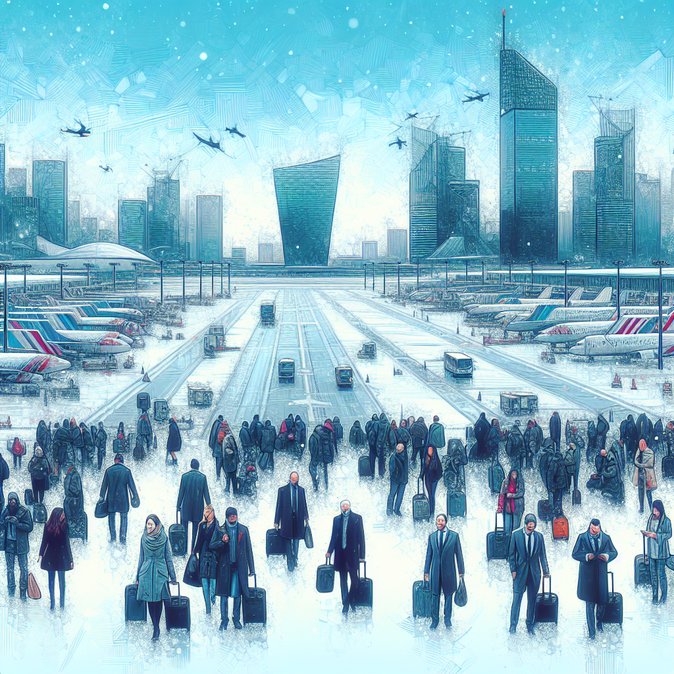
A sharp cold front dubbed “Jorty” barrelled across Western Europe on 17 January, and the fallout was quantified on 19 January: aviation-tracker The Traveler logged 851 delays and 53 outright cancellations, with Paris-Charles-de-Gaulle (CDG) and Orly responsible for roughly 22 % of the disruptions. De-icing backlogs pushed turnaround times beyond airline minimums, while runway-friction readings briefly dipped below regulatory thresholds, forcing the French Civil Aviation Authority (DGAC) to pare back slot allocations.
EUROCONTROL activated its Crisis Coordination Cell, reducing French air-space capacity by 15 %. Cargo operators re-routed temperature-sensitive freight via Lyon and Toulouse, and relocation companies reported household-goods deliveries slipping by up to 72 hours.
For international assignees stuck beyond their intended Schengen exit date, French border police can issue a force-majeure stamp to avoid over-stay penalties, but HR teams must coach travellers to request it proactively. Compensation under EU Reg. 261 does not apply—weather counts as an “extraordinary circumstance”—yet airlines remain obliged to provide meals after two hours and accommodation for overnight delays.
![Storm “Jorty” Triggers 851 Flight Delays and 53 Cancellations at French Airports]()
During such disruptions, third-party specialists like VisaHQ can simplify the paperwork maze: their online portal (https://www.visahq.com/france/) guides travellers through Schengen visa extensions, emergency travel documents, and country-specific entry rules, offering real-time support so HR coordinators aren’t left scrambling.
Météo-France expects temperatures to rise above freezing late on 18 January, allowing a gradual return to normal operations; nevertheless, slot displacement is forecast to ripple through the morning of 20 January. Mobility managers should urge staff to rely on dynamic airline-app updates rather than static itineraries and to keep receipts for reimbursable out-of-pocket costs.
The episode underlines how climate-driven volatility is straining Europe’s hub-and-spoke model. Industry analysts note that CDG’s resilience plan—expanded de-icing pads and automated glycol-recovery systems—will not come fully online until winter 2026-27.
EUROCONTROL activated its Crisis Coordination Cell, reducing French air-space capacity by 15 %. Cargo operators re-routed temperature-sensitive freight via Lyon and Toulouse, and relocation companies reported household-goods deliveries slipping by up to 72 hours.
For international assignees stuck beyond their intended Schengen exit date, French border police can issue a force-majeure stamp to avoid over-stay penalties, but HR teams must coach travellers to request it proactively. Compensation under EU Reg. 261 does not apply—weather counts as an “extraordinary circumstance”—yet airlines remain obliged to provide meals after two hours and accommodation for overnight delays.
During such disruptions, third-party specialists like VisaHQ can simplify the paperwork maze: their online portal (https://www.visahq.com/france/) guides travellers through Schengen visa extensions, emergency travel documents, and country-specific entry rules, offering real-time support so HR coordinators aren’t left scrambling.
Météo-France expects temperatures to rise above freezing late on 18 January, allowing a gradual return to normal operations; nevertheless, slot displacement is forecast to ripple through the morning of 20 January. Mobility managers should urge staff to rely on dynamic airline-app updates rather than static itineraries and to keep receipts for reimbursable out-of-pocket costs.
The episode underlines how climate-driven volatility is straining Europe’s hub-and-spoke model. Industry analysts note that CDG’s resilience plan—expanded de-icing pads and automated glycol-recovery systems—will not come fully online until winter 2026-27.