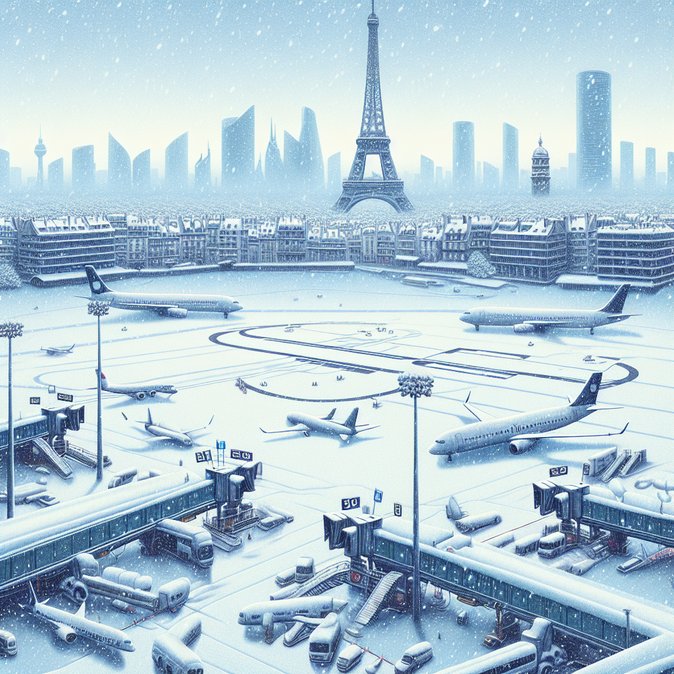
A sharp cold front nicknamed “Jorty” barrelled across Western Europe on 17 January, triggering 851 flight delays and 53 cancellations continent-wide, according to aviation-tracking portal The Traveler. Paris-Charles-de-Gaulle and Orly accounted for roughly 22 % of the disruptions as de-icing queues lengthened and runway-friction readings dipped below safety thresholds. London-Heathrow, Amsterdam-Schiphol and Istanbul also suffered widespread knock-ons. (visahq.com)
For mobility programmes the headaches are two-fold: missed connections and inadvertent Schengen overstays. French border police can issue a “force majeure” stamp that defends travellers against over-stay penalties when weather forces extra days in the bloc, but HR teams must coach employees to request it proactively. EU Regulation 261 compensation is not payable when weather is deemed extraordinary, yet airlines must still provide meals after two hours and hotels for overnight delays. (visahq.com)
![Storm ‘Jorty’ Causes 851 Flight Delays and 53 Cancellations at French Airports]()
Amid the scramble, VisaHQ can shoulder much of the paperwork stress. Its France platform (https://www.visahq.com/france/) lets travellers and global mobility teams check remaining Schengen days, download force-majeure request templates and even arrange next-day courier pickup for passport renewals—tools that streamline compliance when storms suddenly upend itineraries.
Cargo and relocation firms also felt the impact. Several temperature-sensitive household-goods shipments bound for Paris were off-loaded in Lyon, extending delivery windows for inbound expatriates by up to 72 hours. Biotech samples were rerouted through Toulouse using FedEx’s cold-chain service at an extra €300 per consignment. EUROCONTROL reduced French airspace capacity by 15 % and activated its Crisis Coordination Cell at 05:30 CET, underlining how climate-linked volatility is straining network resilience. (visahq.com)
Météo-France expects temperatures to climb above freezing by late 18 January, allowing CDG to return to normal operations, but slot displacement is likely to ripple into early 19 January. Mobility managers should therefore monitor airline apps for rolling re-timings rather than relying on static e-tickets and may need to issue emergency per-diem guidance for stranded travellers. (visahq.com)
For mobility programmes the headaches are two-fold: missed connections and inadvertent Schengen overstays. French border police can issue a “force majeure” stamp that defends travellers against over-stay penalties when weather forces extra days in the bloc, but HR teams must coach employees to request it proactively. EU Regulation 261 compensation is not payable when weather is deemed extraordinary, yet airlines must still provide meals after two hours and hotels for overnight delays. (visahq.com)
Amid the scramble, VisaHQ can shoulder much of the paperwork stress. Its France platform (https://www.visahq.com/france/) lets travellers and global mobility teams check remaining Schengen days, download force-majeure request templates and even arrange next-day courier pickup for passport renewals—tools that streamline compliance when storms suddenly upend itineraries.
Cargo and relocation firms also felt the impact. Several temperature-sensitive household-goods shipments bound for Paris were off-loaded in Lyon, extending delivery windows for inbound expatriates by up to 72 hours. Biotech samples were rerouted through Toulouse using FedEx’s cold-chain service at an extra €300 per consignment. EUROCONTROL reduced French airspace capacity by 15 % and activated its Crisis Coordination Cell at 05:30 CET, underlining how climate-linked volatility is straining network resilience. (visahq.com)
Météo-France expects temperatures to climb above freezing by late 18 January, allowing CDG to return to normal operations, but slot displacement is likely to ripple into early 19 January. Mobility managers should therefore monitor airline apps for rolling re-timings rather than relying on static e-tickets and may need to issue emergency per-diem guidance for stranded travellers. (visahq.com)