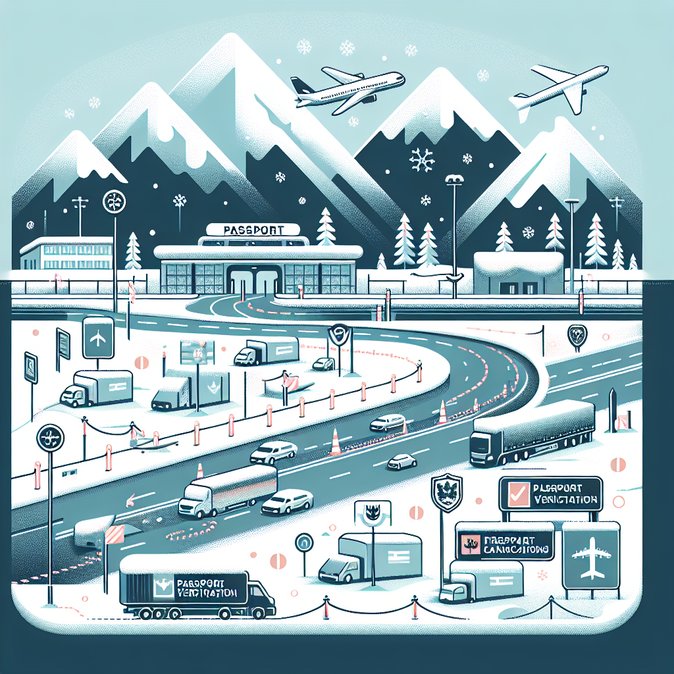
Holiday-makers, lorry drivers and daily commuters all ran into the same headache on Saturday, 17 January, when traffic on the 153-kilometre A12 Inntalautobahn ground to a halt between the German border at Kufstein–Kiefersfelden and Innsbruck. German police quietly re-introduced random passport controls at midnight as part of Berlin’s new migration-control package. Motorists who had expected a seamless Schengen crossing suddenly found themselves in kilometre-long queues while officers inspected IDs vehicle-by-vehicle. The surprise checks coincided with the first big ski-change-over weekend of the season, multiplying volumes on an already strained corridor. (visahq.com)
Nature did not cooperate. Snow flurries and black ice reduced speeds to a crawl and forced snow-ploughs onto the same narrowed carriageways where maintenance crews are already resurfacing the Hall West–Innsbruck Ost section. Live data published by travel portal Reisereporter showed delays of up to 90 minutes just to clear the Kufstein node, while the Tirol Chamber of Commerce warned of contractual penalties for late deliveries of perishables. Innsbruck Airport reported longer check-in lines after British charter flights missed their slots because coaches were stuck on the autobahn. (visahq.com)
Travellers caught off-guard by these snap checks can smooth the process by turning to VisaHQ’s comprehensive visa and passport service: the Vienna-based team maintains real-time entry requirements for Austria, Germany and the wider Schengen Zone, offers rapid document renewals and supplies digital copies that satisfy on-the-spot police requests. Check your status or start an application at https://www.visahq.com/austria/
![Surprise Border Checks and Heavy Snow Create Gridlock on Austria’s A12 Inntalautobahn]()
The disruption carries real costs for business. Cross-border commuters risk losing shifts and pay, and logistics firms must either absorb overtime or reroute via the Brenner Pass (A13) or Germany’s A8/A95/A96 chain, adding fuel and toll expense. Tyrol’s long-standing “anti-rat-run” rules—on-the-spot fines for drivers who exit the motorway to snake through villages—remain in force, limiting creative detours. Mobility managers should build generous buffers into itineraries for the next few winter weekends and alert travellers that random German checks can pop up without warning. (visahq.com)
Practical tips: carry a physical passport (not just an ID card) to avoid secondary screening; keep hotel or ski-pass confirmations handy if police invoke winter-weather contingency powers; and, for time-critical freight, pre-book slots on the Brenner or consider night runs when both traffic and inspections ease. Companies with large volumes on the Germany–Italy lane may wish to stagger departures or shift some loads onto rail until the bottleneck eases.
While the controls are technically legal under Schengen safeguard clauses, regional politicians on both sides of the border are already trading barbs about the economic fallout. If congestion persists, expect renewed calls from Tyrolean leaders for tighter caps on lorry traffic and from Bavarian officials for Austria to waive weekend truck bans to smooth the flow.
Nature did not cooperate. Snow flurries and black ice reduced speeds to a crawl and forced snow-ploughs onto the same narrowed carriageways where maintenance crews are already resurfacing the Hall West–Innsbruck Ost section. Live data published by travel portal Reisereporter showed delays of up to 90 minutes just to clear the Kufstein node, while the Tirol Chamber of Commerce warned of contractual penalties for late deliveries of perishables. Innsbruck Airport reported longer check-in lines after British charter flights missed their slots because coaches were stuck on the autobahn. (visahq.com)
Travellers caught off-guard by these snap checks can smooth the process by turning to VisaHQ’s comprehensive visa and passport service: the Vienna-based team maintains real-time entry requirements for Austria, Germany and the wider Schengen Zone, offers rapid document renewals and supplies digital copies that satisfy on-the-spot police requests. Check your status or start an application at https://www.visahq.com/austria/

The disruption carries real costs for business. Cross-border commuters risk losing shifts and pay, and logistics firms must either absorb overtime or reroute via the Brenner Pass (A13) or Germany’s A8/A95/A96 chain, adding fuel and toll expense. Tyrol’s long-standing “anti-rat-run” rules—on-the-spot fines for drivers who exit the motorway to snake through villages—remain in force, limiting creative detours. Mobility managers should build generous buffers into itineraries for the next few winter weekends and alert travellers that random German checks can pop up without warning. (visahq.com)
Practical tips: carry a physical passport (not just an ID card) to avoid secondary screening; keep hotel or ski-pass confirmations handy if police invoke winter-weather contingency powers; and, for time-critical freight, pre-book slots on the Brenner or consider night runs when both traffic and inspections ease. Companies with large volumes on the Germany–Italy lane may wish to stagger departures or shift some loads onto rail until the bottleneck eases.
While the controls are technically legal under Schengen safeguard clauses, regional politicians on both sides of the border are already trading barbs about the economic fallout. If congestion persists, expect renewed calls from Tyrolean leaders for tighter caps on lorry traffic and from Bavarian officials for Austria to waive weekend truck bans to smooth the flow.