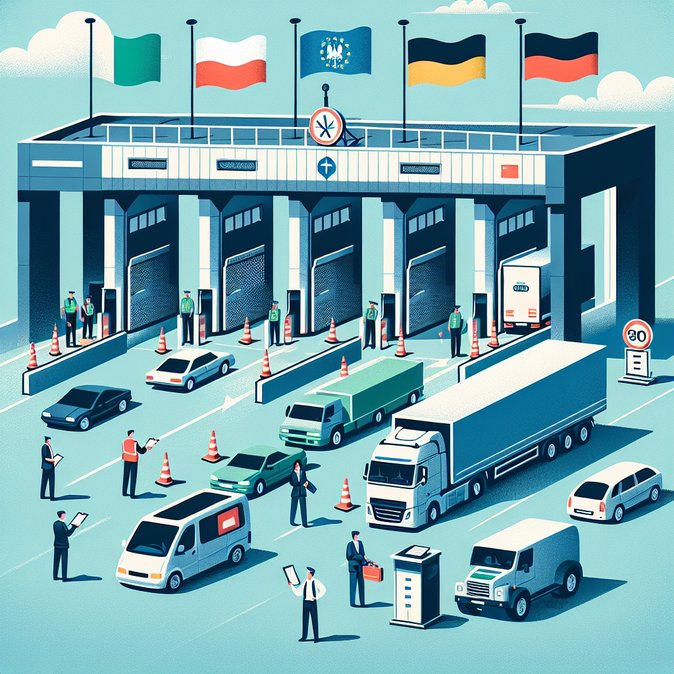
Poland’s Council of Ministers signed a regulation on 16 January that prolongs temporary checks at its normally open borders with Germany and Lithuania for another 90 days, pushing the expiry date to 4 April 2026. First imposed in July 2025 amid a spike in secondary migrant movements, the regime allows Border Guard, police and Territorial Defence units to stop vehicles, verify identity documents and search cargo at 65 road and rail crossings.
Officials cite a year-end uptick in migrants who originally entered the EU via Belarus or the Baltics and then attempted to reach Germany through Poland. The Interior Ministry is also quietly stress-testing new e-gates hooked into the EU Entry/Exit System and piloting blockchain-sealed freight containers.
Business implications are immediate. Commuters who live in Germany’s border towns but work in Wrocław report 5–15-minute ID checks; truckers moving components for Poland’s automotive plants have seen occasional half-hour delays. Mobility managers should update travel-risk dashboards, circulate a list of open crossings and remind foreign assignees to carry a Polish residence card or biometric passport.
![Schengen on Pause: Poland Extends Border Checks with Germany and Lithuania to 4 April 2026]()
Amid these shifting requirements, VisaHQ’s Poland portal (https://www.visahq.com/poland/) can help corporate mobility teams and individual travellers stay compliant by providing real-time updates on entry documentation, facilitating expedited processing of residence cards and visas, and issuing alerts when checkpoint policies change.
If pilots prove successful, some hardware could remain even after controls are lifted, signalling a permanent shift toward “smart borders” inside the Schengen zone.
EU law allows internal checks for renewable 30-day blocks up to a maximum of two years. Warsaw has already used more than half of that allowance, meaning corporate lobbyists see rising pressure on the government to either normalise the technology or restore full freedom of movement by next summer.
Officials cite a year-end uptick in migrants who originally entered the EU via Belarus or the Baltics and then attempted to reach Germany through Poland. The Interior Ministry is also quietly stress-testing new e-gates hooked into the EU Entry/Exit System and piloting blockchain-sealed freight containers.
Business implications are immediate. Commuters who live in Germany’s border towns but work in Wrocław report 5–15-minute ID checks; truckers moving components for Poland’s automotive plants have seen occasional half-hour delays. Mobility managers should update travel-risk dashboards, circulate a list of open crossings and remind foreign assignees to carry a Polish residence card or biometric passport.
Amid these shifting requirements, VisaHQ’s Poland portal (https://www.visahq.com/poland/) can help corporate mobility teams and individual travellers stay compliant by providing real-time updates on entry documentation, facilitating expedited processing of residence cards and visas, and issuing alerts when checkpoint policies change.
If pilots prove successful, some hardware could remain even after controls are lifted, signalling a permanent shift toward “smart borders” inside the Schengen zone.
EU law allows internal checks for renewable 30-day blocks up to a maximum of two years. Warsaw has already used more than half of that allowance, meaning corporate lobbyists see rising pressure on the government to either normalise the technology or restore full freedom of movement by next summer.