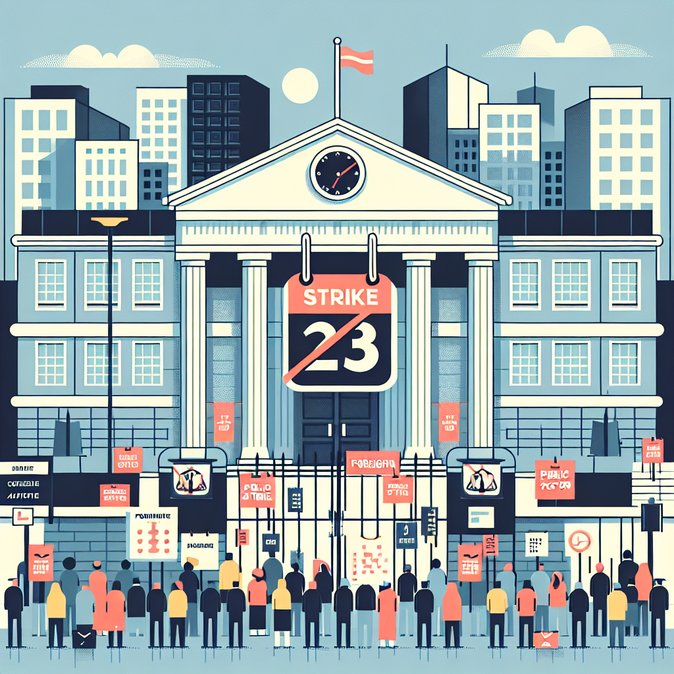
Germany’s capital region woke up on 16 January to closed counters and long digital queues after the Verdi and GEW unions staged a 24-hour warning strike across the public sector. Citizens’ offices (Bürgerämter), municipal administrations and several university admissions desks either shut completely or offered only skeleton staffing. For globally mobile staff the biggest pain-point was at Berlin’s two Foreigners’ Authorities (LEA) on Friedrich-Krause-Ufer and Keplerstraße, where walk-in services for residence-permit extensions and EU Blue-Card issuances were cancelled without notice. Applicants who had waited months for scarce biometric slots were turned away at the door. (visahq.com)
The industrial action is part of an ongoing pay dispute with the Tarifgemeinschaft deutscher Länder (TdL). Unions are demanding a 7 % salary increase—or at least €300 per month—for lower pay bands. Roughly 5 000 workers marched to the Rotes Rathaus, causing traffic gridlock and forcing some expatriates to miss connecting appointments at other agencies. Immigration advisers warn that the backlog will ripple through appointment calendars for weeks because the Consular Services Portal still requires an in-person biometric step even after an online filing. (visahq.com)
For those caught in the fallout, VisaHQ can offer a useful safety net: its Germany team monitors last-minute openings at consulates nationwide, pre-screens paperwork and can even courier files to alternative jurisdictions, helping applicants avoid overstays and costly rescheduling fees. Full details and live chat support are available at https://www.visahq.com/germany/
![Berlin–Brandenburg strike shutters Foreigners’ Authorities, delaying visa renewals]()
Large multinational employers have already issued travel alerts telling assignees whose permits expire before mid-February to carry (1) the electronic receipt of an online extension application and (2) a print-out of the strike announcement when travelling inside Schengen. Although §81(4) of the Residence Act grants “fictional validity” once an extension has been filed, airlines and border guards often request additional proof at short notice. Companies are also advising HR teams to build strike clauses into future relocation timelines.
The next wage-talks round resumes this week in Potsdam. If no deal is reached, Verdi has threatened longer walk-outs that could coincide with the spring intake of international students—potentially paralysing the LEA at the very moment thousands of newcomers attempt to register. For now, mobility managers should monitor local news and keep duplicate appointment trackers so that cancelled biometric slots can be re-booked the moment they are re-released.
Beyond Berlin, several Brandenburg police administrative units that endorse work-permit stickers operated with reduced staffing, underscoring how swiftly regional labour disputes can disrupt an otherwise federal immigration system.
The industrial action is part of an ongoing pay dispute with the Tarifgemeinschaft deutscher Länder (TdL). Unions are demanding a 7 % salary increase—or at least €300 per month—for lower pay bands. Roughly 5 000 workers marched to the Rotes Rathaus, causing traffic gridlock and forcing some expatriates to miss connecting appointments at other agencies. Immigration advisers warn that the backlog will ripple through appointment calendars for weeks because the Consular Services Portal still requires an in-person biometric step even after an online filing. (visahq.com)
For those caught in the fallout, VisaHQ can offer a useful safety net: its Germany team monitors last-minute openings at consulates nationwide, pre-screens paperwork and can even courier files to alternative jurisdictions, helping applicants avoid overstays and costly rescheduling fees. Full details and live chat support are available at https://www.visahq.com/germany/

Large multinational employers have already issued travel alerts telling assignees whose permits expire before mid-February to carry (1) the electronic receipt of an online extension application and (2) a print-out of the strike announcement when travelling inside Schengen. Although §81(4) of the Residence Act grants “fictional validity” once an extension has been filed, airlines and border guards often request additional proof at short notice. Companies are also advising HR teams to build strike clauses into future relocation timelines.
The next wage-talks round resumes this week in Potsdam. If no deal is reached, Verdi has threatened longer walk-outs that could coincide with the spring intake of international students—potentially paralysing the LEA at the very moment thousands of newcomers attempt to register. For now, mobility managers should monitor local news and keep duplicate appointment trackers so that cancelled biometric slots can be re-booked the moment they are re-released.
Beyond Berlin, several Brandenburg police administrative units that endorse work-permit stickers operated with reduced staffing, underscoring how swiftly regional labour disputes can disrupt an otherwise federal immigration system.