Poland’s Council of Ministers has signed a regulation that stretches the temporary border-control regime on the country’s western and north-eastern frontiers for another 90 days, taking the end-date to 4 April 2026. The measure, first introduced on 7 July 2025, suspends normal Schengen free-movement rules at 52 designated crossings with Germany and 13 with Lithuania. Travellers can be stopped for identification, vehicle searches and document verification, while freight operators must be prepared for ad-hoc inspections that target high-risk cargo or suspicious routings.
Officials justify the extension by pointing to “persistent secondary movements” of migrants who initially enter the European Union via Belarus or the Baltic states and then attempt to reach Germany through Poland. Warsaw says nearly 2,100 people were intercepted on the German side in 2025 after irregularly crossing Poland’s territory, a figure it calls unsustainable. The Polish Border Guard has deployed mobile patrols equipped with automatic-number-plate-recognition cameras and thermal drones, backed up by police and Territorial Defence troops.
VisaHQ’s Poland portal (https://www.visahq.com/poland/) offers an up-to-date overview of travel-document requirements, residence-permit rules and the forthcoming e-visa system that will be trialled at select border e-gates. Mobility teams can set up alerts for regulation changes, generate business-invitation letters and arrange courier collection for passport renewals, helping travellers spend less time in queues while staying fully compliant with the reinforced checks.
![Poland prolongs Schengen-internal border checks with Germany and Lithuania until 4 April 2026]()
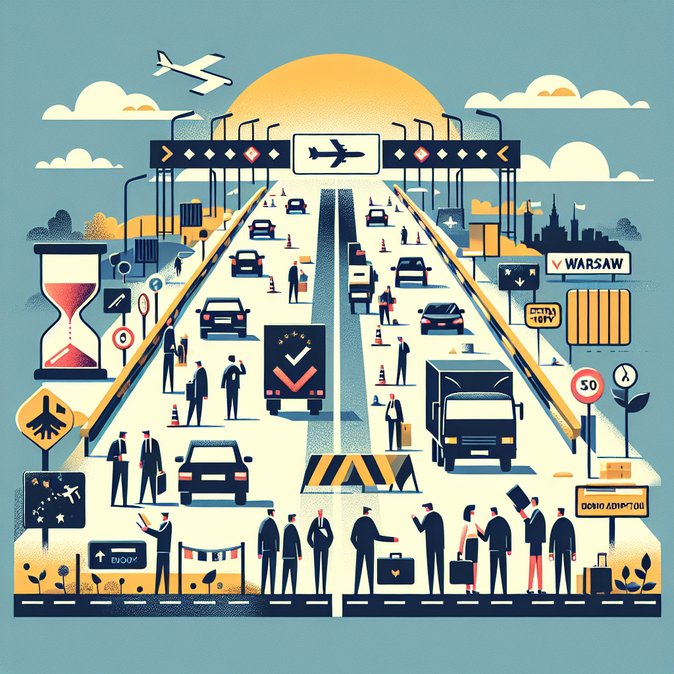
For business-travel planners the immediate impact is time: passenger coaches and corporate shuttles on the Warsaw–Berlin and Warsaw–Vilnius corridors are reporting average spot-check delays of 15-25 minutes, with authorities advising operators to build 45-minute buffers into itineraries. Air links remain unaffected, but road hauliers moving just-in-time components between Kaunas, Poznań and Leipzig must pre-lodge electronic manifests to avoid secondary screening. HR teams relocating new hires through Germany or Lithuania should remind assignees to carry either a biometric passport or a Polish residence card in order to shorten verification times.
The government is also using the pause to pilot new technology. Six crossings now feature e-gates that read EU Digital COVID Certificates and soon will verify e-visas. Customs authorities are testing blockchain-based seals to flag diverted cargo. If successful, these tools could survive long after the extraordinary controls lapse, potentially reshaping how intra-EU borders are policed.
Corporate mobility managers should disseminate the new timeline, update duty-of-care platforms and ensure that driver briefings include the coordinates of all still-open crossings. Companies with supply-chain dependencies on just-in-sequence delivery may wish to reroute via Czechia or Slovakia until normal Schengen rules resume.
Officials justify the extension by pointing to “persistent secondary movements” of migrants who initially enter the European Union via Belarus or the Baltic states and then attempt to reach Germany through Poland. Warsaw says nearly 2,100 people were intercepted on the German side in 2025 after irregularly crossing Poland’s territory, a figure it calls unsustainable. The Polish Border Guard has deployed mobile patrols equipped with automatic-number-plate-recognition cameras and thermal drones, backed up by police and Territorial Defence troops.
VisaHQ’s Poland portal (https://www.visahq.com/poland/) offers an up-to-date overview of travel-document requirements, residence-permit rules and the forthcoming e-visa system that will be trialled at select border e-gates. Mobility teams can set up alerts for regulation changes, generate business-invitation letters and arrange courier collection for passport renewals, helping travellers spend less time in queues while staying fully compliant with the reinforced checks.

For business-travel planners the immediate impact is time: passenger coaches and corporate shuttles on the Warsaw–Berlin and Warsaw–Vilnius corridors are reporting average spot-check delays of 15-25 minutes, with authorities advising operators to build 45-minute buffers into itineraries. Air links remain unaffected, but road hauliers moving just-in-time components between Kaunas, Poznań and Leipzig must pre-lodge electronic manifests to avoid secondary screening. HR teams relocating new hires through Germany or Lithuania should remind assignees to carry either a biometric passport or a Polish residence card in order to shorten verification times.
The government is also using the pause to pilot new technology. Six crossings now feature e-gates that read EU Digital COVID Certificates and soon will verify e-visas. Customs authorities are testing blockchain-based seals to flag diverted cargo. If successful, these tools could survive long after the extraordinary controls lapse, potentially reshaping how intra-EU borders are policed.
Corporate mobility managers should disseminate the new timeline, update duty-of-care platforms and ensure that driver briefings include the coordinates of all still-open crossings. Companies with supply-chain dependencies on just-in-sequence delivery may wish to reroute via Czechia or Slovakia until normal Schengen rules resume.