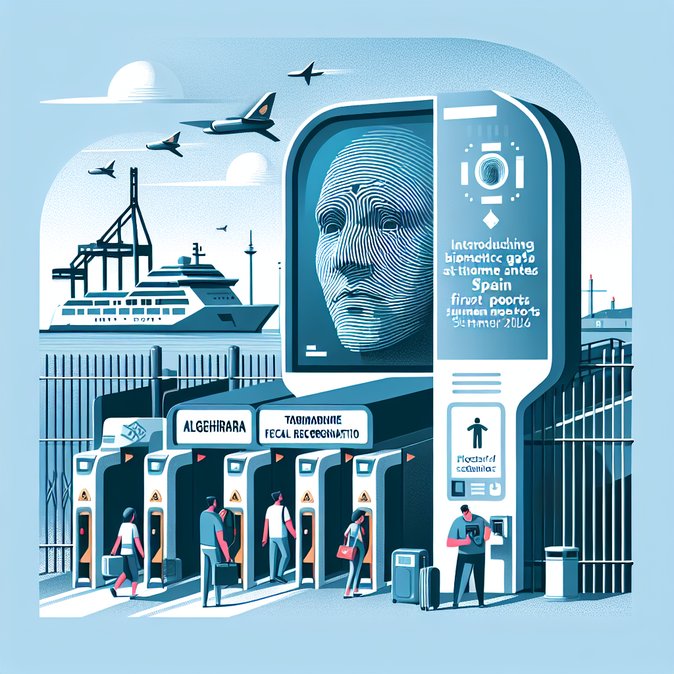
Spain’s busiest passenger-ferry hubs—Algeciras and Tarifa—will become the country’s first maritime terminals to deploy the EU’s Entry/Exit System (EES) and ETIAS biometric gates, following a €3.2 million contract awarded on 13 January to French-Spanish integrator Inetum. The company will supply self-service kiosks, ABC e-gates and assisted booths, training auxiliary staff to support Policía Nacional officers during the roll-out.
Phase 1, funded 75 % by the EU Border Management & Visa Instrument, aims to go live “before the summer”, capturing fingerprints and facial images of all non-EU travellers crossing the Strait of Gibraltar. Phase 2 budgets €10.8 million for three years of operational support and sets a blueprint for Spain’s other ports and land crossings.
![Spanish ports of Algeciras and Tarifa to pioneer EES/ETIAS biometric gates before the summer]()
To navigate these new border formalities smoothly, individual travellers and corporate mobility managers can leverage VisaHQ, which streamlines ETIAS pre-authorisations, Spanish visas and related documentation through an intuitive online portal. The platform’s experts provide up-to-date compliance advice and can coordinate group submissions, minimising delays at ports—full details are available at https://www.visahq.com/spain/
For ferry operators and cruise lines, the upgrade means adjusting passenger-handling processes: first-time enrolment is expected to take 45–60 seconds per traveller, requiring segregated flows for EU and non-EU citizens. Carriers must also update Advance Passenger Information (API) messaging to include EES tokens, while corporate travel departments should brief Moroccan business visitors and offshore workers on the new pre-enrolment requirements.
The Interior Ministry hopes that piloting in predictable maritime environments will avoid the airport chaos seen during 2025 EES tests in other Schengen states. Lessons learned will feed into larger deployments at Madrid-Barajas and Barcelona-El Prat ahead of the October 2026 deadline for full EES compliance.
Phase 1, funded 75 % by the EU Border Management & Visa Instrument, aims to go live “before the summer”, capturing fingerprints and facial images of all non-EU travellers crossing the Strait of Gibraltar. Phase 2 budgets €10.8 million for three years of operational support and sets a blueprint for Spain’s other ports and land crossings.

To navigate these new border formalities smoothly, individual travellers and corporate mobility managers can leverage VisaHQ, which streamlines ETIAS pre-authorisations, Spanish visas and related documentation through an intuitive online portal. The platform’s experts provide up-to-date compliance advice and can coordinate group submissions, minimising delays at ports—full details are available at https://www.visahq.com/spain/
For ferry operators and cruise lines, the upgrade means adjusting passenger-handling processes: first-time enrolment is expected to take 45–60 seconds per traveller, requiring segregated flows for EU and non-EU citizens. Carriers must also update Advance Passenger Information (API) messaging to include EES tokens, while corporate travel departments should brief Moroccan business visitors and offshore workers on the new pre-enrolment requirements.
The Interior Ministry hopes that piloting in predictable maritime environments will avoid the airport chaos seen during 2025 EES tests in other Schengen states. Lessons learned will feed into larger deployments at Madrid-Barajas and Barcelona-El Prat ahead of the October 2026 deadline for full EES compliance.