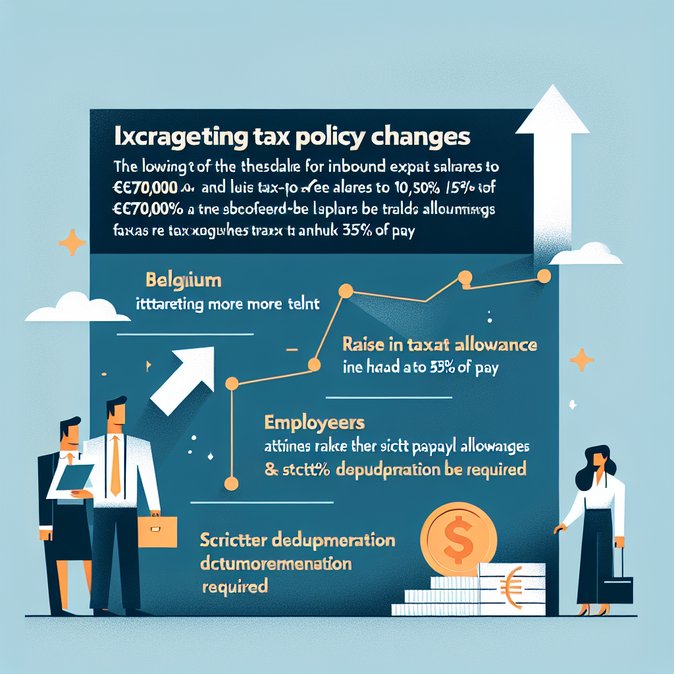
On 14 January the Belgian Parliament passed amendments enhancing the special tax regime for inbound taxpayers and researchers, a cornerstone of Belgium’s strategy to stay competitive for international talent. The law, published on 30 December 2025, takes immediate effect and applies retroactively to employees who relocated during 2025.
Key changes include a drop in the minimum qualifying salary from €75,000 to €70,000 gross, a higher cap on tax-free employer allowances—35 % of remuneration instead of 30 %—and the abolition of the €90,000 ceiling on those allowances. Cost-of-living reimbursements such as housing and school fees remain outside the taxable base.
Individuals who started Belgian employment in 2025 but failed to reach the old threshold now have until 9 April 2026 to file a retroactive application. Employers must also update payroll systems quickly: the new benefits apply to income earned from 1 January 2026, and withholding corrections may be required.
![Parliament approves richer expat tax regime: lower salary threshold and bigger allowances]()
For relocating employees who still need to secure work or residence visas, VisaHQ can simplify the administrative burden. Its dedicated Belgium portal (https://www.visahq.com/belgium/) offers step-by-step guidance, document checklists, and real-time status tracking, helping both employers and assignees stay compliant with Belgian immigration rules while taking advantage of the refreshed tax regime.
Tax advisers say the reforms make Belgium more attractive than neighbouring France and the Netherlands, where expatriate regimes are being tightened. For multinational headquarters in Brussels, the lower threshold widens the pool of regional specialists—particularly in IT and life sciences—who can be hired under the scheme.
Companies should, however, review assignment policies: the law adds claw-back provisions if an employee leaves within two years and tightens documentation requirements to prove “expertise not readily available on the Belgian labour market.” Failure to meet the new rules could trigger back taxes and penalties.
Key changes include a drop in the minimum qualifying salary from €75,000 to €70,000 gross, a higher cap on tax-free employer allowances—35 % of remuneration instead of 30 %—and the abolition of the €90,000 ceiling on those allowances. Cost-of-living reimbursements such as housing and school fees remain outside the taxable base.
Individuals who started Belgian employment in 2025 but failed to reach the old threshold now have until 9 April 2026 to file a retroactive application. Employers must also update payroll systems quickly: the new benefits apply to income earned from 1 January 2026, and withholding corrections may be required.

For relocating employees who still need to secure work or residence visas, VisaHQ can simplify the administrative burden. Its dedicated Belgium portal (https://www.visahq.com/belgium/) offers step-by-step guidance, document checklists, and real-time status tracking, helping both employers and assignees stay compliant with Belgian immigration rules while taking advantage of the refreshed tax regime.
Tax advisers say the reforms make Belgium more attractive than neighbouring France and the Netherlands, where expatriate regimes are being tightened. For multinational headquarters in Brussels, the lower threshold widens the pool of regional specialists—particularly in IT and life sciences—who can be hired under the scheme.
Companies should, however, review assignment policies: the law adds claw-back provisions if an employee leaves within two years and tightens documentation requirements to prove “expertise not readily available on the Belgian labour market.” Failure to meet the new rules could trigger back taxes and penalties.