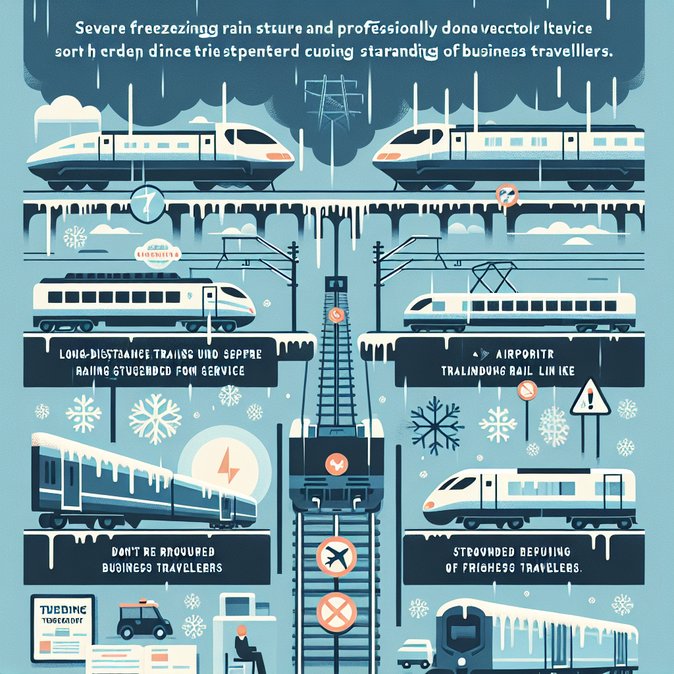
Austria’s state-owned rail operator, ÖBB, took the extraordinary step of publishing a formal country-wide “Reisewarnung” late on 12 January after forecasters warned that a band of super-cooled rain would sweep across the Danube valley. By the morning peak of 13 January, overhead lines on the core Vienna–St Pölten–Salzburg Weststrecke were coated in ice, forcing dozens of Railjet, WESTbahn and Nightjet services to be cancelled or curtailed at Vienna-Meidling to relieve congestion at the main station.
For mobility managers the immediate headache was the suspension of CAT and S-Bahn airport links, severing the rail-air corridor that most business travellers use to reach Vienna International Airport (VIE). ÖBB moved quickly to lift “Zugbindung” (fixed-train) conditions on all domestic tickets issued before 12 January, allowing stranded passengers to rebook or claim refunds without penalty—a precedent many corporate travel policies will now adopt as best practice.
Freight also felt the impact. Rail Cargo Austria diverted time-critical automotive components over the Tauern and Brenner corridors, adding up to eight hours and an estimated €3 million in knock-on production costs for German assembly plants. Municipal road-salt teams in Vienna, Lower Austria and Styria were authorised to exceed normal environmental limits to keep tram tracks and bus lanes clear, but workplace-mobility apps still recorded absentee spikes of up to 18 percent as commuters opted to stay home.
![ÖBB issues nationwide travel warning as ice storm paralyses Austria’s inter-city rail network]()
Business travellers whose itineraries now require alternative routings through neighbouring countries should also verify entry requirements; VisaHQ’s Austria portal (https://www.visahq.com/austria/) offers a fast way to check and secure any additional visas or travel documents, streamlining last-minute adjustments to disrupted schedules.
The episode reinforces the need for robust weather clauses in vendor contracts and for real-time communication channels between travel desks and employees on assignment. Companies with staff due to transit Austria this winter are advised to preload eSIM data packs, keep physical identity documents handy in case last-minute bus diversions cross borders, and review contingency budgets for overnight accommodation.
Longer-term, the Ministry for Climate Action has promised an inquiry into whether critical rail junctions should be fitted with heated catenary sections or ice-scraper units—a move the business community says would pay for itself in a single severe weather event.
For mobility managers the immediate headache was the suspension of CAT and S-Bahn airport links, severing the rail-air corridor that most business travellers use to reach Vienna International Airport (VIE). ÖBB moved quickly to lift “Zugbindung” (fixed-train) conditions on all domestic tickets issued before 12 January, allowing stranded passengers to rebook or claim refunds without penalty—a precedent many corporate travel policies will now adopt as best practice.
Freight also felt the impact. Rail Cargo Austria diverted time-critical automotive components over the Tauern and Brenner corridors, adding up to eight hours and an estimated €3 million in knock-on production costs for German assembly plants. Municipal road-salt teams in Vienna, Lower Austria and Styria were authorised to exceed normal environmental limits to keep tram tracks and bus lanes clear, but workplace-mobility apps still recorded absentee spikes of up to 18 percent as commuters opted to stay home.

Business travellers whose itineraries now require alternative routings through neighbouring countries should also verify entry requirements; VisaHQ’s Austria portal (https://www.visahq.com/austria/) offers a fast way to check and secure any additional visas or travel documents, streamlining last-minute adjustments to disrupted schedules.
The episode reinforces the need for robust weather clauses in vendor contracts and for real-time communication channels between travel desks and employees on assignment. Companies with staff due to transit Austria this winter are advised to preload eSIM data packs, keep physical identity documents handy in case last-minute bus diversions cross borders, and review contingency budgets for overnight accommodation.
Longer-term, the Ministry for Climate Action has promised an inquiry into whether critical rail junctions should be fitted with heated catenary sections or ice-scraper units—a move the business community says would pay for itself in a single severe weather event.