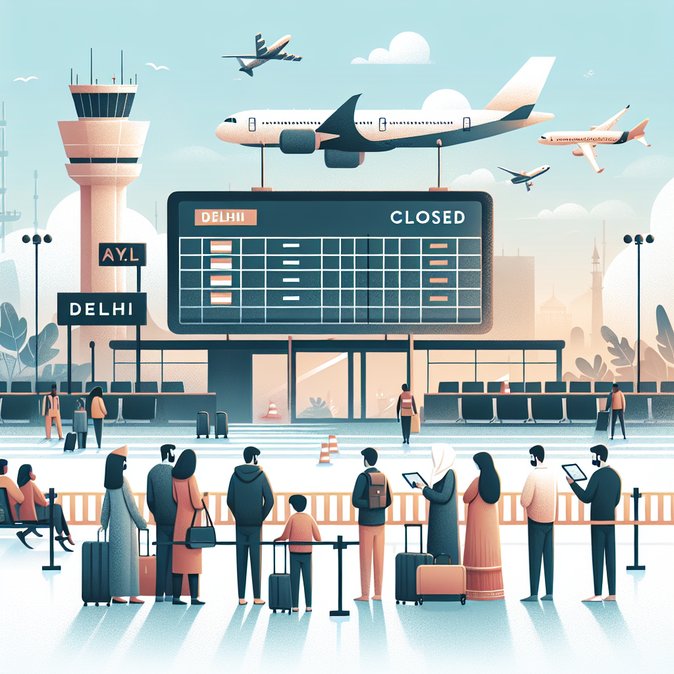
New Delhi’s Indira Gandhi International Airport—already grappling with winter fog—will see additional disruption between 21 and 26 January 2026 as the Indian Air Force conducts fly-past drills for Republic Day. A NOTAM issued on 13 January confirms daily airspace closures from 10:20 a.m. to 12:45 p.m., overlapping one of IGIA’s busiest departure banks. Analytics firm Cirium estimates more than 600 scheduled flights will be affected across the six-day window.
While the two-hour-and-25-minute block may appear modest, aviation planners warn of a domino effect. Aircraft and crew rotations timed to Europe-bound long-hauls will be pushed outside their slots, cascading into missed connections at Mumbai, Bengaluru and overseas hubs. Airlines have just eight days to retime operations, secure parking stands and re-issue passenger notifications—a costly exercise during peak fog season when on-time performance is already below 60 percent.
![Republic Day Rehearsals to Shut Delhi Airspace Six Days, 600 Flights Face Ripple-Effect Delays]()
Corporate travel teams are advised to add at least six hours of buffer when booking mission-critical itineraries via Delhi during the rehearsal week, and to consider secondary gateways such as Hyderabad or Ahmedabad for high-value movements. Freight forwarders moving time-sensitive pharmaceuticals and auto parts through Delhi’s cargo terminal should likewise build contingency lead-times or divert shipments.
On the documentation front, travelers coping with sudden flight reshuffles can at least remove visa red tape from the equation. VisaHQ’s online platform (https://www.visahq.com/india/) provides fast e-visa processing for India and dozens of onward destinations, complete with real-time status updates and embassy alert monitoring. Securing travel documents through the service in parallel with rebooking can give both corporate and leisure passengers a crucial cushion during the January closures.
The Directorate General of Civil Aviation (DGCA) has instructed carriers to offer free rebooking or refunds. However, hotels and ground-transport providers say they still face potential no-show losses; many are pressing the Ministry of Civil Aviation for clearer cross-industry coordination in future years.
While the two-hour-and-25-minute block may appear modest, aviation planners warn of a domino effect. Aircraft and crew rotations timed to Europe-bound long-hauls will be pushed outside their slots, cascading into missed connections at Mumbai, Bengaluru and overseas hubs. Airlines have just eight days to retime operations, secure parking stands and re-issue passenger notifications—a costly exercise during peak fog season when on-time performance is already below 60 percent.
Corporate travel teams are advised to add at least six hours of buffer when booking mission-critical itineraries via Delhi during the rehearsal week, and to consider secondary gateways such as Hyderabad or Ahmedabad for high-value movements. Freight forwarders moving time-sensitive pharmaceuticals and auto parts through Delhi’s cargo terminal should likewise build contingency lead-times or divert shipments.
On the documentation front, travelers coping with sudden flight reshuffles can at least remove visa red tape from the equation. VisaHQ’s online platform (https://www.visahq.com/india/) provides fast e-visa processing for India and dozens of onward destinations, complete with real-time status updates and embassy alert monitoring. Securing travel documents through the service in parallel with rebooking can give both corporate and leisure passengers a crucial cushion during the January closures.
The Directorate General of Civil Aviation (DGCA) has instructed carriers to offer free rebooking or refunds. However, hotels and ground-transport providers say they still face potential no-show losses; many are pressing the Ministry of Civil Aviation for clearer cross-industry coordination in future years.