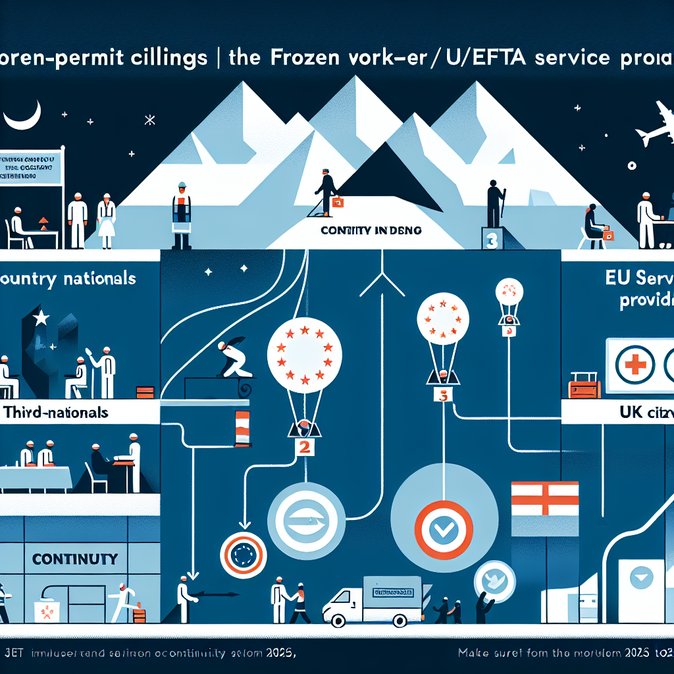
In a move welcomed by multinational employers and global-mobility managers, the Swiss Federal Council formally confirmed on 11 January 2026 that the ceilings for Swiss work permits will remain at 2025 levels throughout the new year. The decision is written into the revised Ordinance on Admission, Residence and Gainful Activity (OASA), which took effect on 1 January and was published in the government’s official gazette late Sunday night. For 2026, a maximum of 8,500 permits is again available to highly-skilled specialists from so-called ‘third countries’—4,500 B-residence permits and 4,000 short-term L-permits. Quotas for EU/EFTA service providers staying more than 120 days stay at 3,500 (3,000 L and 500 B), while the post-Brexit quota for UK nationals is fixed at 3,500 (2,100 B and 1,400 L). (visahq.com)
The announcement ends weeks of speculation that the government might tighten allocations after utilisation rates hit 93 % in 2025, particularly in the biotech clusters around Basel and Lake Geneva. For HR teams the continuity is significant: cantonal authorities allocate permits on a strict first-come, first-served basis, meaning companies can front-load 2026 staffing plans without fear of a mid-year squeeze. Immigration lawyers nonetheless advise filing as early as possible because unused 2025 quota does not roll over. (visahq.com)
![Swiss Federal Council Keeps 2026 Work-Permit Quotas Unchanged, Giving Employers Rare Predictability]()
For employers looking to turn these quotas into actual work authorisations, VisaHQ’s Switzerland specialists can streamline the entire process—from verifying real-time quota availability and preparing compliant documentation to lodging applications with the relevant canton and tracking approvals online. The platform’s dashboard at https://www.visahq.com/switzerland/ gives HR teams instant visibility into case status, renewal deadlines and biometric appointments, freeing them to focus on talent instead of paperwork.
From a policy perspective, the Council’s decision strikes a balance between business demands for talent and mounting political pressure to limit net migration, which reached 69,000 last year. Officials hinted that any upward revision will depend on macro-economic indicators and the outcome of exploratory talks with the EU over a new institutional framework—talks that could resurrect a contentious ‘protective clause’ allowing Switzerland to cap EU inflows temporarily. Observers therefore see 2026 as a breathing space rather than the end of the quota debate.
Practically, global-mobility teams should audit salary grids against the latest cost-of-living indices, because cantonal labour inspectors increasingly benchmark intra-company transferee salaries against local percentiles. Employers should also remember that quota numbers are national, but permits are issued at cantonal level; front-loading applications in cantons with historically lower demand (for example, Solothurn or Zug) can provide an extra safety margin. Finally, because the separate EU Entry/Exit System (EES) biometric roll-out later this year may extend airport processing times, companies are encouraged to build extra buffer days into on-boarding schedules for assignees arriving in Switzerland.
The announcement ends weeks of speculation that the government might tighten allocations after utilisation rates hit 93 % in 2025, particularly in the biotech clusters around Basel and Lake Geneva. For HR teams the continuity is significant: cantonal authorities allocate permits on a strict first-come, first-served basis, meaning companies can front-load 2026 staffing plans without fear of a mid-year squeeze. Immigration lawyers nonetheless advise filing as early as possible because unused 2025 quota does not roll over. (visahq.com)

For employers looking to turn these quotas into actual work authorisations, VisaHQ’s Switzerland specialists can streamline the entire process—from verifying real-time quota availability and preparing compliant documentation to lodging applications with the relevant canton and tracking approvals online. The platform’s dashboard at https://www.visahq.com/switzerland/ gives HR teams instant visibility into case status, renewal deadlines and biometric appointments, freeing them to focus on talent instead of paperwork.
From a policy perspective, the Council’s decision strikes a balance between business demands for talent and mounting political pressure to limit net migration, which reached 69,000 last year. Officials hinted that any upward revision will depend on macro-economic indicators and the outcome of exploratory talks with the EU over a new institutional framework—talks that could resurrect a contentious ‘protective clause’ allowing Switzerland to cap EU inflows temporarily. Observers therefore see 2026 as a breathing space rather than the end of the quota debate.
Practically, global-mobility teams should audit salary grids against the latest cost-of-living indices, because cantonal labour inspectors increasingly benchmark intra-company transferee salaries against local percentiles. Employers should also remember that quota numbers are national, but permits are issued at cantonal level; front-loading applications in cantons with historically lower demand (for example, Solothurn or Zug) can provide an extra safety margin. Finally, because the separate EU Entry/Exit System (EES) biometric roll-out later this year may extend airport processing times, companies are encouraged to build extra buffer days into on-boarding schedules for assignees arriving in Switzerland.