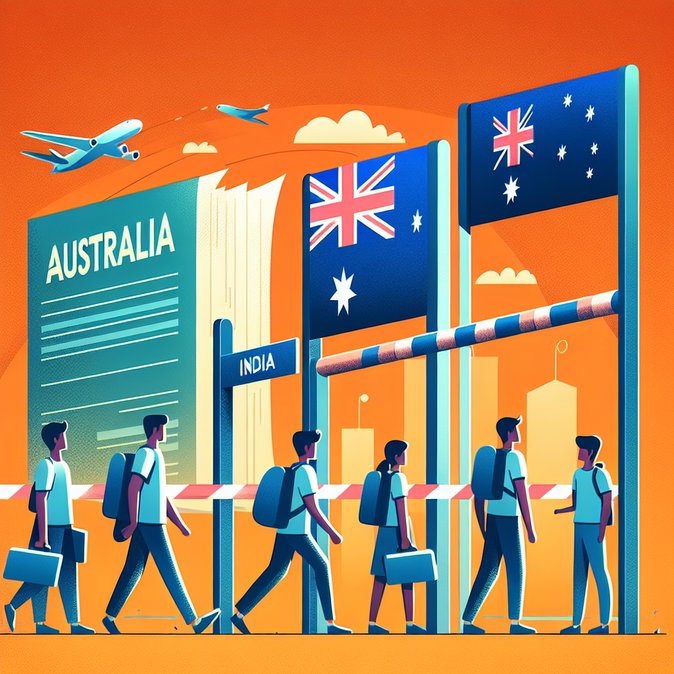
The Department of Home Affairs has quietly reclassified India from Evidence Level 2 to Level 3 under the Simplified Student Visa Framework, putting it in the highest-risk tier alongside Nepal and Bangladesh. The change, announced internally on 8 January but confirmed publicly on 12 January, means Indian applicants must supply more extensive financial evidence, English-language scores and biometric data. (m.economictimes.com)
Australian universities—already bracing for January/February intake—say the out-of-cycle downgrade could delay visa processing by several weeks and raise compliance costs. Education agents report that requests for Genuine Student (GS) interviews have doubled since Friday, while refusal rates for low-ranked providers are expected to climb.
The Home Affairs rationale cites “emerging integrity risks”, including a spike in fraudulent financial statements and non-genuine applications funnelled through certain regional campuses. India remains Australia’s second-largest source of international students (second only to China), so the tightening is a major blow to institutions reliant on fee revenue.
![Australia moves India to highest-risk tier for student visas, triggering extra scrutiny and delays]()
For applicants looking to navigate the new Evidence Level 3 requirements smoothly, VisaHQ offers end-to-end assistance—from validating financial documents to scheduling biometrics—through its user-friendly portal. Their Australia section (https://www.visahq.com/australia/) provides up-to-date checklists, live status tracking and expert support, helping students and sponsors reduce processing delays and avoid costly refusals.
Corporate mobility teams that sponsor graduate trainees from Indian universities should anticipate longer lead-times for Temporary Graduate (subclass 485) visas because the new Level 3 rating also feeds into post-study work assessments.
Universities Australia is lobbying for transitional concessions for applicants who lodged before 8 January, but officials say any grandfathering would undermine the integrity objective. For now, the advice to employers is simple: build a four-to-six-week buffer into mobilisation timelines for Indian nationals starting in the second quarter of 2026.
Australian universities—already bracing for January/February intake—say the out-of-cycle downgrade could delay visa processing by several weeks and raise compliance costs. Education agents report that requests for Genuine Student (GS) interviews have doubled since Friday, while refusal rates for low-ranked providers are expected to climb.
The Home Affairs rationale cites “emerging integrity risks”, including a spike in fraudulent financial statements and non-genuine applications funnelled through certain regional campuses. India remains Australia’s second-largest source of international students (second only to China), so the tightening is a major blow to institutions reliant on fee revenue.

For applicants looking to navigate the new Evidence Level 3 requirements smoothly, VisaHQ offers end-to-end assistance—from validating financial documents to scheduling biometrics—through its user-friendly portal. Their Australia section (https://www.visahq.com/australia/) provides up-to-date checklists, live status tracking and expert support, helping students and sponsors reduce processing delays and avoid costly refusals.
Corporate mobility teams that sponsor graduate trainees from Indian universities should anticipate longer lead-times for Temporary Graduate (subclass 485) visas because the new Level 3 rating also feeds into post-study work assessments.
Universities Australia is lobbying for transitional concessions for applicants who lodged before 8 January, but officials say any grandfathering would undermine the integrity objective. For now, the advice to employers is simple: build a four-to-six-week buffer into mobilisation timelines for Indian nationals starting in the second quarter of 2026.
More From Australia
View all
Parliament recalled to pass tough hate-speech and gun laws that expand ministerial visa-cancellation powers

Cyclone Koji disrupts North Queensland aviation, forcing widespread flight cancellations and re-routing