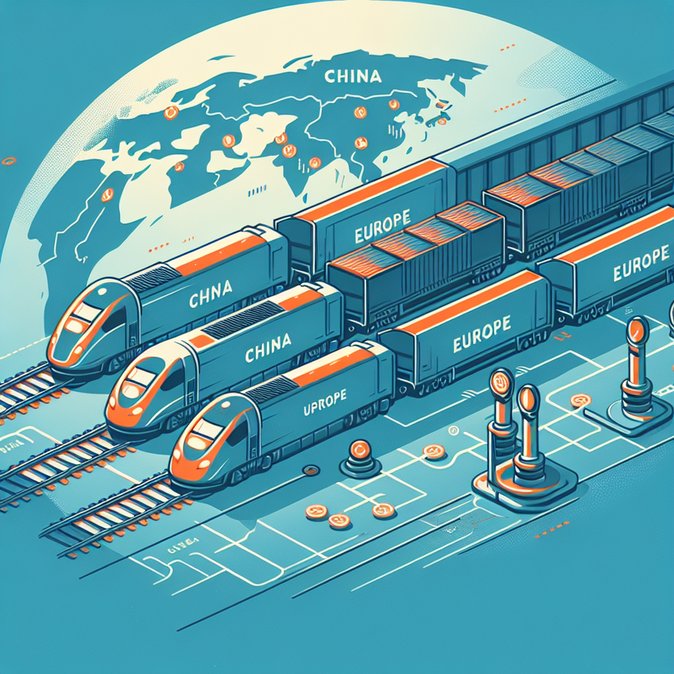
China kicked off 2026 with a series of high-profile China-Europe freight-train departures, the General Administration of Customs told the Global Times on 11 January. The Guangdong-Hong Kong-Macao Greater Bay Area dispatched its first train of the year from Zengcheng West Station bound for Poland’s Malaszewicze via Horgos, carrying 110 TEUs of consumer goods worth ¥20 million.
Parallel launches took place in Wuhan, where a direct rail link to Copenhagen debuted, and in Xi’an, which sent its inaugural 2026 service to Azerbaijan. Officials say the dense early-year schedule builds on 2025’s record 34,000 China-Europe and China-Asia trips, a 9.8 percent year-on-year rise.
Although passenger mobility is not directly involved, the rail boom has clear implications for corporate relocations and assignment logistics: easier, faster movement of machinery and personal effects lowers costs for companies placing staff in Central Asia and Europe. Balanced return trips—now hauling European cosmetics and agri-products back to China—also reduce bottlenecks that previously stranded containers abroad.
![First week of 2026 sees flurry of China–Europe freight-train departures, boosting over-land mobility of goods]()
For companies and assignees needing to align travel documentation with these streamlined logistics, VisaHQ can simplify the visa process. Through its China portal (https://www.visahq.com/china/), the platform offers end-to-end application support, real-time status tracking, and corporate account tools that help HR teams secure the necessary permits in parallel with freight scheduling, keeping relocation timelines on track.
Supply-chain analysts note a shift toward higher-value cargo such as auto parts and new-energy equipment, signalling rail’s evolution from emergency COVID workaround to strategic artery. For firms seeking alternatives to Red Sea sea-lanes, the over-land corridor offers predictable 14-18-day lead times that integrate neatly with assignment timelines.
HR mobility teams should dovetail personnel movements with rail schedules: some relocation firms already bundle household-goods shipping on westbound trains with staggered air tickets for transferees, cutting total move budgets by up to 22 percent compared with air-freight options.
Parallel launches took place in Wuhan, where a direct rail link to Copenhagen debuted, and in Xi’an, which sent its inaugural 2026 service to Azerbaijan. Officials say the dense early-year schedule builds on 2025’s record 34,000 China-Europe and China-Asia trips, a 9.8 percent year-on-year rise.
Although passenger mobility is not directly involved, the rail boom has clear implications for corporate relocations and assignment logistics: easier, faster movement of machinery and personal effects lowers costs for companies placing staff in Central Asia and Europe. Balanced return trips—now hauling European cosmetics and agri-products back to China—also reduce bottlenecks that previously stranded containers abroad.

For companies and assignees needing to align travel documentation with these streamlined logistics, VisaHQ can simplify the visa process. Through its China portal (https://www.visahq.com/china/), the platform offers end-to-end application support, real-time status tracking, and corporate account tools that help HR teams secure the necessary permits in parallel with freight scheduling, keeping relocation timelines on track.
Supply-chain analysts note a shift toward higher-value cargo such as auto parts and new-energy equipment, signalling rail’s evolution from emergency COVID workaround to strategic artery. For firms seeking alternatives to Red Sea sea-lanes, the over-land corridor offers predictable 14-18-day lead times that integrate neatly with assignment timelines.
HR mobility teams should dovetail personnel movements with rail schedules: some relocation firms already bundle household-goods shipping on westbound trains with staggered air tickets for transferees, cutting total move budgets by up to 22 percent compared with air-freight options.