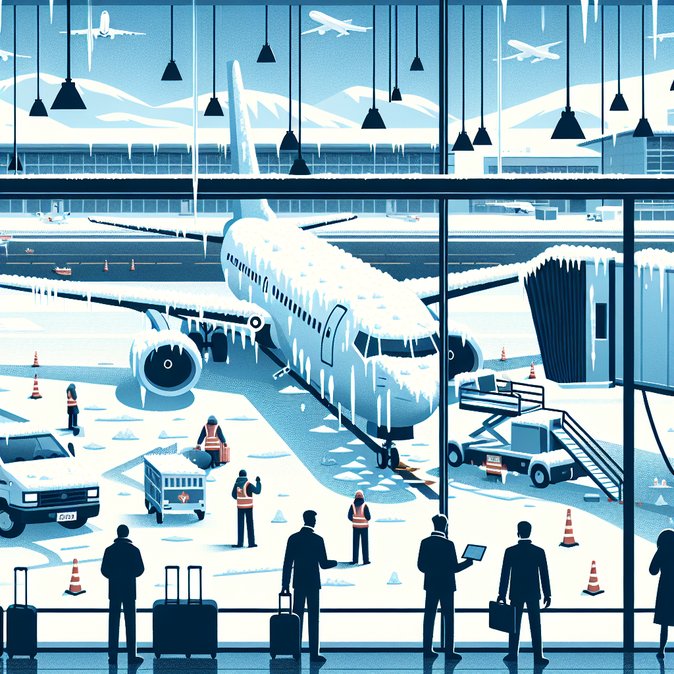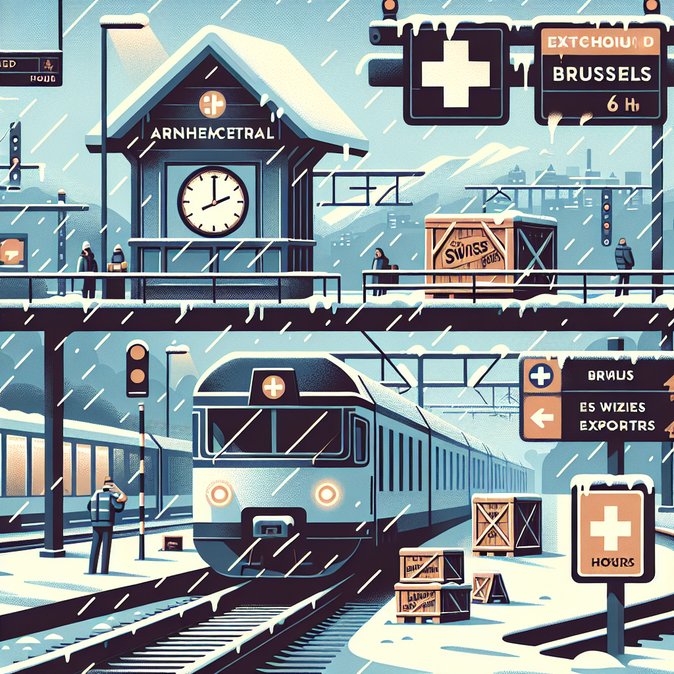
A severe snowstorm in the eastern Netherlands shut Arnhem Centraal station for almost six hours on 10 January 2026, cutting the principal high-speed artery between the Rhine-Ruhr region and Switzerland. The freeze forced Dutch infrastructure manager ProRail to impose a total train stop from 05:09 to 10:55 CET while crews de-iced overhead lines and cleared frozen points.
Among the worst-hit services were ÖBB’s Nightjet 403 (Amsterdam–Zürich) and Deutsche Bahn’s daily Amsterdam–Basel ICE 105, leaving hundreds of passengers – including business travellers heading for Monday meetings in Zürich’s financial district – facing delays of up to four hours or rerouting via Brussels or Paris. Knock-on effects persisted throughout the weekend as rolling stock and crews fell out of cycle, compelling ÖBB to run subsequent Nightjets with reduced carriage counts and no economy couchettes.
![Dutch blizzard severs rail link to Switzerland, stranding Nightjet sleepers and Basel ICEs]()
Swiss exporters reported disruption too: automotive suppliers around Basel were forced to shift time-critical freight onto trucks, tightening capacity at German trans-shipment terminals already stretched by weather-related backlogs. Travel managers with staff booked on Swiss-Dutch rail itineraries should monitor SBB and NS International alerts and verify that Schengen visas remain valid for any unexpected detours through Belgium or France.
Should any traveller discover that their documentation no longer aligns with an altered itinerary, VisaHQ can step in quickly. The platform’s Switzerland portal (https://www.visahq.com/switzerland/) walks users through Schengen-visa requirements, provides real-time fee and processing updates and can arrange courier pick-up for urgent renewals—services that prove invaluable when winter weather forces last-minute detours.
ProRail says normal timetabling resumed by Sunday afternoon, but warns that further Arctic outbreaks are possible. ÖBB is allowing free rebookings for Nightjet passengers until 15 January, while DB has lifted train-specificity rules on sparpreis tickets for journeys touching the Netherlands.
Among the worst-hit services were ÖBB’s Nightjet 403 (Amsterdam–Zürich) and Deutsche Bahn’s daily Amsterdam–Basel ICE 105, leaving hundreds of passengers – including business travellers heading for Monday meetings in Zürich’s financial district – facing delays of up to four hours or rerouting via Brussels or Paris. Knock-on effects persisted throughout the weekend as rolling stock and crews fell out of cycle, compelling ÖBB to run subsequent Nightjets with reduced carriage counts and no economy couchettes.

Swiss exporters reported disruption too: automotive suppliers around Basel were forced to shift time-critical freight onto trucks, tightening capacity at German trans-shipment terminals already stretched by weather-related backlogs. Travel managers with staff booked on Swiss-Dutch rail itineraries should monitor SBB and NS International alerts and verify that Schengen visas remain valid for any unexpected detours through Belgium or France.
Should any traveller discover that their documentation no longer aligns with an altered itinerary, VisaHQ can step in quickly. The platform’s Switzerland portal (https://www.visahq.com/switzerland/) walks users through Schengen-visa requirements, provides real-time fee and processing updates and can arrange courier pick-up for urgent renewals—services that prove invaluable when winter weather forces last-minute detours.
ProRail says normal timetabling resumed by Sunday afternoon, but warns that further Arctic outbreaks are possible. ÖBB is allowing free rebookings for Nightjet passengers until 15 January, while DB has lifted train-specificity rules on sparpreis tickets for journeys touching the Netherlands.