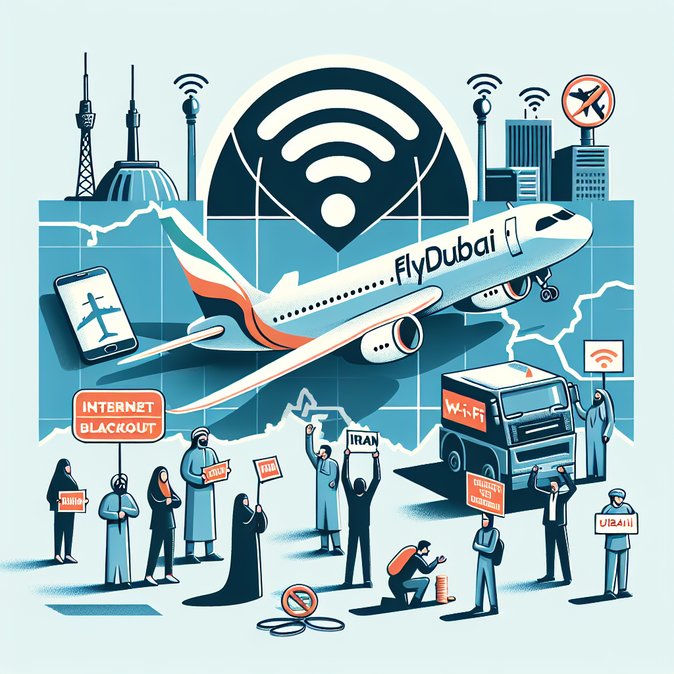
Business and leisure itineraries between the UAE and Iran were thrown into disarray on 9 January when Dubai Airports’ live departures board showed 17 Flydubai services to Tehran, Shiraz and Mashhad as **cancelled**. Turkish Airlines, Ajet and Pegasus immediately followed suit, while Doha–Tehran flights on Qatar Airways were also pulled. Airline statements were terse, saying only that schedules were being ‘continuously monitored’. (reuters.com)
Behind the operational notices lie growing safety concerns. Iran has been rocked by a nationwide internet blackout and large-scale protests over spiralling living costs since late December. Aviation security specialists told Global Mobility News that carriers are proactively avoiding Iranian airspace lest civil unrest spill over into threats against airports or ground staff. The precaution mirrors earlier disruptions during the 2020 US-Iran standoff, when many Gulf airlines re-routed or grounded aircraft to the Islamic Republic.
For corporate travellers still obliged to navigate shifting entry rules as flights resume or reroute, VisaHQ’s UAE portal (https://www.visahq.com/united-arab-emirates/) can remove some of the administrative friction. The platform keeps real-time tabs on Iranian, Emirati and third-country visa requirements, processes e-visa applications, and even handles passport renewals—giving mobility teams a reliable one-stop shop while they juggle alternative flight plans and contingency budgets.
![Dubai-Iran air corridor disrupted as Dubai Airports lists 17 Flydubai cancellations]()
For UAE-based multinationals the immediate impact is two-fold. First, critical project teams with suppliers or clients in Iran now face uncertain travel windows; some companies have already activated virtual collaboration protocols and are requesting short-term extensions to contract milestones. Second, cargo carried in the belly-hold of narrow-body flights—particularly time-sensitive medical and electronic components—must now move via longer trans-shipment routings, adding cost and 24-48 hours’ delay.
Mobility managers are advised to issue real-time alerts to travellers on Flydubai, Turkish Airlines and other affected carriers, and to instruct employees not to attempt last-minute airport re-booking. Insurance providers confirm that most standard corporate travel policies cover ‘civil unrest’ disruptions, but only if trips were booked before public warnings were issued. Organisations are therefore urged to document their internal cut-off times for future claims.
Longer-term, analysts expect a phased resumption of flights once on-the-ground security reports stabilise. Until then, global mobility teams should build contingency budgets into Q1 travel forecasts and explore remote-work waivers for staff assigned to Iranian projects.
Behind the operational notices lie growing safety concerns. Iran has been rocked by a nationwide internet blackout and large-scale protests over spiralling living costs since late December. Aviation security specialists told Global Mobility News that carriers are proactively avoiding Iranian airspace lest civil unrest spill over into threats against airports or ground staff. The precaution mirrors earlier disruptions during the 2020 US-Iran standoff, when many Gulf airlines re-routed or grounded aircraft to the Islamic Republic.
For corporate travellers still obliged to navigate shifting entry rules as flights resume or reroute, VisaHQ’s UAE portal (https://www.visahq.com/united-arab-emirates/) can remove some of the administrative friction. The platform keeps real-time tabs on Iranian, Emirati and third-country visa requirements, processes e-visa applications, and even handles passport renewals—giving mobility teams a reliable one-stop shop while they juggle alternative flight plans and contingency budgets.
For UAE-based multinationals the immediate impact is two-fold. First, critical project teams with suppliers or clients in Iran now face uncertain travel windows; some companies have already activated virtual collaboration protocols and are requesting short-term extensions to contract milestones. Second, cargo carried in the belly-hold of narrow-body flights—particularly time-sensitive medical and electronic components—must now move via longer trans-shipment routings, adding cost and 24-48 hours’ delay.
Mobility managers are advised to issue real-time alerts to travellers on Flydubai, Turkish Airlines and other affected carriers, and to instruct employees not to attempt last-minute airport re-booking. Insurance providers confirm that most standard corporate travel policies cover ‘civil unrest’ disruptions, but only if trips were booked before public warnings were issued. Organisations are therefore urged to document their internal cut-off times for future claims.
Longer-term, analysts expect a phased resumption of flights once on-the-ground security reports stabilise. Until then, global mobility teams should build contingency budgets into Q1 travel forecasts and explore remote-work waivers for staff assigned to Iranian projects.