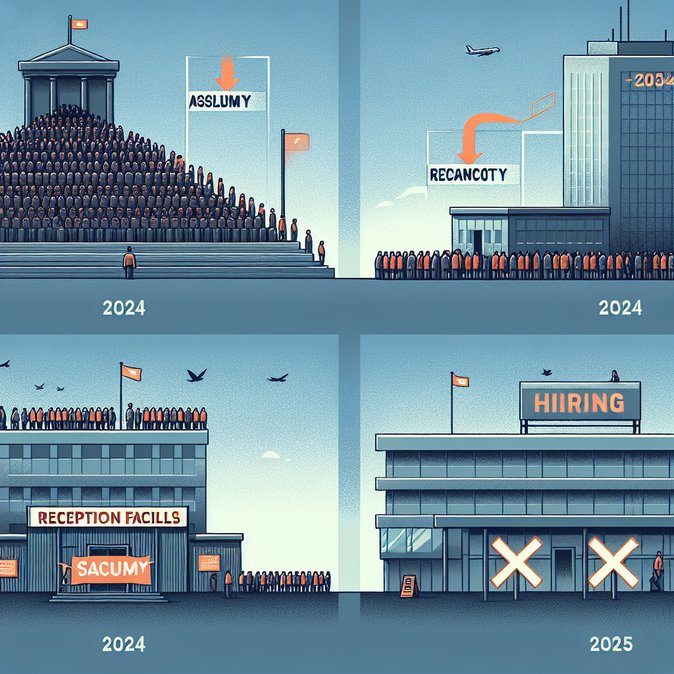
New statistics released by the Department of Justice on 7 January show that 13,160 people sought international protection in Ireland during 2025, down from an all-time high of 18,651 in 2024. The 29.4 per cent year-on-year drop follows a string of deterrent measures, including the designation of 15 ‘safe countries of origin’, the introduction of an accelerated two-step decision model and a sharper focus on voluntary and forced returns.
Under the fast-track framework, claims from nationals of safe countries are now decided within as little as three months. Internal data suggest applications from those jurisdictions fell by nearly 70 % last year. Meanwhile, 1,609 applicants opted for voluntary return—up 72 %—and forced removals increased to 205. Officials say the policy mix is beginning to ease pressure on the accommodation network, which was hosting almost 33,000 protection applicants across more than 300 centres at end-December.
Against this backdrop, VisaHQ’s Ireland practice can help both employers and prospective migrants understand the full range of Irish immigration options—whether that involves securing work authorisation, arranging travel visas or preparing follow-on residency applications. The digital platform streamlines document collection, tracks deadlines and provides real-time status updates, making compliance easier as policies evolve. Learn more at https://www.visahq.com/ireland/
![Ireland Reports 30 % Fall in Asylum Applications for 2025 After Fast-Track Reforms]()
For global-mobility teams, the sharper decline could translate into a smaller pool of asylum-seeker work-permission holders later this year. Under current rules, protection applicants can seek labour-market access after six months in the process; employers who rely on that pipeline may need to diversify recruitment channels or adjust workforce-planning models.
Advocacy groups have urged Government to complement the deterrence strategy with faster integration pathways for those ultimately granted status, arguing that prolonged processing and limited access to training hamper labour-market outcomes. The Department of Justice says a review of integration supports is under way, with proposals due before Cabinet in Q2 2026.
From a compliance standpoint, mobility managers should expect heightened enforcement of overstays and failed-claimant removals at ports and airports. Companies hosting contractors from high-risk jurisdictions are advised to audit immigration documentation and ensure exit-tracking mechanisms are robust.
Under the fast-track framework, claims from nationals of safe countries are now decided within as little as three months. Internal data suggest applications from those jurisdictions fell by nearly 70 % last year. Meanwhile, 1,609 applicants opted for voluntary return—up 72 %—and forced removals increased to 205. Officials say the policy mix is beginning to ease pressure on the accommodation network, which was hosting almost 33,000 protection applicants across more than 300 centres at end-December.
Against this backdrop, VisaHQ’s Ireland practice can help both employers and prospective migrants understand the full range of Irish immigration options—whether that involves securing work authorisation, arranging travel visas or preparing follow-on residency applications. The digital platform streamlines document collection, tracks deadlines and provides real-time status updates, making compliance easier as policies evolve. Learn more at https://www.visahq.com/ireland/

For global-mobility teams, the sharper decline could translate into a smaller pool of asylum-seeker work-permission holders later this year. Under current rules, protection applicants can seek labour-market access after six months in the process; employers who rely on that pipeline may need to diversify recruitment channels or adjust workforce-planning models.
Advocacy groups have urged Government to complement the deterrence strategy with faster integration pathways for those ultimately granted status, arguing that prolonged processing and limited access to training hamper labour-market outcomes. The Department of Justice says a review of integration supports is under way, with proposals due before Cabinet in Q2 2026.
From a compliance standpoint, mobility managers should expect heightened enforcement of overstays and failed-claimant removals at ports and airports. Companies hosting contractors from high-risk jurisdictions are advised to audit immigration documentation and ensure exit-tracking mechanisms are robust.