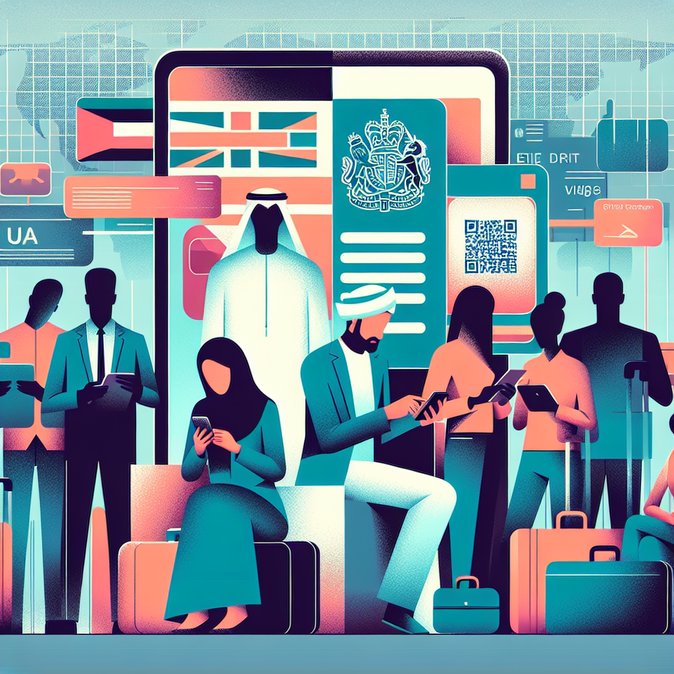
Emirates Airline has issued an urgent advisory to passengers in the UAE who plan to visit the United Kingdom in the coming weeks. According to the carrier, the UK Home Office will switch fully to digital immigration permissions on 25 February 2026. From that date, all visa-waiver nationals—including Emiratis and UAE residents eligible for short-stay entry—must hold an approved Electronic Travel Authorisation (ETA) before they board a flight, ferry or Eurostar train to the UK. Travellers who need a visa will see their existing physical documents replaced by an online e-Visa that is linked to their passport number.
The ETA will cost £10 and is valid for two years or until the traveller’s passport expires, whichever comes first. Applications are submitted through a mobile app or the UK government website and typically take up to three working days to process, although Emirates is urging customers to apply well in advance because passengers without an approved ETA will be denied boarding. The airline is also advising UAE residents who already hold UK visas—such as students, workers and family-route migrants—to create a UK Visas & Immigration (UKVI) account now so that their new e-Visa can be issued digitally.
Travellers who would prefer hands-on assistance with the new ETA or any other UK visa requirements can enlist the services of VisaHQ. The company’s UAE team guides applicants through form completion, document uploads and UKVI account setup, ensuring submissions are accurate and timely—an advantage for business flyers facing tight schedules. More information is available at https://www.visahq.com/united-arab-emirates/
![Emirates warns UAE travellers: UK to enforce mandatory ETA and e-Visa system from 25 February 2026]()
For GCC citizens, the introduction of mandatory ETAs effectively replaces the old Electronic Visa Waiver (EVW) scheme and aligns Britain with similar systems in the US (ESTA) and Canada (eTA). Business-travel consultants say the change will streamline border checks in the long term, but warn that companies should update their travel policies immediately. Employers used to booking last-minute tickets to London for meetings will now need to build in ETA lead times, and mobility managers must ensure that staff members hold passports linked to the correct e-Visa account to avoid denial of entry.
Practical implications include updating HR systems with ETA expiry dates, briefing frequent flyers on the new requirement, and reminding assignees that each new passport triggers a fresh ETA application. Organisations that sponsor UK visas for employees should also note that paper Biometric Residence Permits (BRPs) and vignettes will cease to be accepted as proof of status; instead, assignees will need to generate a share code from their UKVI account. Failure to do so could affect right-to-work checks and onward travel plans.
Travel industry analysts view the UK’s digital migration as part of a wider global trend. The European Union’s ETIAS scheme is due to launch later in 2026, while the UAE is itself piloting biometric gates and a Smart Travel initiative at Abu Dhabi’s Zayed International Airport. For now, the message from Emirates is clear: “No ETA, no boarding.”
The ETA will cost £10 and is valid for two years or until the traveller’s passport expires, whichever comes first. Applications are submitted through a mobile app or the UK government website and typically take up to three working days to process, although Emirates is urging customers to apply well in advance because passengers without an approved ETA will be denied boarding. The airline is also advising UAE residents who already hold UK visas—such as students, workers and family-route migrants—to create a UK Visas & Immigration (UKVI) account now so that their new e-Visa can be issued digitally.
Travellers who would prefer hands-on assistance with the new ETA or any other UK visa requirements can enlist the services of VisaHQ. The company’s UAE team guides applicants through form completion, document uploads and UKVI account setup, ensuring submissions are accurate and timely—an advantage for business flyers facing tight schedules. More information is available at https://www.visahq.com/united-arab-emirates/

For GCC citizens, the introduction of mandatory ETAs effectively replaces the old Electronic Visa Waiver (EVW) scheme and aligns Britain with similar systems in the US (ESTA) and Canada (eTA). Business-travel consultants say the change will streamline border checks in the long term, but warn that companies should update their travel policies immediately. Employers used to booking last-minute tickets to London for meetings will now need to build in ETA lead times, and mobility managers must ensure that staff members hold passports linked to the correct e-Visa account to avoid denial of entry.
Practical implications include updating HR systems with ETA expiry dates, briefing frequent flyers on the new requirement, and reminding assignees that each new passport triggers a fresh ETA application. Organisations that sponsor UK visas for employees should also note that paper Biometric Residence Permits (BRPs) and vignettes will cease to be accepted as proof of status; instead, assignees will need to generate a share code from their UKVI account. Failure to do so could affect right-to-work checks and onward travel plans.
Travel industry analysts view the UK’s digital migration as part of a wider global trend. The European Union’s ETIAS scheme is due to launch later in 2026, while the UAE is itself piloting biometric gates and a Smart Travel initiative at Abu Dhabi’s Zayed International Airport. For now, the message from Emirates is clear: “No ETA, no boarding.”