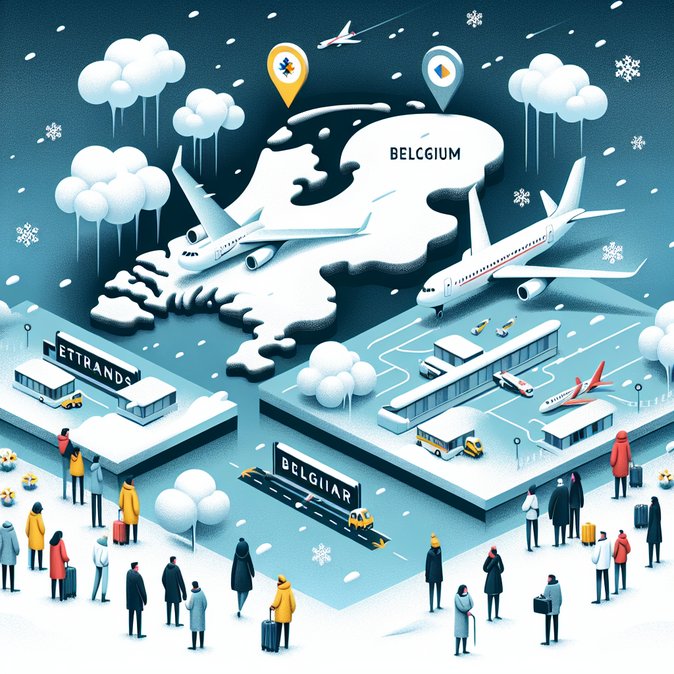
A deep Arctic front that swept across northern Europe on 6 January triggered large-scale operational disruptions at Amsterdam-Schiphol and Brussels airports, resulting in a cascade of cancellations that reached Dublin. Dublin Airport remained fully open, but low-visibility procedures and de-icing delays on the continent led Aer Lingus, KLM and Brussels Airlines to scrub three Dublin–Amsterdam return rotations and one Dublin–Brussels return rotation. In total, eight flights and roughly 1,260 passengers were affected. (roscommonherald.ie)
Airport operator DAA warned that re-accommodation options were limited because remaining services were departing close to capacity. Travellers with onward long-haul connections via Schiphol were advised to rebook for later dates or routings. While the disruption was modest compared with the 700-plus cancellations reported at Schiphol itself, it underscores Dublin’s vulnerability to weather issues at key European hubs.
For travellers suddenly rerouted through unfamiliar airports or countries, VisaHQ’s Ireland portal (https://www.visahq.com/ireland/) can quickly secure any additional transit or entry visas that new itineraries might require. The platform’s real-time guidance and expedited processing help corporations and assignees adjust plans smoothly when weather throws schedules into disarray.
![Snow in continental Europe forces eight Dublin flights to cancel; 1,260 passengers affected]()
Airlines are applying EU261 re-routing and duty-of-care rules; however, mobility managers should remind assignees that accommodation and meal entitlements vary by carrier and delay length. Where same-day connections are critical, companies may wish to rout travellers through Frankfurt or Paris, which reported fewer cancellations.
The Irish Aviation Authority has not issued capacity restrictions at Dublin, but further knock-on delays are possible as aircraft and crews reposition. Irish employers should monitor airline alerts and build additional buffer time into itineraries for meetings scheduled this week.
From a broader mobility perspective, the incident illustrates the importance of multi-hub contingency planning—in particular for Schengen-connecting flights used by business travellers heading to Asia-Pacific and North America via Amsterdam.
Airport operator DAA warned that re-accommodation options were limited because remaining services were departing close to capacity. Travellers with onward long-haul connections via Schiphol were advised to rebook for later dates or routings. While the disruption was modest compared with the 700-plus cancellations reported at Schiphol itself, it underscores Dublin’s vulnerability to weather issues at key European hubs.
For travellers suddenly rerouted through unfamiliar airports or countries, VisaHQ’s Ireland portal (https://www.visahq.com/ireland/) can quickly secure any additional transit or entry visas that new itineraries might require. The platform’s real-time guidance and expedited processing help corporations and assignees adjust plans smoothly when weather throws schedules into disarray.

Airlines are applying EU261 re-routing and duty-of-care rules; however, mobility managers should remind assignees that accommodation and meal entitlements vary by carrier and delay length. Where same-day connections are critical, companies may wish to rout travellers through Frankfurt or Paris, which reported fewer cancellations.
The Irish Aviation Authority has not issued capacity restrictions at Dublin, but further knock-on delays are possible as aircraft and crews reposition. Irish employers should monitor airline alerts and build additional buffer time into itineraries for meetings scheduled this week.
From a broader mobility perspective, the incident illustrates the importance of multi-hub contingency planning—in particular for Schengen-connecting flights used by business travellers heading to Asia-Pacific and North America via Amsterdam.