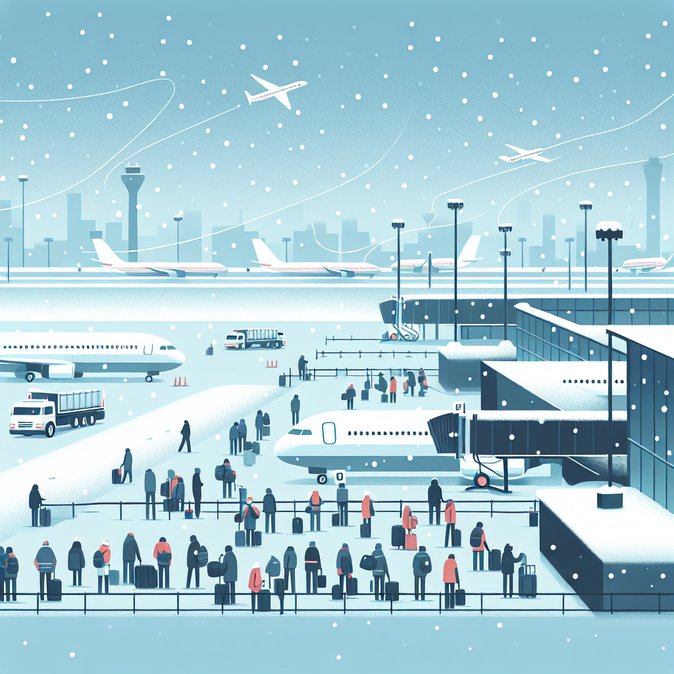
A rare January snowstorm—named Storm Goretti by Météo-France—swept across the Paris region overnight, forcing the Civil Aviation Authority (DGAC) to order drastic capacity cuts at the capital’s two main hubs. Between 06:00 and 12:00 on 7 January, airlines had to cancel 40 % of movements at Charles-de-Gaulle (CDG) and 25 % at Orly (ORY).
Air France scrapped close to 200 short- and medium-haul flights but kept its entire long-haul programme intact by consolidating feeder services and up-gauge aircraft. Low-cost carriers Transavia France and easyJet pre-emptively grounded dozens of rotations to Mediterranean and domestic leisure destinations, re-booking passengers through their apps.
Under EU 261, airlines must offer duty-of-care—including meals and hotel accommodation—for delays exceeding two hours. DGAC reminded carriers that the weather exemption applies only to compensation, not to assistance, and warned business-class lounges were already at capacity by 08:00.
![Paris Airports Slash Morning Flights as Snowstorm Goretti Hits Île-de-France]()
For passengers who now have to reroute via different countries or extend their stay, VisaHQ can help fast-track any unexpected visa requirements. Its user-friendly portal (https://www.visahq.com/france/) allows travelers to secure French or transit visas online, providing real-time status updates—an invaluable service when storm-related disruptions force rapid itinerary changes.
Corporate travel managers were urged to move meetings online or route executives through provincial airports such as Lyon or Toulouse, where runway conditions remained within limits. Eurostar reported a surge in last-minute bookings as travellers switched from air to rail, although snow on the northern approach into Paris Nord caused 30-minute delays.
With further flurries forecast into the evening, DGAC signalled it could extend flight-caps into the night-wave. Mobility teams should monitor real-time NOTAMs, advise assignees to arrive at airports at least four hours before departure, and remind staff of flexible-working policies during severe-weather events.
Air France scrapped close to 200 short- and medium-haul flights but kept its entire long-haul programme intact by consolidating feeder services and up-gauge aircraft. Low-cost carriers Transavia France and easyJet pre-emptively grounded dozens of rotations to Mediterranean and domestic leisure destinations, re-booking passengers through their apps.
Under EU 261, airlines must offer duty-of-care—including meals and hotel accommodation—for delays exceeding two hours. DGAC reminded carriers that the weather exemption applies only to compensation, not to assistance, and warned business-class lounges were already at capacity by 08:00.

For passengers who now have to reroute via different countries or extend their stay, VisaHQ can help fast-track any unexpected visa requirements. Its user-friendly portal (https://www.visahq.com/france/) allows travelers to secure French or transit visas online, providing real-time status updates—an invaluable service when storm-related disruptions force rapid itinerary changes.
Corporate travel managers were urged to move meetings online or route executives through provincial airports such as Lyon or Toulouse, where runway conditions remained within limits. Eurostar reported a surge in last-minute bookings as travellers switched from air to rail, although snow on the northern approach into Paris Nord caused 30-minute delays.
With further flurries forecast into the evening, DGAC signalled it could extend flight-caps into the night-wave. Mobility teams should monitor real-time NOTAMs, advise assignees to arrive at airports at least four hours before departure, and remind staff of flexible-working policies during severe-weather events.