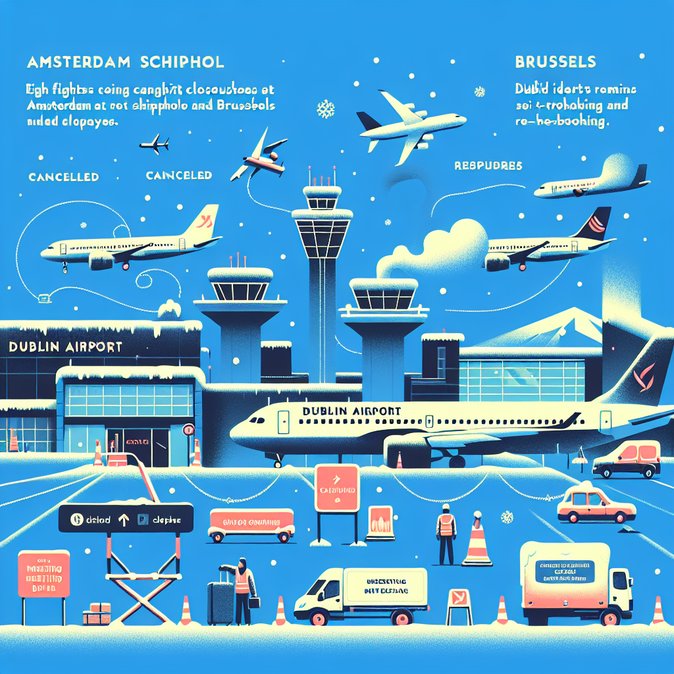
A sudden Arctic front that moved south over the weekend has blanketed parts of the Netherlands, Belgium and the UK in snow, triggering a domino-effect of schedule changes that reached Ireland on the morning of 6 January. While Dublin Airport stayed open, low-visibility procedures at Amsterdam Schiphol and de-icing delays at Brussels led Aer Lingus, KLM and Brussels Airlines to scrub three return Dublin-Amsterdam services and one return Dublin-Brussels rotation.
According to Dublin Airport operator DAA, the eight cancellations affect roughly 1,260 passengers, many of whom were due to connect onward to long-haul flights from Schiphol. The airport advised travellers to use airline apps for re-booking and warned that remaining flights are likely to depart completely full, limiting same-day reaccommodation options. Business-travel managers are being urged to reconfirm meetings scheduled for 7-8 January and to consider video-conference alternatives.
![Heavy snow across Europe forces multiple Dublin-Amsterdam and Dublin-Brussels cancellations]()
For travelers whose itineraries suddenly change, keeping visa and transit paperwork up to date can be a headache. VisaHQ’s Ireland portal (https://www.visahq.com/ireland/) helps by letting passengers quickly verify entry requirements and submit visa applications online, ensuring documentation is in order even when last-minute rerouting is required.
Meteorologists expect the freezing conditions in Benelux to persist until Thursday, meaning further disruption is possible. Airlines are permitted to invoke ‘extraordinary circumstances’ under EU261, removing the duty to pay compensation, but they must still offer re-routing or refunds. Companies with time-sensitive cargo on the Dublin-Amsterdam route—especially pharmaceuticals—have started to shift shipments to quieter Scandinavian gateways to avoid backlogs.
Travel-risk experts note that today’s events underscore a wider vulnerability in winter timetables: with aircraft utilisation already high, the loss of even a few rotations can ripple through a carrier’s network for days. Employers should remind travelling staff to keep digital copies of boarding passes, as these are often required when claiming out-of-pocket expenses or EU261 reimbursements.
According to Dublin Airport operator DAA, the eight cancellations affect roughly 1,260 passengers, many of whom were due to connect onward to long-haul flights from Schiphol. The airport advised travellers to use airline apps for re-booking and warned that remaining flights are likely to depart completely full, limiting same-day reaccommodation options. Business-travel managers are being urged to reconfirm meetings scheduled for 7-8 January and to consider video-conference alternatives.

For travelers whose itineraries suddenly change, keeping visa and transit paperwork up to date can be a headache. VisaHQ’s Ireland portal (https://www.visahq.com/ireland/) helps by letting passengers quickly verify entry requirements and submit visa applications online, ensuring documentation is in order even when last-minute rerouting is required.
Meteorologists expect the freezing conditions in Benelux to persist until Thursday, meaning further disruption is possible. Airlines are permitted to invoke ‘extraordinary circumstances’ under EU261, removing the duty to pay compensation, but they must still offer re-routing or refunds. Companies with time-sensitive cargo on the Dublin-Amsterdam route—especially pharmaceuticals—have started to shift shipments to quieter Scandinavian gateways to avoid backlogs.
Travel-risk experts note that today’s events underscore a wider vulnerability in winter timetables: with aircraft utilisation already high, the loss of even a few rotations can ripple through a carrier’s network for days. Employers should remind travelling staff to keep digital copies of boarding passes, as these are often required when claiming out-of-pocket expenses or EU261 reimbursements.