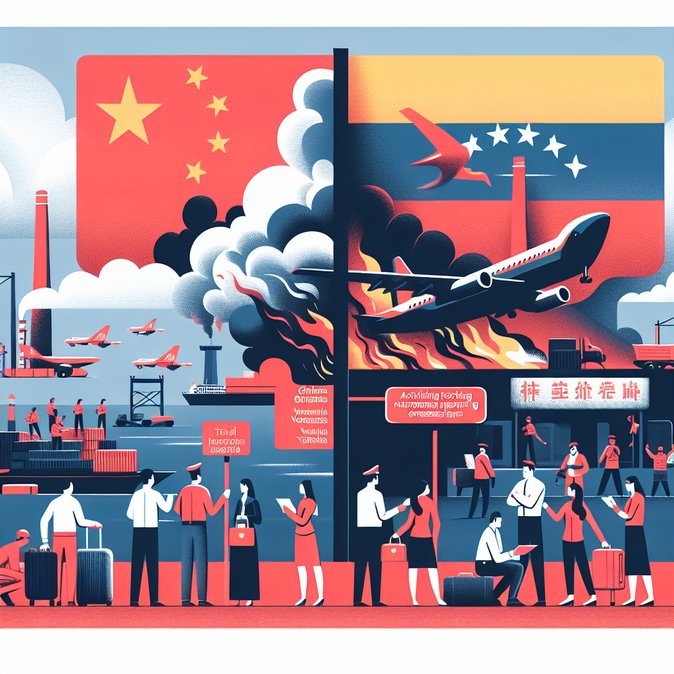
At the Ministry of Foreign Affairs’ first press briefing of 2026, held at 21:12 Beijing time on 5 January, spokesperson Lin Jian confirmed that no Chinese nationals have so far been harmed by the armed conflict that erupted in Venezuela after U.S. strikes on 3 January. Nevertheless, the Foreign Ministry reiterated its advisory for Chinese citizens to “temporarily refrain from travelling” to Venezuela and urged those already in the country to heighten security precautions and stay in close contact with the Chinese Embassy in Caracas.
The advisory, first issued jointly by the Ministry and the embassy on 4 January, emphasises avoiding conflict zones and maintaining emergency preparedness. It follows the U.S. seizure of Venezuelan President Nicolás Maduro and his wife, an act China condemned as a violation of international law.
![Beijing issues fresh security update on Venezuela; companies told to reassess duty-of-care for China staff in South America]()
Should employees nonetheless need to travel, VisaHQ’s China portal (https://www.visahq.com/china/) can simplify logistics by providing real-time visa guidance, alternative routing options, and automated alerts that align with corporate duty-of-care systems—giving HR teams an extra layer of support when time and clarity are paramount.
For multinational employers the guidance triggers renewed duty-of-care obligations. HR and global mobility teams should (1) locate any Chinese assignees or travellers currently in Venezuela, (2) ensure they are enrolled in company security-tracking apps, and (3) review evacuation and medical-assistance contracts. Firms contemplating site visits related to oil-and-gas or infrastructure projects should postpone non-essential travel until risk levels are downgraded.
With Latin America an increasingly important destination under China’s Belt and Road Initiative, the episode is a reminder that outbound travel risk management must keep pace with China’s accelerating international footprint. Many Chinese passport holders still rely on local travel agencies rather than corporate security briefings; companies may wish to mandate pre-trip security training and require staff to register itineraries with HQ before departure to high-risk destinations.
The advisory, first issued jointly by the Ministry and the embassy on 4 January, emphasises avoiding conflict zones and maintaining emergency preparedness. It follows the U.S. seizure of Venezuelan President Nicolás Maduro and his wife, an act China condemned as a violation of international law.

Should employees nonetheless need to travel, VisaHQ’s China portal (https://www.visahq.com/china/) can simplify logistics by providing real-time visa guidance, alternative routing options, and automated alerts that align with corporate duty-of-care systems—giving HR teams an extra layer of support when time and clarity are paramount.
For multinational employers the guidance triggers renewed duty-of-care obligations. HR and global mobility teams should (1) locate any Chinese assignees or travellers currently in Venezuela, (2) ensure they are enrolled in company security-tracking apps, and (3) review evacuation and medical-assistance contracts. Firms contemplating site visits related to oil-and-gas or infrastructure projects should postpone non-essential travel until risk levels are downgraded.
With Latin America an increasingly important destination under China’s Belt and Road Initiative, the episode is a reminder that outbound travel risk management must keep pace with China’s accelerating international footprint. Many Chinese passport holders still rely on local travel agencies rather than corporate security briefings; companies may wish to mandate pre-trip security training and require staff to register itineraries with HQ before departure to high-risk destinations.
More From China
View all
China’s 2026 New Year holiday sets mobility record with 6.6 million border crossings and 142 million domestic trips

Hong Kong counts 5.4 million mainland-linked trips over New Year break, signalling Greater Bay Area rebound