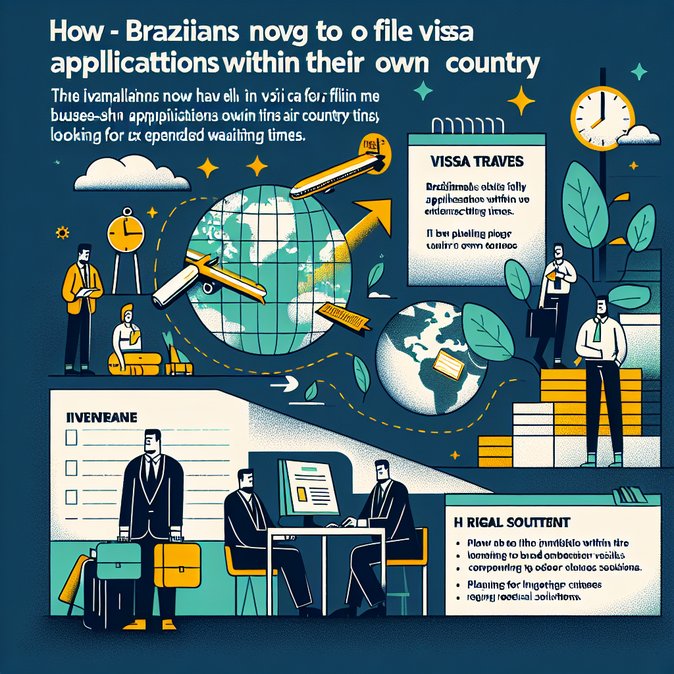
Brazilian executives accustomed to flying to third-country U.S. consulates for faster visa appointments are about to lose that safety valve. On 4 January 2026 the U.S. State Department confirmed that, once the One Big Beautiful Act takes effect later this year, nearly all non-immigrant visa applicants must apply in the country of their citizenship or long-term residence. For Brazilians, that means filing at consulates in São Paulo, Rio de Janeiro, Brasília, Recife or Porto Alegre—even though those posts already have some of the world’s longest wait-times, averaging 250 days for a B-1/B-2 interview.
Consular-shopping in Buenos Aires, Montevideo and Santiago has been a vital pressure valve since the pandemic. Visa facilitation firm VisaHQ estimates that rerouting those applicants back to Brazil could swell local demand by 20-30 percent in the first year, pushing interview queues past 300 days unless the State Department adds staff or expands interview-waiver criteria.
To help corporate travelers stay ahead of these changing requirements, VisaHQ offers Brazil-based applicants a digital concierge service that pre-screens documentation, flags eligibility for interview waivers and, through its dashboard (https://www.visahq.com/brazil/), tracks appointment openings in real time—often securing earlier slots that appear and disappear within minutes. The platform can also coordinate applications for accompanying family members and alternative visas, easing the administrative burden on HR teams.
![U.S. ‘Home Country Rule’ to Lengthen Brazil-U.S. Visa Queues]()
The timing could not be worse for multinational companies. January kicks off the conference season—CES in Las Vegas, NRF Retail’s Big Show in New York and the Prospectors & Developers mining summit in Toronto—all events that rely on Brazilian deal-makers. ABAV, Brazil’s travel-agent association, warns of up to R$750 million in lost revenue if delays force trip cancellations. Some firms are already shifting meetings to Mexico City or Bogotá, where Brazilians can enter visa-free and U.S. executives face shorter consular queues.
Global-mobility managers should advise travelers to renew U.S. visas at least 12 months before expiry, keep digital copies of previous visas (to qualify for interview-waivers) and map alternative hubs for regional projects. Companies with mixed-nationality staff may lean more heavily on ESTA-eligible or visa-exempt passport holders to maintain face-to-face engagement with U.S. clients.
In the long term the rule underscores a broader shift toward place-of-residence filing—also favored by Canada and the U.K.—that could reshape global assignment planning. Brazil’s Foreign Ministry is expected to lobby Washington for extra staffing, but no relief is likely before the northern-summer peak.
Consular-shopping in Buenos Aires, Montevideo and Santiago has been a vital pressure valve since the pandemic. Visa facilitation firm VisaHQ estimates that rerouting those applicants back to Brazil could swell local demand by 20-30 percent in the first year, pushing interview queues past 300 days unless the State Department adds staff or expands interview-waiver criteria.
To help corporate travelers stay ahead of these changing requirements, VisaHQ offers Brazil-based applicants a digital concierge service that pre-screens documentation, flags eligibility for interview waivers and, through its dashboard (https://www.visahq.com/brazil/), tracks appointment openings in real time—often securing earlier slots that appear and disappear within minutes. The platform can also coordinate applications for accompanying family members and alternative visas, easing the administrative burden on HR teams.

The timing could not be worse for multinational companies. January kicks off the conference season—CES in Las Vegas, NRF Retail’s Big Show in New York and the Prospectors & Developers mining summit in Toronto—all events that rely on Brazilian deal-makers. ABAV, Brazil’s travel-agent association, warns of up to R$750 million in lost revenue if delays force trip cancellations. Some firms are already shifting meetings to Mexico City or Bogotá, where Brazilians can enter visa-free and U.S. executives face shorter consular queues.
Global-mobility managers should advise travelers to renew U.S. visas at least 12 months before expiry, keep digital copies of previous visas (to qualify for interview-waivers) and map alternative hubs for regional projects. Companies with mixed-nationality staff may lean more heavily on ESTA-eligible or visa-exempt passport holders to maintain face-to-face engagement with U.S. clients.
In the long term the rule underscores a broader shift toward place-of-residence filing—also favored by Canada and the U.K.—that could reshape global assignment planning. Brazil’s Foreign Ministry is expected to lobby Washington for extra staffing, but no relief is likely before the northern-summer peak.