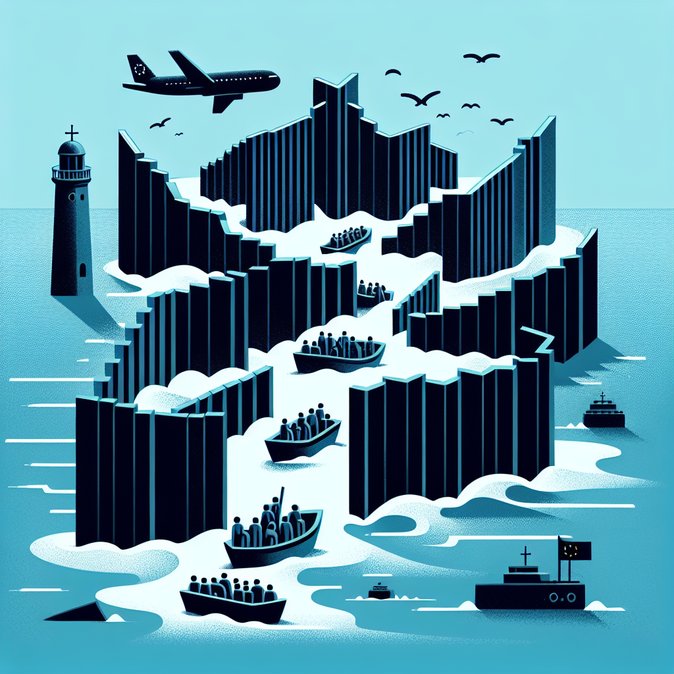
Spain’s migration debate closed the year on a sombre note as rights group Caminando Fronteras released its annual casualty audit on 29 December. The NGO calculates that at least 3,090 migrants – including 192 women and 437 children – died or disappeared while attempting to reach Spanish territory between 1 January and 15 December 2025. Although fatalities are down sharply from the record 10,457 deaths recorded in 2024, campaigners warn the improvement is deceptive.
Stricter EU-funded controls in departure countries such as Mauritania have slashed overall arrivals – Interior Ministry data show 35,935 irregular entries, a 40 % year-on-year fall – but have pushed would-be migrants onto longer, riskier sea corridors. The Atlantic passage to the Canary Islands still claimed 1,906 lives, while a newer Algeria-to-Balearics route accounted for 1,037 deaths. The report logged 303 shipwrecks and notes that 70 boats vanished without trace, suggesting the true toll could be higher.
For corporations and relocation managers the figures underpin a hard reality: Spain’s labour market shortages, especially in agriculture, hospitality and elder care, are colliding with ever-more dangerous legal pathways for non-EU workers. As regular work-visa quotas remain tiny, irregular migration will remain a humanitarian and political flashpoint in 2026, influencing border-checkpoint wait times, documentation scrutiny and public sentiment toward foreign assignees.
![NGO Report: 3,090 People Died on Routes to Spain in 2025 Despite 40 % Drop in Arrivals]()
In light of these shifting dynamics, VisaHQ can streamline the formal visa process for both employers and individual applicants. Its dedicated Spain page (https://www.visahq.com/spain/) offers real-time information on permit categories, digital application tools and concierge support, helping travellers avoid paperwork pitfalls and meet compliance deadlines even as regulations evolve.
Caminando Fronteras criticises what it calls “institutional failures” in search-and-rescue and blames anti-migrant rhetoric for eroding political will. The Spanish government replies that joint Frontex patrols have saved thousands and that a new bilateral readmission deal with Senegal will open lawful seasonal-work channels next year.
HR teams should monitor province-level policy shifts: Andalusia’s pilot to regularise farm workers with six-month contracts could expand, easing recruitment while reducing dangerous crossings. Meanwhile, crisis-response protocols for posted staff in the Canaries – a hotspot for vessel arrivals – should be updated to reflect new security advisories.
Stricter EU-funded controls in departure countries such as Mauritania have slashed overall arrivals – Interior Ministry data show 35,935 irregular entries, a 40 % year-on-year fall – but have pushed would-be migrants onto longer, riskier sea corridors. The Atlantic passage to the Canary Islands still claimed 1,906 lives, while a newer Algeria-to-Balearics route accounted for 1,037 deaths. The report logged 303 shipwrecks and notes that 70 boats vanished without trace, suggesting the true toll could be higher.
For corporations and relocation managers the figures underpin a hard reality: Spain’s labour market shortages, especially in agriculture, hospitality and elder care, are colliding with ever-more dangerous legal pathways for non-EU workers. As regular work-visa quotas remain tiny, irregular migration will remain a humanitarian and political flashpoint in 2026, influencing border-checkpoint wait times, documentation scrutiny and public sentiment toward foreign assignees.

In light of these shifting dynamics, VisaHQ can streamline the formal visa process for both employers and individual applicants. Its dedicated Spain page (https://www.visahq.com/spain/) offers real-time information on permit categories, digital application tools and concierge support, helping travellers avoid paperwork pitfalls and meet compliance deadlines even as regulations evolve.
Caminando Fronteras criticises what it calls “institutional failures” in search-and-rescue and blames anti-migrant rhetoric for eroding political will. The Spanish government replies that joint Frontex patrols have saved thousands and that a new bilateral readmission deal with Senegal will open lawful seasonal-work channels next year.
HR teams should monitor province-level policy shifts: Andalusia’s pilot to regularise farm workers with six-month contracts could expand, easing recruitment while reducing dangerous crossings. Meanwhile, crisis-response protocols for posted staff in the Canaries – a hotspot for vessel arrivals – should be updated to reflect new security advisories.