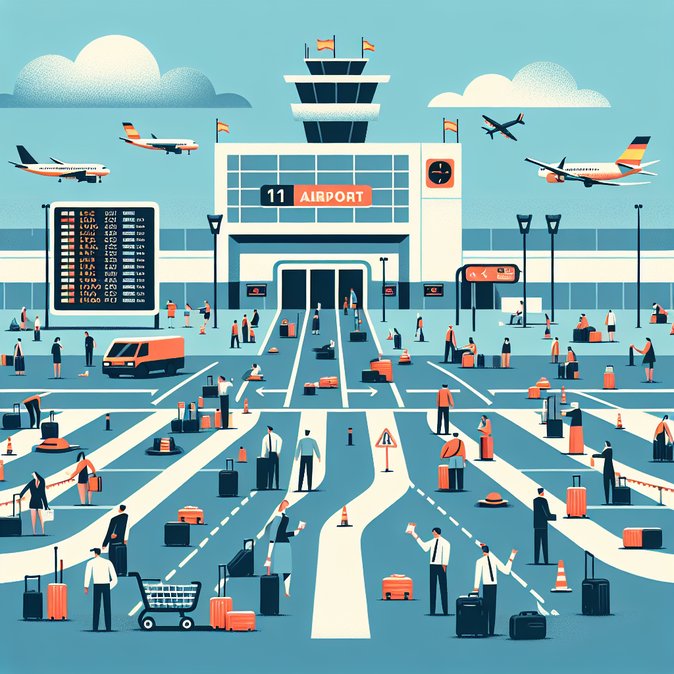
Business travellers heading to or through Spain this week are facing an unwelcome Christmas-to-New-Year headache. Ground-handling employees of Azul Handling – the Ryanair subsidiary that loads bags, guides aircraft and performs check-in for the low-cost carrier – have been walking off the job every Wednesday, Friday, Saturday and Sunday since mid-August and have vowed to continue until at least 31 December. The latest 24-hour stoppage on 30 December again hit Madrid-Barajas, Barcelona-El Prat, Málaga, Palma, Valencia, Seville, Girona, Ibiza, Tenerife South, Lanzarote and Santiago de Compostela.
The strikers, represented by Spain’s UGT union, say unpaid wages, chronic understaffing, chaotic rosters and arbitrary holiday allocations have made peak-season work untenable. The action is timed to coincide with the busiest travel days of the festive season, maximising pressure on management. Three daily strike windows (05:00–09:00, 12:00–15:00 and 21:00–23:59) are creating rolling queues at security, snarling baggage belts and delaying Ryanair departures – particularly at hub airports where rapid 25-minute turn-arounds are critical to the airline’s business model.
For corporate travellers juggling reroutes and tight project timelines, ensuring documentation stays up-to-date is crucial. VisaHQ’s platform (https://www.visahq.com/spain/) can expedite Schengen visa processing, provide invitation letters and send real-time entry-requirement alerts, streamlining admin so mobility teams can focus on mitigating strike-related disruptions rather than scrambling for consular appointments.
![Nationwide Ryanair Ground-Handling Strikes Snarl Holiday Travel at 11 Spanish Airports]()
From a corporate-mobility standpoint the disruption is material. Ryanair accounts for roughly one in five seats on Spain’s domestic and short-haul European market; Barcelona and Madrid are major connectors for intra-EU and North-Africa assignments. Travel-management companies are warning clients to add at least two hours to normal dwell times, to travel with cabin-only bags where possible, and to keep critical meeting materials in carry-on luggage. HR teams with last-minute project travel are being advised to consider rail (AVE), alternate carriers or even routing via Lisbon or Toulouse to avoid the most congested periods.
The dispute lands in a wider context of strained industrial relations across Europe’s aviation sector after two inflationary years. Azul Handling’s staff have seen a 3 % nominal pay offer turn negative in real terms against Spanish CPI of 4.3 %. Analysts note that Ryanair’s fourth-quarter schedule is already thinner than 2024 because of Boeing delivery delays, leaving little slack to re-accommodate passengers. If no agreement is struck, unions threaten to extend action into the Three Kings long weekend (5–7 January) – another peak for inbound business events such as FITUR in Madrid.
Negotiations resume on 2 January under the mediation of Spain’s Servicio Interconfederal de Mediación y Arbitraje (SIMA). A compromise on back-pay and roster guarantees would end the immediate turmoil, but mobility managers are braced for a volatile first quarter as other airport service providers eye 2026 wage talks. For now, the watch-word is contingency planning: re-route, travel light and build delay buffers into itineraries.
The strikers, represented by Spain’s UGT union, say unpaid wages, chronic understaffing, chaotic rosters and arbitrary holiday allocations have made peak-season work untenable. The action is timed to coincide with the busiest travel days of the festive season, maximising pressure on management. Three daily strike windows (05:00–09:00, 12:00–15:00 and 21:00–23:59) are creating rolling queues at security, snarling baggage belts and delaying Ryanair departures – particularly at hub airports where rapid 25-minute turn-arounds are critical to the airline’s business model.
For corporate travellers juggling reroutes and tight project timelines, ensuring documentation stays up-to-date is crucial. VisaHQ’s platform (https://www.visahq.com/spain/) can expedite Schengen visa processing, provide invitation letters and send real-time entry-requirement alerts, streamlining admin so mobility teams can focus on mitigating strike-related disruptions rather than scrambling for consular appointments.
From a corporate-mobility standpoint the disruption is material. Ryanair accounts for roughly one in five seats on Spain’s domestic and short-haul European market; Barcelona and Madrid are major connectors for intra-EU and North-Africa assignments. Travel-management companies are warning clients to add at least two hours to normal dwell times, to travel with cabin-only bags where possible, and to keep critical meeting materials in carry-on luggage. HR teams with last-minute project travel are being advised to consider rail (AVE), alternate carriers or even routing via Lisbon or Toulouse to avoid the most congested periods.
The dispute lands in a wider context of strained industrial relations across Europe’s aviation sector after two inflationary years. Azul Handling’s staff have seen a 3 % nominal pay offer turn negative in real terms against Spanish CPI of 4.3 %. Analysts note that Ryanair’s fourth-quarter schedule is already thinner than 2024 because of Boeing delivery delays, leaving little slack to re-accommodate passengers. If no agreement is struck, unions threaten to extend action into the Three Kings long weekend (5–7 January) – another peak for inbound business events such as FITUR in Madrid.
Negotiations resume on 2 January under the mediation of Spain’s Servicio Interconfederal de Mediación y Arbitraje (SIMA). A compromise on back-pay and roster guarantees would end the immediate turmoil, but mobility managers are braced for a volatile first quarter as other airport service providers eye 2026 wage talks. For now, the watch-word is contingency planning: re-route, travel light and build delay buffers into itineraries.