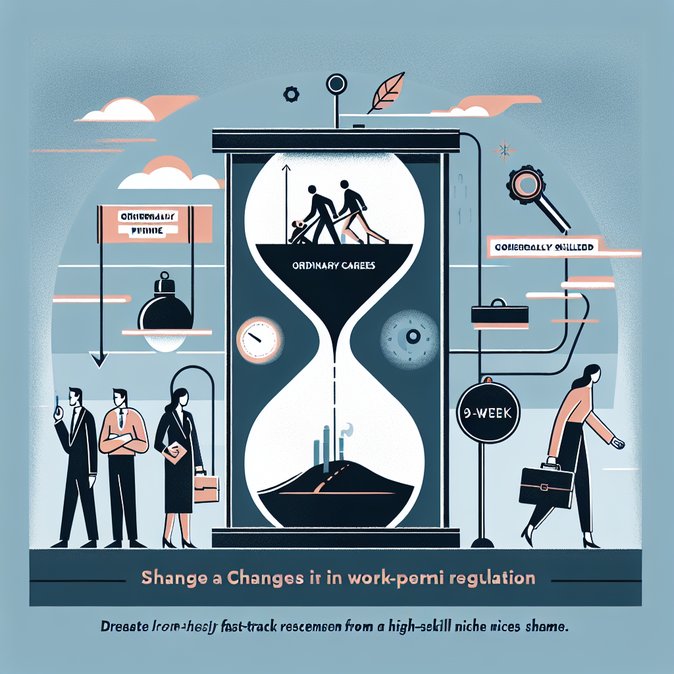
The Flemish Government has confirmed that it will slash the list of occupations eligible for accelerated economic-migration processing from 1 January 2026. Under the new decree, everyday jobs such as bus and truck drivers, bakers and butchers disappear from the so-called ‘bottleneck list’. Employers that still wish to fill these roles with non-EU nationals will have to prove at least nine weeks of fruitless recruitment across Belgium and the wider European labour market before filing a work-permit request.
Employment Minister Zuhal Demir argues that the fast-track was never intended for low-skill roles that, in her words, merely mask “an over-reliance on cheap third-country labour.” In place of the deleted categories the Region is adding highly specialised trades, including diamond cutters and asbestos-removal technicians, reflecting lobbying from Antwerp’s gem cluster and construction-safety firms. Low-skill positions will no longer qualify for the accelerated ‘economic migration’ channel at all.
For multinational employers the most immediate impact is procedural. Positions no longer on the list must now clear a formal labour-market test and move through the standard Single-Permit route, extending processing times by four to six weeks. Work permits already issued remain valid, but extensions filed after New Year will be assessed under the tougher criteria. Immigration lawyers are therefore urging HR teams to lodge renewal requests before 31 December and to gather robust evidence of domestic recruitment efforts for 2026 filings.
![Flanders Shrinks Shortage-Occupation List, Adding Extra Hurdles for Non-EU Recruiters]()
To help businesses adapt to these shifts, VisaHQ’s Belgium desk (https://www.visahq.com/belgium/) offers end-to-end support with Single-Permit applications, renewal filings and the compilation of labour-market-test evidence, giving HR teams a streamlined, compliance-ready pathway even as regional rules tighten.
Sector bodies are split. The Flemish Transport & Logistics Association warns that removing drivers from the list will aggravate an already acute shortage and potentially hit supply-chain reliability. Demir counters that recent wage hikes and relaxed EU cabotage rules should entice more local candidates, while simplified seasonal-worker procedures—introduced in parallel with the new regime—will give agriculture and hospitality employers a quicker route during peak periods.
Practically, global-mobility managers should update project-planning timelines for Belgium, alert business-line leaders to the longer lead times and ensure salary budgets remain within the minimum thresholds that underpin the Single-Permit system. Companies that rely on rotational drivers or food-production staff may need to hedge with short-term agency labour or intra-EU postings while the domestic talent pipeline stabilises.
Employment Minister Zuhal Demir argues that the fast-track was never intended for low-skill roles that, in her words, merely mask “an over-reliance on cheap third-country labour.” In place of the deleted categories the Region is adding highly specialised trades, including diamond cutters and asbestos-removal technicians, reflecting lobbying from Antwerp’s gem cluster and construction-safety firms. Low-skill positions will no longer qualify for the accelerated ‘economic migration’ channel at all.
For multinational employers the most immediate impact is procedural. Positions no longer on the list must now clear a formal labour-market test and move through the standard Single-Permit route, extending processing times by four to six weeks. Work permits already issued remain valid, but extensions filed after New Year will be assessed under the tougher criteria. Immigration lawyers are therefore urging HR teams to lodge renewal requests before 31 December and to gather robust evidence of domestic recruitment efforts for 2026 filings.

To help businesses adapt to these shifts, VisaHQ’s Belgium desk (https://www.visahq.com/belgium/) offers end-to-end support with Single-Permit applications, renewal filings and the compilation of labour-market-test evidence, giving HR teams a streamlined, compliance-ready pathway even as regional rules tighten.
Sector bodies are split. The Flemish Transport & Logistics Association warns that removing drivers from the list will aggravate an already acute shortage and potentially hit supply-chain reliability. Demir counters that recent wage hikes and relaxed EU cabotage rules should entice more local candidates, while simplified seasonal-worker procedures—introduced in parallel with the new regime—will give agriculture and hospitality employers a quicker route during peak periods.
Practically, global-mobility managers should update project-planning timelines for Belgium, alert business-line leaders to the longer lead times and ensure salary budgets remain within the minimum thresholds that underpin the Single-Permit system. Companies that rely on rotational drivers or food-production staff may need to hedge with short-term agency labour or intra-EU postings while the domestic talent pipeline stabilises.