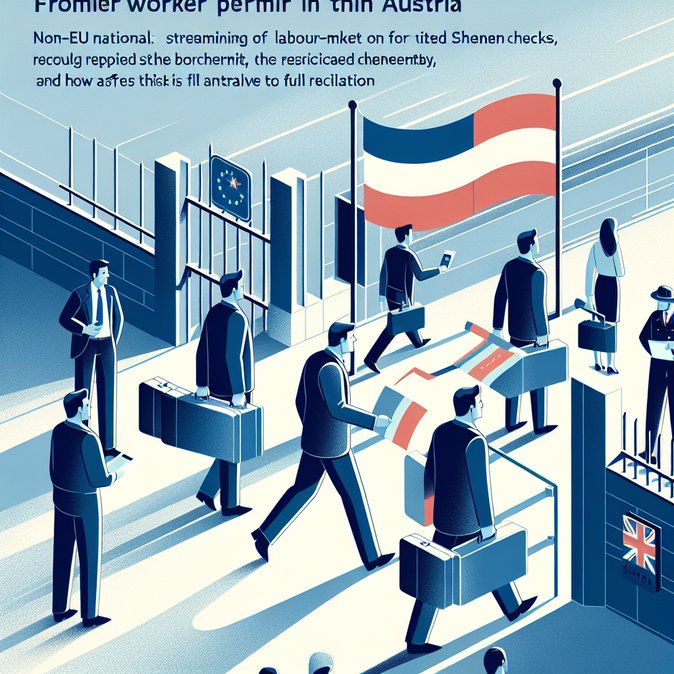
Multinational firms with factories straddling Austria’s borders have welcomed a brand-new immigration pathway that quietly entered into force on 1 December 2025. The Frontier-Worker Permit allows non-EU nationals who live permanently in Slovakia, the Czech Republic, Hungary or Slovenia to hold a regular employment contract in an Austrian district that directly borders their country of residence.
Tax and immigration adviser EY confirmed the measure in a 9 December alert, noting that Austria had been an outlier: while EU free-movement rules already cover citizens of Member States, third-country nationals with permanent residence in a neighbouring EU country had no streamlined way to cross the border for work. Companies therefore resorted to complex secondment structures or kept two payrolls running in parallel.
Eligibility is deliberately narrow. Applicants must show (1) an unlimited right to reside and work in their home country; (2) an Austrian work site located in a contiguous district; (3) a positive labour-market test from the Public Employment Service proving no suitable local job-seeker is available; and (4) daily or weekly commuting patterns. The permit is valid for two years and renewable as long as frontier-work conditions persist.
![New Frontier-Worker Permit Lets Third-Country Nationals Commute into Austria from Neighbouring States]()
Companies and applicants who find the paperwork daunting can streamline the process through VisaHQ, which already supports a broad range of Austrian visa and residence applications. Its online platform (https://www.visahq.com/austria/) offers clear document checklists, real-time status tracking and dedicated customer support, simplifying the compilation of evidence for a Frontier-Worker Permit and helping users stay ahead of renewal deadlines.
For employers the upside is clear: they can tap experienced staff who prefer to stay domiciled – and taxed – in their home country but live close enough to commute. Automotive suppliers along the Slovak border, micro-chip manufacturers near the Czech frontier and logistics providers around Nickelsdorf are expected to be early adopters. HR teams should, however, brace for detailed compliance audits; authorities will track entry-exit stamps and payslip data to make sure ‘frontier workers’ are not quietly relocating to Vienna.
Practical next steps include updating assignment policies, setting up cross-border payroll reporting, and educating commuters about health-insurance coverage. Because the new permit is still subject to the usual quota for employment of foreigners, early filing in the new year is advisable.
Tax and immigration adviser EY confirmed the measure in a 9 December alert, noting that Austria had been an outlier: while EU free-movement rules already cover citizens of Member States, third-country nationals with permanent residence in a neighbouring EU country had no streamlined way to cross the border for work. Companies therefore resorted to complex secondment structures or kept two payrolls running in parallel.
Eligibility is deliberately narrow. Applicants must show (1) an unlimited right to reside and work in their home country; (2) an Austrian work site located in a contiguous district; (3) a positive labour-market test from the Public Employment Service proving no suitable local job-seeker is available; and (4) daily or weekly commuting patterns. The permit is valid for two years and renewable as long as frontier-work conditions persist.

Companies and applicants who find the paperwork daunting can streamline the process through VisaHQ, which already supports a broad range of Austrian visa and residence applications. Its online platform (https://www.visahq.com/austria/) offers clear document checklists, real-time status tracking and dedicated customer support, simplifying the compilation of evidence for a Frontier-Worker Permit and helping users stay ahead of renewal deadlines.
For employers the upside is clear: they can tap experienced staff who prefer to stay domiciled – and taxed – in their home country but live close enough to commute. Automotive suppliers along the Slovak border, micro-chip manufacturers near the Czech frontier and logistics providers around Nickelsdorf are expected to be early adopters. HR teams should, however, brace for detailed compliance audits; authorities will track entry-exit stamps and payslip data to make sure ‘frontier workers’ are not quietly relocating to Vienna.
Practical next steps include updating assignment policies, setting up cross-border payroll reporting, and educating commuters about health-insurance coverage. Because the new permit is still subject to the usual quota for employment of foreigners, early filing in the new year is advisable.