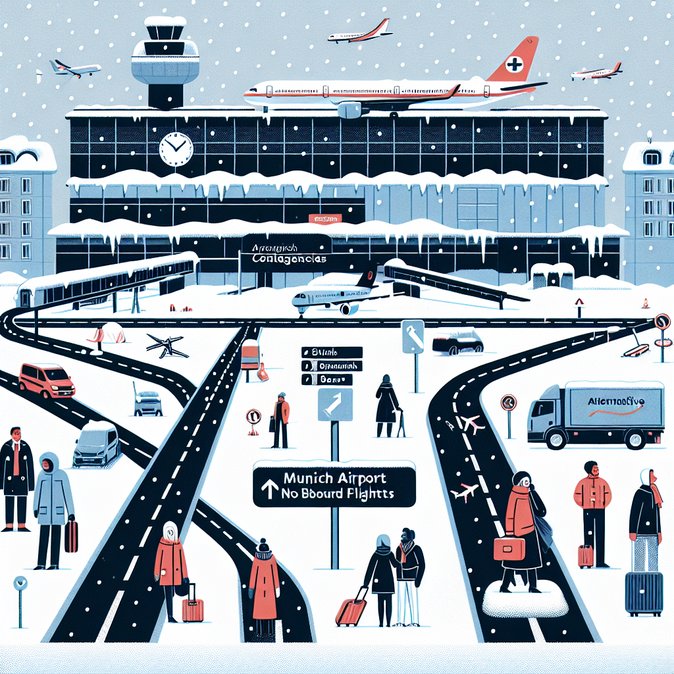
A severe winter front that swept across the northern Alps has exposed how quickly Central Europe’s air links can unravel—and how agile corporate mobility teams need to be. Heavy snow forced Munich Airport (MUC) to close both runways on 6 December, wiping out every flight to Vienna and Graz for 24 hours and knocking airline schedules out of kilter well into 8 December. Austrian Airlines, Lufthansa and several low-cost carriers cancelled or diverted more than 40 rotations, stranding an estimated 6 800 travellers, many of them consultants and plant engineers who shuttle between Bavarian and Austrian manufacturing hubs. Vienna International Airport (VIE) avoided heavy snowfall but operated under Category III low-visibility rules, leading to de-icing queues and secondary cancellations.
Corporate travel desks were forced into rapid triage. Ernst & Young rerouted 300 staff within six hours, opting for Zurich or Prague connections or, where seats were still available, the ÖBB Railjet that makes the Vienna–Munich run in four hours. Other firms dispatched charter buses to pick up employees diverted to Linz or Salzburg. Travel-risk specialists said the incident underscored the need for contingency plans that combine air, rail and road options across the D-A-CH region.
![Alpine snowstorm disrupts Munich–Vienna air corridor; corporates pivot to ÖBB Railjet]()
For mobility teams scrambling to keep personnel moving, VisaHQ can streamline the documentation side of crisis response. Its Austria portal (https://www.visahq.com/austria/) allows companies to centralize traveler profiles and arrange Schengen visas, passport renewals, or auxiliary travel documents at short notice—critical when weather disruptions force a switch from planes to cross-border trains and coaches.
While airlines offered rebooking and meal vouchers, many passengers found automated re-routing hampered by the limited interline agreements on short intra-Schengen hops. Mobility managers recommend storing employee passport and ticket data centrally so that alternative bookings—rail or air—can be issued quickly when carrier apps jam. The storm also highlighted capacity constraints on Railjet services: trains ran full within hours, prompting ÖBB to add two relief sets and consider a permanent frequency increase during winter.
Looking ahead, Munich Airport has pledged to review snow-clearing protocols, while Vienna airport will accelerate its plan to install an additional de-icing pad before the 2026 ski season. Companies with frequent cross-border commuters are advised to revisit force-majeure clauses in client contracts and ensure staff have EU Digital Identity wallets ready to cross the border by rail if airports shut again.
Corporate travel desks were forced into rapid triage. Ernst & Young rerouted 300 staff within six hours, opting for Zurich or Prague connections or, where seats were still available, the ÖBB Railjet that makes the Vienna–Munich run in four hours. Other firms dispatched charter buses to pick up employees diverted to Linz or Salzburg. Travel-risk specialists said the incident underscored the need for contingency plans that combine air, rail and road options across the D-A-CH region.

For mobility teams scrambling to keep personnel moving, VisaHQ can streamline the documentation side of crisis response. Its Austria portal (https://www.visahq.com/austria/) allows companies to centralize traveler profiles and arrange Schengen visas, passport renewals, or auxiliary travel documents at short notice—critical when weather disruptions force a switch from planes to cross-border trains and coaches.
While airlines offered rebooking and meal vouchers, many passengers found automated re-routing hampered by the limited interline agreements on short intra-Schengen hops. Mobility managers recommend storing employee passport and ticket data centrally so that alternative bookings—rail or air—can be issued quickly when carrier apps jam. The storm also highlighted capacity constraints on Railjet services: trains ran full within hours, prompting ÖBB to add two relief sets and consider a permanent frequency increase during winter.
Looking ahead, Munich Airport has pledged to review snow-clearing protocols, while Vienna airport will accelerate its plan to install an additional de-icing pad before the 2026 ski season. Companies with frequent cross-border commuters are advised to revisit force-majeure clauses in client contracts and ensure staff have EU Digital Identity wallets ready to cross the border by rail if airports shut again.