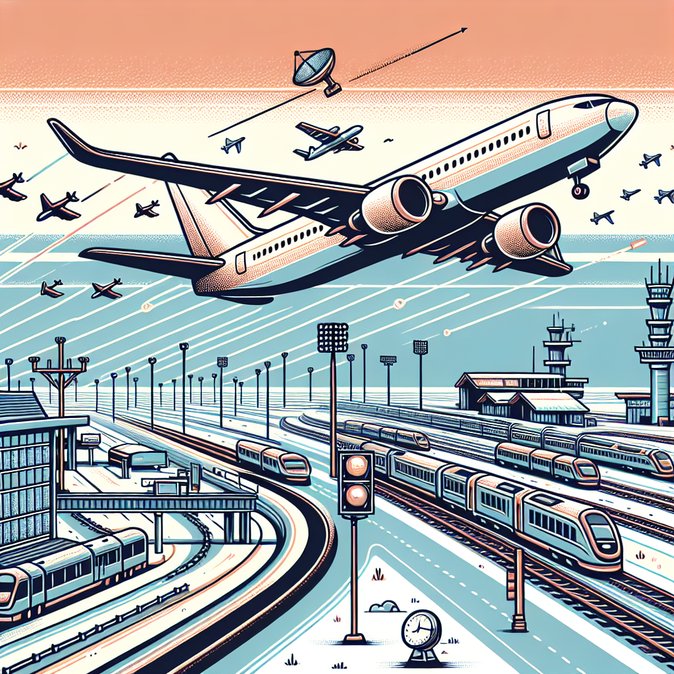
Business travellers heading south from Scotland on Monday faced major disruption when British Airways flight BA1443 from Edinburgh to London Heathrow declared a 7700 general emergency and returned barely ten minutes after departure. Flight-tracking data show the Airbus A320 levelled at 4,000 ft, circled over Stirling to burn fuel, and landed safely back on Runway 24 at 12:08 pm.
Airport officials immediately suspended operations, diverting at least 17 inbound services to Glasgow and Prestwick while rescue vehicles inspected the runway and the aircraft was towed to a remote stand. Ground crews spent a further hour clearing hydraulic fluid before reopening the airfield around 2:15 pm. Normal schedules resumed mid-afternoon, but BA and easyJet warned of residual delays throughout the evening peak.
BA confirmed that the crew were unable to fully retract the landing gear and followed standard safety procedures. All 142 passengers disembarked by coach and were re-booked on later flights or on the rail network; the airline offered overnight accommodation for those missing onward connections at Heathrow.
![Edinburgh Airport halts all traffic after British Airways A320 returns with landing-gear fault]()
If last-minute diversions push a journey into Schengen airspace, VisaHQ can fast-track the required documentation, sparing stranded teams from costly delays. Their UK portal (https://www.visahq.com/united-kingdom/) lets travellers check live visa rules, submit digital applications and arrange courier pickup, giving mobility managers an easy contingency tool.
The incident is Edinburgh’s second headline-grabbing disruption in a week, following a 5 December air-traffic-control IT outage. Travel-risk consultancies say the double hit underscores the need for contingency planning on the busy UK domestic corridor linking financial hubs in Edinburgh, Leeds and London. Corporations using day-return flights for project teams are advised to add flexible rail tickets and ensure travellers register with duty-of-care platforms so alerts reach them in real time.
From a compliance angle, immigration impact is minimal because the route is domestic. However, mobility managers should note that prolonged runway closures can force diversions to Dublin or Amsterdam, potentially triggering Schengen entry for passengers without EU documentary proof. Companies should remind employees to carry passports even on UK domestic sectors operated under the Common Travel Area.
Airport officials immediately suspended operations, diverting at least 17 inbound services to Glasgow and Prestwick while rescue vehicles inspected the runway and the aircraft was towed to a remote stand. Ground crews spent a further hour clearing hydraulic fluid before reopening the airfield around 2:15 pm. Normal schedules resumed mid-afternoon, but BA and easyJet warned of residual delays throughout the evening peak.
BA confirmed that the crew were unable to fully retract the landing gear and followed standard safety procedures. All 142 passengers disembarked by coach and were re-booked on later flights or on the rail network; the airline offered overnight accommodation for those missing onward connections at Heathrow.
If last-minute diversions push a journey into Schengen airspace, VisaHQ can fast-track the required documentation, sparing stranded teams from costly delays. Their UK portal (https://www.visahq.com/united-kingdom/) lets travellers check live visa rules, submit digital applications and arrange courier pickup, giving mobility managers an easy contingency tool.
The incident is Edinburgh’s second headline-grabbing disruption in a week, following a 5 December air-traffic-control IT outage. Travel-risk consultancies say the double hit underscores the need for contingency planning on the busy UK domestic corridor linking financial hubs in Edinburgh, Leeds and London. Corporations using day-return flights for project teams are advised to add flexible rail tickets and ensure travellers register with duty-of-care platforms so alerts reach them in real time.
From a compliance angle, immigration impact is minimal because the route is domestic. However, mobility managers should note that prolonged runway closures can force diversions to Dublin or Amsterdam, potentially triggering Schengen entry for passengers without EU documentary proof. Companies should remind employees to carry passports even on UK domestic sectors operated under the Common Travel Area.