
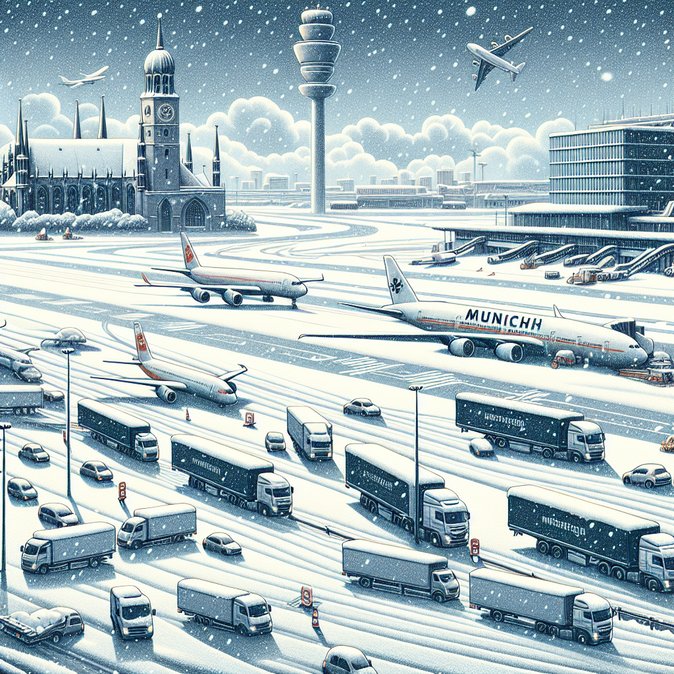
Austria’s first major Alpine winter storm of the season arrived overnight on 5 December, sweeping in from Bavaria and dumping heavy, wet snow across the north-western Alps. While Vienna International Airport (VIE) escaped the heaviest precipitation, Lufthansa, Austrian Airlines and multiple low-cost carriers proactively cancelled or diverted all services linking Munich with Vienna and Graz after Munich Airport (MUC) closed both runways for de-icing and snow-clearance from 03:00 to 11:45. Graz Airport (GRZ) shut its single runway twice for ploughing and friction-measurements.
By Friday afternoon more than 40 rotations had been scrubbed, affecting around 6,800 passengers—many of them business travellers returning to Vienna after week-end meetings in southern Germany. De-icing queues at VIE stretched to 25 minutes for narrow-body aircraft, prompting airlines to load contingency fuel and warn of knock-on delays throughout the weekend. Low-visibility procedures reduced runway capacity, forcing Austrian Airlines to cancel three intra-Schengen departures to Milan, Zurich and Prague to free slots for delayed Munich in-bounds.
![Snow-storm grounds Munich–Vienna & Munich–Graz flights, corporate mobility teams scramble]()
Corporate travel departments report a surge in itinerary changes. Ernst & Young’s Vienna mobility desk said more than 300 consultants were automatically rerouted via Zurich or – where practicable – onto ÖBB Railjet services. Most carriers activated EU261 ‘severe weather’ policies, allowing free re-booking for 6–7 December, but premium-class inventory was already close to sold-out by mid-day. Travellers holding restrictive economy fares were reminded that EU261 cash compensation does not apply to weather, but that downstream hotel or ground-transport costs are usually reimbursable under corporate insurance.
Air-cargo schedules were also hit. DHL and UPS both declared force-majeure for time-definite shipments transiting Vienna’s night-sort. Logistics analysts warn that Austria’s high aviation taxes and ground-handling fees discourage carriers from basing spare aircraft in VIE, reducing resilience when weather forces rapid rescheduling. Vienna Airport’s management reignited its campaign for a tax overhaul, arguing that lower charges would keep contingency capacity in the country and reduce future business-travel disruption.
Looking ahead, Austro Control expects further snow-showers through Saturday evening. Mobility managers are advising travellers to consider rail for trips within 500 km and to monitor airline apps for gate and slot changes in real time.
By Friday afternoon more than 40 rotations had been scrubbed, affecting around 6,800 passengers—many of them business travellers returning to Vienna after week-end meetings in southern Germany. De-icing queues at VIE stretched to 25 minutes for narrow-body aircraft, prompting airlines to load contingency fuel and warn of knock-on delays throughout the weekend. Low-visibility procedures reduced runway capacity, forcing Austrian Airlines to cancel three intra-Schengen departures to Milan, Zurich and Prague to free slots for delayed Munich in-bounds.
Corporate travel departments report a surge in itinerary changes. Ernst & Young’s Vienna mobility desk said more than 300 consultants were automatically rerouted via Zurich or – where practicable – onto ÖBB Railjet services. Most carriers activated EU261 ‘severe weather’ policies, allowing free re-booking for 6–7 December, but premium-class inventory was already close to sold-out by mid-day. Travellers holding restrictive economy fares were reminded that EU261 cash compensation does not apply to weather, but that downstream hotel or ground-transport costs are usually reimbursable under corporate insurance.
Air-cargo schedules were also hit. DHL and UPS both declared force-majeure for time-definite shipments transiting Vienna’s night-sort. Logistics analysts warn that Austria’s high aviation taxes and ground-handling fees discourage carriers from basing spare aircraft in VIE, reducing resilience when weather forces rapid rescheduling. Vienna Airport’s management reignited its campaign for a tax overhaul, arguing that lower charges would keep contingency capacity in the country and reduce future business-travel disruption.
Looking ahead, Austro Control expects further snow-showers through Saturday evening. Mobility managers are advising travellers to consider rail for trips within 500 km and to monitor airline apps for gate and slot changes in real time.