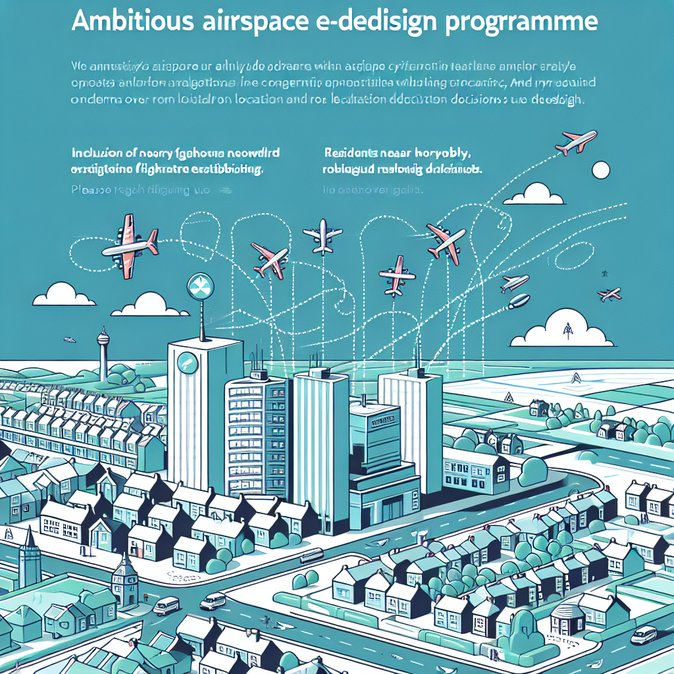
An internal Department for Transport (DfT) memo released under Freedom-of-Information rules reveals that civil servants have urged ministers to reject calls for statutory compensation to homeowners who will find themselves beneath newly drawn flight paths when the UK embarks on its biggest airspace redesign since the 1950s. The review is tied to capacity upgrades at Heathrow (third runway) and Gatwick (permanent dual-runway operations) and is intended to shave up to 10 minutes off typical flight times while cutting holdings that burn fuel above London.
While the DfT argues payouts would be ‘costly, complex and distort routing decisions’, community groups say the stance effectively forces residents to subsidise commercial aviation gains through lost property value and increased noise pollution. Airports currently offer limited insulation schemes, but critics warn these are inadequate for areas newly exposed to low-altitude arrivals.
![No compensation for households under new UK flight paths, officials advise, as airspace overhaul accelerates]()
For mobility managers, the policy—if adopted—could affect short-term housing strategies for inbound assignees posted to Greater London and the Home Counties. Relocation providers may need to refresh neighbourhood-briefings and negotiate rental discounts in zones likely to see steeper over-flight frequencies once the redesign is implemented from 2027 onward.
Airlines broadly support the government’s position, noting that compensation obligations could derail the Civil Aviation Authority’s timeline for implementing the UK Airspace Modernisation Strategy, which also includes digitised arrivals management and expanded use of Performance-Based Navigation (PBN). However, legal experts caution that affected homeowners could mount Judicial Review challenges, injecting further uncertainty into long-haul network planning and airport slot allocation.
With public consultation on detailed flight-path maps expected to open in early 2026, corporate travel teams should monitor which corridors their most frequent routes will use, as track-mileage savings may influence ticket pricing, carbon accounting and duty-of-care calculations.
While the DfT argues payouts would be ‘costly, complex and distort routing decisions’, community groups say the stance effectively forces residents to subsidise commercial aviation gains through lost property value and increased noise pollution. Airports currently offer limited insulation schemes, but critics warn these are inadequate for areas newly exposed to low-altitude arrivals.

For mobility managers, the policy—if adopted—could affect short-term housing strategies for inbound assignees posted to Greater London and the Home Counties. Relocation providers may need to refresh neighbourhood-briefings and negotiate rental discounts in zones likely to see steeper over-flight frequencies once the redesign is implemented from 2027 onward.
Airlines broadly support the government’s position, noting that compensation obligations could derail the Civil Aviation Authority’s timeline for implementing the UK Airspace Modernisation Strategy, which also includes digitised arrivals management and expanded use of Performance-Based Navigation (PBN). However, legal experts caution that affected homeowners could mount Judicial Review challenges, injecting further uncertainty into long-haul network planning and airport slot allocation.
With public consultation on detailed flight-path maps expected to open in early 2026, corporate travel teams should monitor which corridors their most frequent routes will use, as track-mileage savings may influence ticket pricing, carbon accounting and duty-of-care calculations.
More From United Kingdom
View all
Starmer lines up late-January trip to Beijing—but embassy deadlock could scupper first UK PM visit since 2018

easyJet unveils Liverpool–Naples link and wider UK expansion, boosting budget options for 2026 mobility