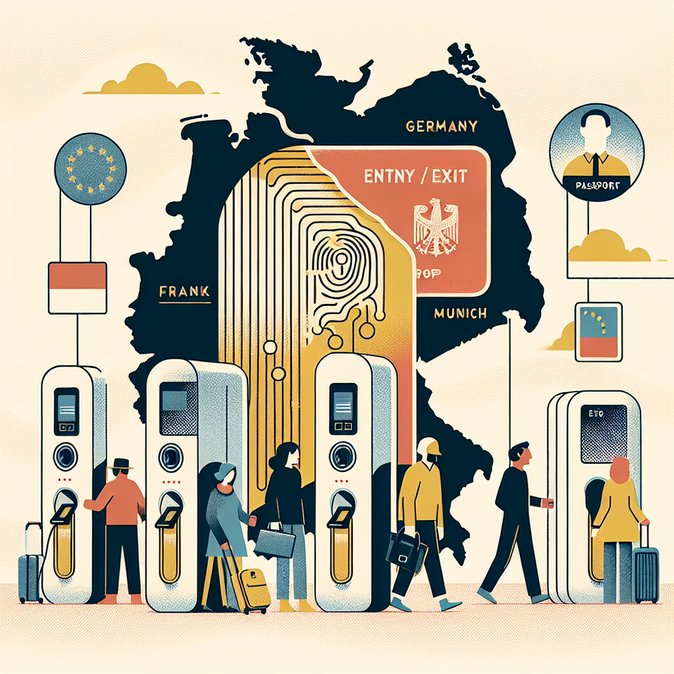
The European Commission confirmed on 2 December that the new Entry/Exit System (EES) has moved into full operational roll-out, and Germany is racing ahead of schedule. Frankfurt and Munich airports have used the biometric regime since October; now the Bundespolizei is extending self-service kiosks to Hamburg, Düsseldorf and the land borders at Kehl (France) and Görlitz (Poland).
EES digitally captures every non-EU traveller’s facial image and fingerprints, replacing manual passport stamps. In live trials, German officials report transaction times falling by 30 percent during off-peak hours, with queues still longer at peak until passengers learn the process. By April 2026, the database will be mandatory at all German air, sea and land crossings and will automatically flag overstays—a compliance boost for companies that rotate staff on short-term assignments.
![Entry/Exit System Roll-out Accelerates: German Border Police Expand Biometric Kiosks]()
For mobility managers the system has three concrete impacts. First, travel-tracking software must be updated to import EES data once APIs are released, allowing real-time monitoring of 90/180-day Schengen stays. Second, traveller education is vital: fingerprints and a photo are now taken at the kiosk before approaching the officer, and failure to register can mean secondary screening. Third, privacy notices and works-council agreements may need revision; Germany’s federal data-protection watchdog is drafting guidance on employer obligations when biometric border records are tied to HR systems.
EES also sets the stage for ETIAS, the pre-travel authorisation that will apply to visa-exempt nationals from late 2026. The two systems will share data, so assignees entering Germany on a business-visitor footing will have their authorised stay calculated automatically.
Early adopters such as Lufthansa and Siemens report smoother crew rotations and fewer manual passport scans. Nonetheless, smaller airports warn they need EU funding to install the scanners. In the meantime, companies should brief travellers to expect mixed technology depending on the point of entry.
EES digitally captures every non-EU traveller’s facial image and fingerprints, replacing manual passport stamps. In live trials, German officials report transaction times falling by 30 percent during off-peak hours, with queues still longer at peak until passengers learn the process. By April 2026, the database will be mandatory at all German air, sea and land crossings and will automatically flag overstays—a compliance boost for companies that rotate staff on short-term assignments.

For mobility managers the system has three concrete impacts. First, travel-tracking software must be updated to import EES data once APIs are released, allowing real-time monitoring of 90/180-day Schengen stays. Second, traveller education is vital: fingerprints and a photo are now taken at the kiosk before approaching the officer, and failure to register can mean secondary screening. Third, privacy notices and works-council agreements may need revision; Germany’s federal data-protection watchdog is drafting guidance on employer obligations when biometric border records are tied to HR systems.
EES also sets the stage for ETIAS, the pre-travel authorisation that will apply to visa-exempt nationals from late 2026. The two systems will share data, so assignees entering Germany on a business-visitor footing will have their authorised stay calculated automatically.
Early adopters such as Lufthansa and Siemens report smoother crew rotations and fewer manual passport scans. Nonetheless, smaller airports warn they need EU funding to install the scanners. In the meantime, companies should brief travellers to expect mixed technology depending on the point of entry.