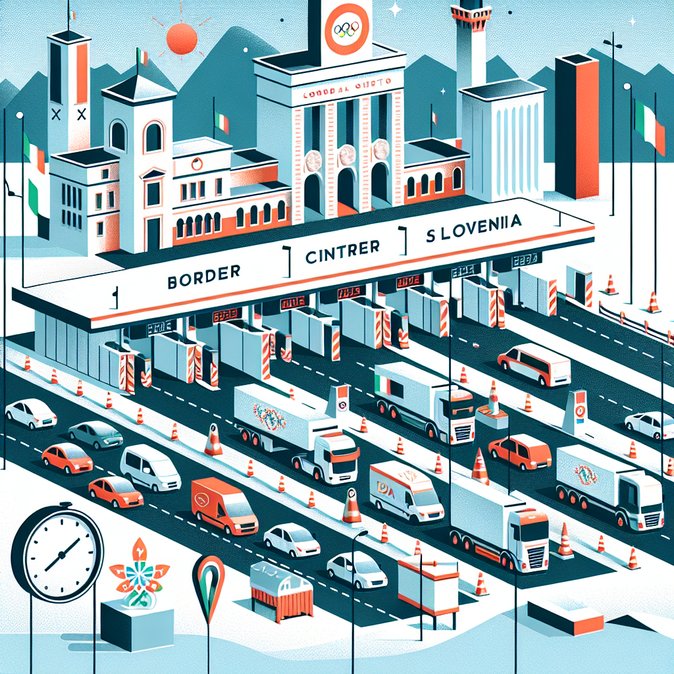
The European Commission’s migration portal, updated on 29 November, confirms that Italy will maintain temporary controls on its land border with Slovenia from 19 December 2025 until 18 June 2026. Rome first reinstated checks in December 2024 citing “heightened security risks linked to irregular migration along the Western Balkan route” and concerns about potential terrorist infiltration during the forthcoming 2026 Universal Jubilee and Winter Olympics.
Under Article 25 of the Schengen Borders Code, member states may temporarily reintroduce internal border controls for renewable six-month periods when serious threats to public policy or internal security are identified. Italy’s notification – its fourth consecutive extension – means travellers by car or rail between Trieste/Gorizia and Nova Gorica/Koper must continue to carry passports or national ID cards and should expect random police inspections.
![EU list confirms Italy’s land border checks with Slovenia extended through mid-2026]()
For businesses the impact is largely one of time and predictability: freight operators have reported average delays of 15–20 minutes at secondary crossing points, while cross-border workers face occasional spot checks during morning peaks. Companies with staff commuting from Slovenia to Italy’s Friuli-Venezia Giulia region are advised to issue written employer letters (in Italian and Slovene) confirming the necessity of travel, a practice that has smoothed inspections over the past year.
Event organisers for the 2025-26 ski season in the Julian Alps and for the Milan-Cortina Games should factor the controls into transfer schedules, particularly for VIP and media shuttles routed through Ljubljana Airport. The Commission notes that any further extension beyond June 2026 would require fresh justification and consultation with neighbouring states – an important marker for corporate planners arranging long-term postings.
Travellers entering Italy from Slovenia by air or sea are unaffected; Schengen rules still apply at those frontiers. However, the Italian Interior Ministry has warned that spot checks could be expanded to train services if intelligence assessments warrant. Mobility managers should monitor official bulletins and ensure employees carry compliant documentation at all times.
Under Article 25 of the Schengen Borders Code, member states may temporarily reintroduce internal border controls for renewable six-month periods when serious threats to public policy or internal security are identified. Italy’s notification – its fourth consecutive extension – means travellers by car or rail between Trieste/Gorizia and Nova Gorica/Koper must continue to carry passports or national ID cards and should expect random police inspections.

For businesses the impact is largely one of time and predictability: freight operators have reported average delays of 15–20 minutes at secondary crossing points, while cross-border workers face occasional spot checks during morning peaks. Companies with staff commuting from Slovenia to Italy’s Friuli-Venezia Giulia region are advised to issue written employer letters (in Italian and Slovene) confirming the necessity of travel, a practice that has smoothed inspections over the past year.
Event organisers for the 2025-26 ski season in the Julian Alps and for the Milan-Cortina Games should factor the controls into transfer schedules, particularly for VIP and media shuttles routed through Ljubljana Airport. The Commission notes that any further extension beyond June 2026 would require fresh justification and consultation with neighbouring states – an important marker for corporate planners arranging long-term postings.
Travellers entering Italy from Slovenia by air or sea are unaffected; Schengen rules still apply at those frontiers. However, the Italian Interior Ministry has warned that spot checks could be expanded to train services if intelligence assessments warrant. Mobility managers should monitor official bulletins and ensure employees carry compliant documentation at all times.