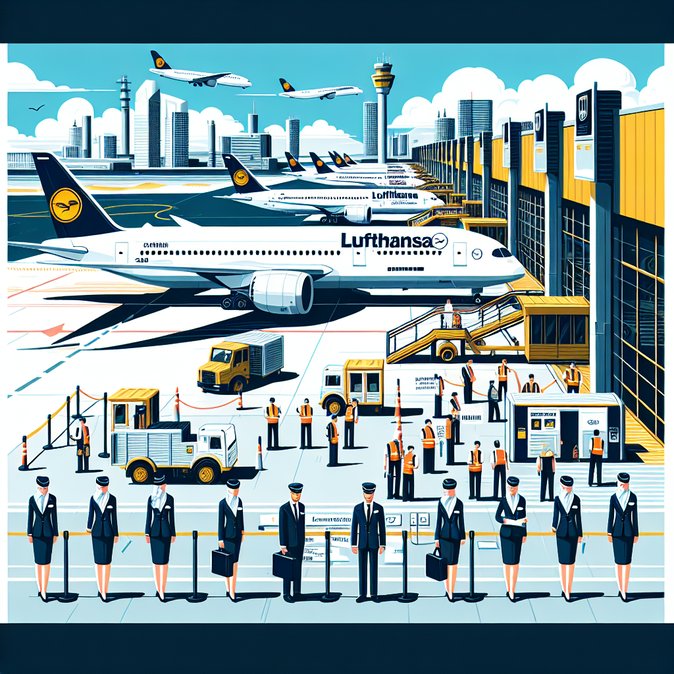
Lufthansa’s mainline flag carrier—long regarded by analysts as the “problem child” inside the Lufthansa Group—has unveiled a sweeping service and productivity plan designed to deliver a “significant profitability jump” in the 2026 financial year.
Speaking to reporters after a board strategy session on 28 November 2025, CEO Jens Ritter said the airline is on track to meet the modest profit targets it set for 2025, but must now "shift from recovery to out-performance." Central to the new plan is faster fleet renewal: ten additional Boeing 787-9s and six Airbus A350-1000s will be delivered in 2026, allowing the retirement of the last A340-300s and early phase-out of several high-cost A330s. All incoming wide-bodies will debut the long-delayed "Allegris" cabin, giving all travel classes direct-aisle access and upgraded in-flight connectivity. For corporate travel buyers the carrier promises a 15 % increase in lie-flat seat inventory on core trans-Atlantic routes.
Cost control will come largely from labour productivity. Having secured new collective agreements with pilot and cabin unions earlier this quarter, Lufthansa will cut the number of standby aircraft and move to a "flex crew" roster that lets the airline interchangeably assign staff across the Lufthansa, CityLine and Eurowings Discover AOC’s for peak operations. Management projects the change will reduce delay-compensation payouts by a further €120 million after a 40 % drop already recorded in 2025. At the same time, a profit-sharing pot worth up to €200 million has been built into the contracts to keep staff on-side during the transition.
![Lufthansa plots 2026 profitability surge with new long-haul cabins and leaner crew model]()
From a customer-experience perspective, Ritter confirmed that the long-haul catering overhaul piloted on the Munich–Chicago route this autumn—fresh menus, larger entrées and pre-order options—will be rolled out network-wide by April 2026. Business-class passengers will also see new mattress toppers and an amenity kit collaboration with German eco-brand ArmedAngels. “Premium demand is strong again, but passengers now benchmark us against the Middle East ‘sandpit’ carriers,” Ritter said. “We have to win that comparison without surrendering our cost discipline.”
For mobility managers the plan matters on two fronts. First, more fuel-efficient 787s and A350s strengthen Lufthansa’s argument that companies can hit Scope-3 CO₂-reduction goals while keeping Frankfurt and Munich as hubs. Second, the promise of better on-time performance—underpinned by a 20 % cut in reserve aircraft—could reduce hidden costs from missed connections and duty-of-care headaches. Ritter insisted the leaner spare-ratio would not compromise resilience, noting that 2025’s operational stability allowed Lufthansa to slash irregular-operation compensation expenses from €217 million in 2024 to under €130 million this year.
Industry analysts were cautiously optimistic. Bernstein Research aviation lead Alex Irving said the mix of hard-product upgrades and labour-rule flexibility “finally aligns Lufthansa’s cost and revenue sides with IAG and Air France-KLM.” Still, he warned that macro risks—particularly a weakening euro and elevated airport charges in Germany—could squeeze the targeted 8 % operating margin. Lufthansa will present detailed 2026 guidance at its March capital-markets day.
Speaking to reporters after a board strategy session on 28 November 2025, CEO Jens Ritter said the airline is on track to meet the modest profit targets it set for 2025, but must now "shift from recovery to out-performance." Central to the new plan is faster fleet renewal: ten additional Boeing 787-9s and six Airbus A350-1000s will be delivered in 2026, allowing the retirement of the last A340-300s and early phase-out of several high-cost A330s. All incoming wide-bodies will debut the long-delayed "Allegris" cabin, giving all travel classes direct-aisle access and upgraded in-flight connectivity. For corporate travel buyers the carrier promises a 15 % increase in lie-flat seat inventory on core trans-Atlantic routes.
Cost control will come largely from labour productivity. Having secured new collective agreements with pilot and cabin unions earlier this quarter, Lufthansa will cut the number of standby aircraft and move to a "flex crew" roster that lets the airline interchangeably assign staff across the Lufthansa, CityLine and Eurowings Discover AOC’s for peak operations. Management projects the change will reduce delay-compensation payouts by a further €120 million after a 40 % drop already recorded in 2025. At the same time, a profit-sharing pot worth up to €200 million has been built into the contracts to keep staff on-side during the transition.

From a customer-experience perspective, Ritter confirmed that the long-haul catering overhaul piloted on the Munich–Chicago route this autumn—fresh menus, larger entrées and pre-order options—will be rolled out network-wide by April 2026. Business-class passengers will also see new mattress toppers and an amenity kit collaboration with German eco-brand ArmedAngels. “Premium demand is strong again, but passengers now benchmark us against the Middle East ‘sandpit’ carriers,” Ritter said. “We have to win that comparison without surrendering our cost discipline.”
For mobility managers the plan matters on two fronts. First, more fuel-efficient 787s and A350s strengthen Lufthansa’s argument that companies can hit Scope-3 CO₂-reduction goals while keeping Frankfurt and Munich as hubs. Second, the promise of better on-time performance—underpinned by a 20 % cut in reserve aircraft—could reduce hidden costs from missed connections and duty-of-care headaches. Ritter insisted the leaner spare-ratio would not compromise resilience, noting that 2025’s operational stability allowed Lufthansa to slash irregular-operation compensation expenses from €217 million in 2024 to under €130 million this year.
Industry analysts were cautiously optimistic. Bernstein Research aviation lead Alex Irving said the mix of hard-product upgrades and labour-rule flexibility “finally aligns Lufthansa’s cost and revenue sides with IAG and Air France-KLM.” Still, he warned that macro risks—particularly a weakening euro and elevated airport charges in Germany—could squeeze the targeted 8 % operating margin. Lufthansa will present detailed 2026 guidance at its March capital-markets day.