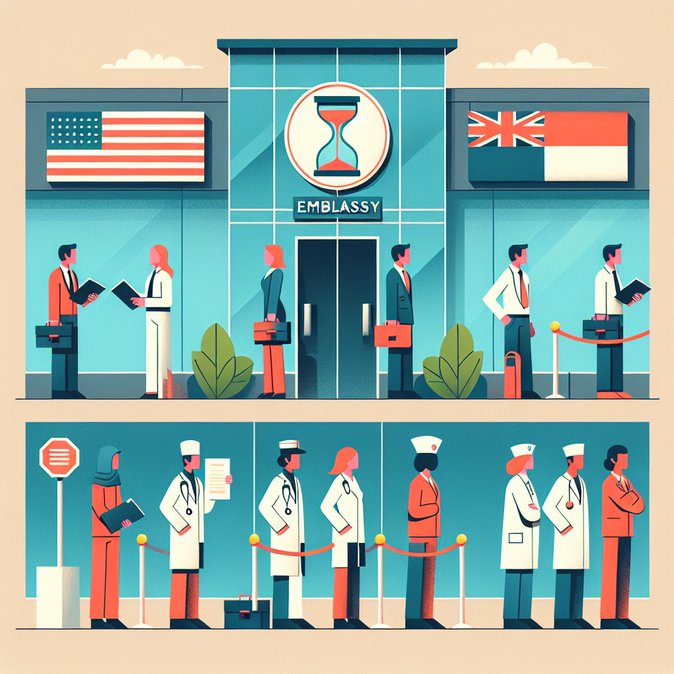
German employers hunting for engineers, nurses and apprentices from Iran are warning of broken contracts and delayed projects after the German embassy in Tehran quietly cut employment-visa appointments to a trickle. In a statement to VisaHQ on 27 November the Federal Foreign Office confirmed that consular staffing in Tehran has been “temporarily reduced,” prioritising family-reunion and humanitarian cases over skilled-worker categories.
The squeeze follows a turbulent year in Iran: anti-government protests, sporadic airport closures and the embassy’s July hand-off to a new external service provider. Since the hand-over, available appointment slots have fallen from roughly 1,200 a month to “barely a few dozen,” according to MiGAZIN, a German migration watchdog. Outside the embassy on Thursday, would-be migrants held placards reading “We have contracts—give us visas!” Some said they had already missed start dates; others reported German HR teams retracting offers because probation periods could no longer be met.
Germany’s labour-shortage statistics underscore the economic stakes: the Federal Employment Agency this month put unfilled vacancies at 1.73 million, with healthcare and STEM roles most acute. Iranian candidates, many German-trained and with B1–C1 language certificates, are part of an official recruitment programme that has placed over 4,000 health-care workers since 2022. Employers now face costly work-around measures—temporary remote work from Iran, or shifting trainees to partner sites in Turkey—while legal advisers warn that lapse of the six-month visa-application validity could force re-filing from scratch.
![German embassy in Tehran slashes appointments, stranding hundreds of Iranian hires]()
Immigration lawyers say Tehran’s backlog exposes a wider vulnerability in Germany’s new Skilled Immigration Act. “Digital filing helps, but visas still live or die on bottlenecks at individual missions,” notes Berlin attorney Katharina Rau. She urges companies to lodge hardship letters citing ‘urgent economic interest’—a provision that can expedite cases under Section 31 of the Act—though success rates vary by post.
For mobility managers the immediate advice is practical: extend onboarding timelines in contracts; build buffer periods of at least 12–14 weeks for Iranian hires; and flag cases with the embassy’s economic section via the AHK Iran if projects are at risk. Some multinational groups are also redeploying Persian-speaking staff already inside the EU to bridge gaps—a stop-gap that comes with its own relocation costs.
The Foreign Office did not give a date for restoring full capacity, saying only that security assessments and staffing constraints were “under ongoing review.” In the meantime, recruiters fear a domino effect: “If Germany sends the message that visas are uncertain, France or Canada will snap up the same talent,” says Farshad Rahimi, CEO of Frankfurt-based MedTalent recruiters. As the scramble for global skills intensifies, Tehran’s visa window—or lack thereof—has become an unexpected choke-point in Germany’s wider competitiveness battle.
The squeeze follows a turbulent year in Iran: anti-government protests, sporadic airport closures and the embassy’s July hand-off to a new external service provider. Since the hand-over, available appointment slots have fallen from roughly 1,200 a month to “barely a few dozen,” according to MiGAZIN, a German migration watchdog. Outside the embassy on Thursday, would-be migrants held placards reading “We have contracts—give us visas!” Some said they had already missed start dates; others reported German HR teams retracting offers because probation periods could no longer be met.
Germany’s labour-shortage statistics underscore the economic stakes: the Federal Employment Agency this month put unfilled vacancies at 1.73 million, with healthcare and STEM roles most acute. Iranian candidates, many German-trained and with B1–C1 language certificates, are part of an official recruitment programme that has placed over 4,000 health-care workers since 2022. Employers now face costly work-around measures—temporary remote work from Iran, or shifting trainees to partner sites in Turkey—while legal advisers warn that lapse of the six-month visa-application validity could force re-filing from scratch.

Immigration lawyers say Tehran’s backlog exposes a wider vulnerability in Germany’s new Skilled Immigration Act. “Digital filing helps, but visas still live or die on bottlenecks at individual missions,” notes Berlin attorney Katharina Rau. She urges companies to lodge hardship letters citing ‘urgent economic interest’—a provision that can expedite cases under Section 31 of the Act—though success rates vary by post.
For mobility managers the immediate advice is practical: extend onboarding timelines in contracts; build buffer periods of at least 12–14 weeks for Iranian hires; and flag cases with the embassy’s economic section via the AHK Iran if projects are at risk. Some multinational groups are also redeploying Persian-speaking staff already inside the EU to bridge gaps—a stop-gap that comes with its own relocation costs.
The Foreign Office did not give a date for restoring full capacity, saying only that security assessments and staffing constraints were “under ongoing review.” In the meantime, recruiters fear a domino effect: “If Germany sends the message that visas are uncertain, France or Canada will snap up the same talent,” says Farshad Rahimi, CEO of Frankfurt-based MedTalent recruiters. As the scramble for global skills intensifies, Tehran’s visa window—or lack thereof—has become an unexpected choke-point in Germany’s wider competitiveness battle.