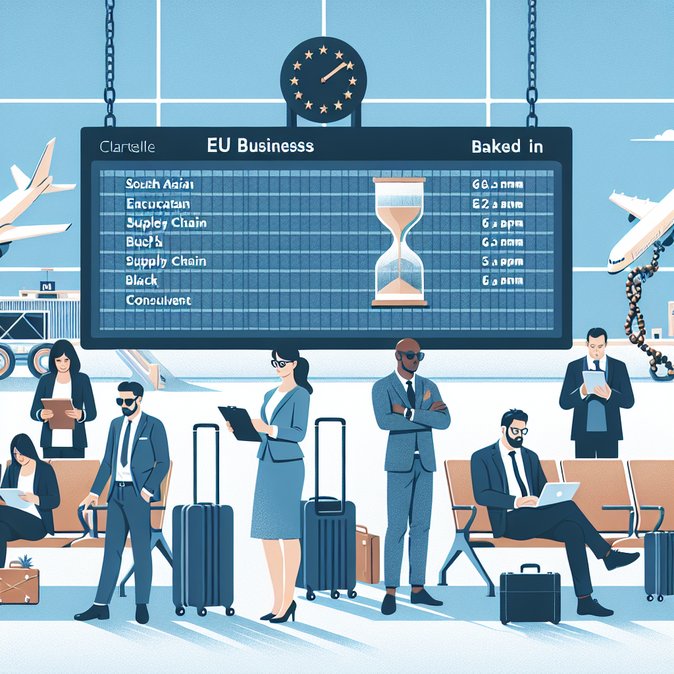
Business travellers flying to or through Germany on 5 March woke to a cascade of delay notifications as airports across Europe cancelled 217 flights and delayed more than 800 others. Frankfurt Airport—Germany’s busiest hub—recorded 15 cancellations and 90 delays, while Munich logged 11 cancellations and 63 delays. Other major nodes such as London Heathrow, Paris-Charles-de-Gaulle and Amsterdam Schiphol were also affected, creating a domino effect across shared aircraft rotations.
Although no single cause was identified, operations managers pointed to a combination of bad weather over the North Sea, staffing shortages in French air-traffic-control centres and ground-handling bottlenecks at Heathrow. German flag-carrier Lufthansa saw 54 delays, forcing last-minute crew-duty re-planning and aircraft swaps. Airlines urged travellers to use mobile apps for re-booking and to allow extra time for connecting flights.
Business travellers looking to minimise disruption should also ensure visa and entry formalities are squared away well ahead of time. VisaHQ’s Germany portal (https://www.visahq.com/germany/) streamlines this process, allowing travel coordinators to check requirements, lodge applications and track approvals in real time, so teams can focus on re-routing flights rather than paperwork.
![Massive same-day flight disruptions hit Frankfurt and Munich as Europe cancels 217 flights]()
For corporates, the disruption underscores how fragile spring schedules remain even after pandemic recovery. Travel managers reported project kick-off meetings in Stuttgart and Frankfurt being moved online at short notice; one automotive supplier said a U.S. engineering team lost an entire day waiting in Zurich after its FRA connection was scrubbed. Experts advise building buffer days into March–April itineraries, when European hubs struggle with weather swings and a surge in trade-fair traffic.
Under EU Regulation 261, passengers departing from Germany are entitled to duty-of-care assistance and, in many cases, compensation if the delay exceeds three hours and is not caused by “extraordinary circumstances.” Lawyers note that ATC staffing shortages are increasingly being judged as a controllable factor. Companies should therefore track delay codes and file claims centrally to recoup costs.
Looking ahead, German airport associations say they will meet the Federal Ministry of Transport next week to discuss contingency staffing funds. Until structural fixes materialise, mobility teams should keep critical staff on flexible tickets and monitor FlightAware alerts for the FRA (Frankfurt) and MUC (Munich) hubs.
Although no single cause was identified, operations managers pointed to a combination of bad weather over the North Sea, staffing shortages in French air-traffic-control centres and ground-handling bottlenecks at Heathrow. German flag-carrier Lufthansa saw 54 delays, forcing last-minute crew-duty re-planning and aircraft swaps. Airlines urged travellers to use mobile apps for re-booking and to allow extra time for connecting flights.
Business travellers looking to minimise disruption should also ensure visa and entry formalities are squared away well ahead of time. VisaHQ’s Germany portal (https://www.visahq.com/germany/) streamlines this process, allowing travel coordinators to check requirements, lodge applications and track approvals in real time, so teams can focus on re-routing flights rather than paperwork.

For corporates, the disruption underscores how fragile spring schedules remain even after pandemic recovery. Travel managers reported project kick-off meetings in Stuttgart and Frankfurt being moved online at short notice; one automotive supplier said a U.S. engineering team lost an entire day waiting in Zurich after its FRA connection was scrubbed. Experts advise building buffer days into March–April itineraries, when European hubs struggle with weather swings and a surge in trade-fair traffic.
Under EU Regulation 261, passengers departing from Germany are entitled to duty-of-care assistance and, in many cases, compensation if the delay exceeds three hours and is not caused by “extraordinary circumstances.” Lawyers note that ATC staffing shortages are increasingly being judged as a controllable factor. Companies should therefore track delay codes and file claims centrally to recoup costs.
Looking ahead, German airport associations say they will meet the Federal Ministry of Transport next week to discuss contingency staffing funds. Until structural fixes materialise, mobility teams should keep critical staff on flexible tickets and monitor FlightAware alerts for the FRA (Frankfurt) and MUC (Munich) hubs.