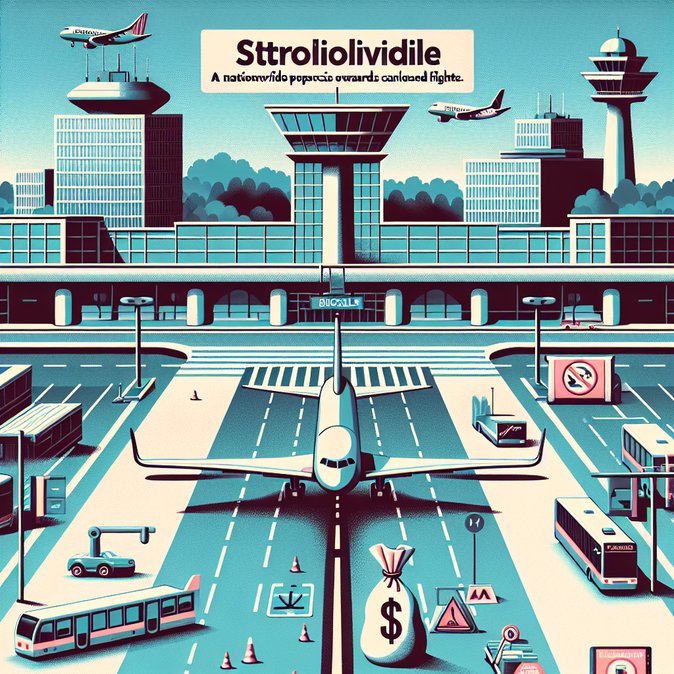
Belgium’s main international gateway, Brussels Airport (BRU), will ground every departing passenger flight on Thursday 12 March after the country’s three largest trade-union confederations confirmed a 24-hour general strike targeting government socio-economic reforms. Airport operator Brussels Airport Company said the walk-out will leave security screening, baggage handling and ground-operations staff too thinly manned to guarantee safety, so a proactive cancellation of the entire outbound programme was the only workable option. (belganewsagency.eu)
Although inbound flights are not formally banned, the airport warns that many will also be scrubbed because aircraft unable to depart cannot rotate back to Brussels. Flag-carrier Brussels Airlines, which accounts for almost half of the airport’s traffic, has already signalled that “most” of its 200-plus scheduled sectors will be axed, costing the company an estimated €15 million in lost revenue and passenger compensation. (belganewsagency.eu)
This is the eighth time since January 2025 that nationwide industrial action unrelated to the airport itself has paralysed BRU. Last year, seven strike days wiped out 2,400 flights and 275,000 passenger journeys. Airport management and business-travel associations have been lobbying the federal government to introduce a minimum-service guarantee similar to those in France and Italy, arguing that repeated shutdowns jeopardise Belgium’s reputation as the de facto capital of the European Union and a key life-sciences logistics hub. (belganewsagency.eu)
![Brussels Airport to Halt All Departing Flights on 12 March Amid Nationwide Strike]()
Corporate travel managers are being advised to reroute itineraries through neighbouring hubs such as Amsterdam-Schiphol, Paris-Charles-de-Gaulle or Frankfurt, or to move meetings online. Travellers holding tickets for 12 March should wait for direct airline communication before making alternative arrangements to preserve their EU261 compensation rights. Companies with posted workers should also check that residence permits remain valid if employees are stranded outside Belgium for longer than 90 days in a 180-day period.
Amid the disruption, some passengers may find their travel plans extending beyond the validity of their Schengen visas or requiring unexpected transits through countries with different entry rules. VisaHQ’s platform can quickly arrange the necessary visas and travel documents for Belgium and its neighbours, saving time for travellers and corporate travel teams alike. For details, visit https://www.visahq.com/belgium/
In the longer term, the episode underscores the vulnerability of Belgium’s single-airport system and may accelerate interest in proposed high-speed rail links and the EU’s forthcoming Multimodal Digital Mobility Services (MDMS) regulation, which promises seamless rebooking across air-rail operators.
Although inbound flights are not formally banned, the airport warns that many will also be scrubbed because aircraft unable to depart cannot rotate back to Brussels. Flag-carrier Brussels Airlines, which accounts for almost half of the airport’s traffic, has already signalled that “most” of its 200-plus scheduled sectors will be axed, costing the company an estimated €15 million in lost revenue and passenger compensation. (belganewsagency.eu)
This is the eighth time since January 2025 that nationwide industrial action unrelated to the airport itself has paralysed BRU. Last year, seven strike days wiped out 2,400 flights and 275,000 passenger journeys. Airport management and business-travel associations have been lobbying the federal government to introduce a minimum-service guarantee similar to those in France and Italy, arguing that repeated shutdowns jeopardise Belgium’s reputation as the de facto capital of the European Union and a key life-sciences logistics hub. (belganewsagency.eu)
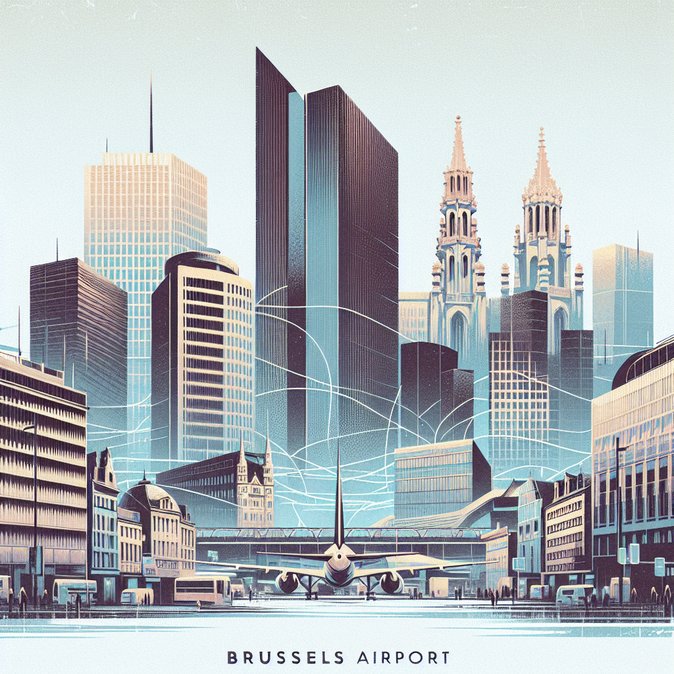
Corporate travel managers are being advised to reroute itineraries through neighbouring hubs such as Amsterdam-Schiphol, Paris-Charles-de-Gaulle or Frankfurt, or to move meetings online. Travellers holding tickets for 12 March should wait for direct airline communication before making alternative arrangements to preserve their EU261 compensation rights. Companies with posted workers should also check that residence permits remain valid if employees are stranded outside Belgium for longer than 90 days in a 180-day period.
Amid the disruption, some passengers may find their travel plans extending beyond the validity of their Schengen visas or requiring unexpected transits through countries with different entry rules. VisaHQ’s platform can quickly arrange the necessary visas and travel documents for Belgium and its neighbours, saving time for travellers and corporate travel teams alike. For details, visit https://www.visahq.com/belgium/
In the longer term, the episode underscores the vulnerability of Belgium’s single-airport system and may accelerate interest in proposed high-speed rail links and the EU’s forthcoming Multimodal Digital Mobility Services (MDMS) regulation, which promises seamless rebooking across air-rail operators.