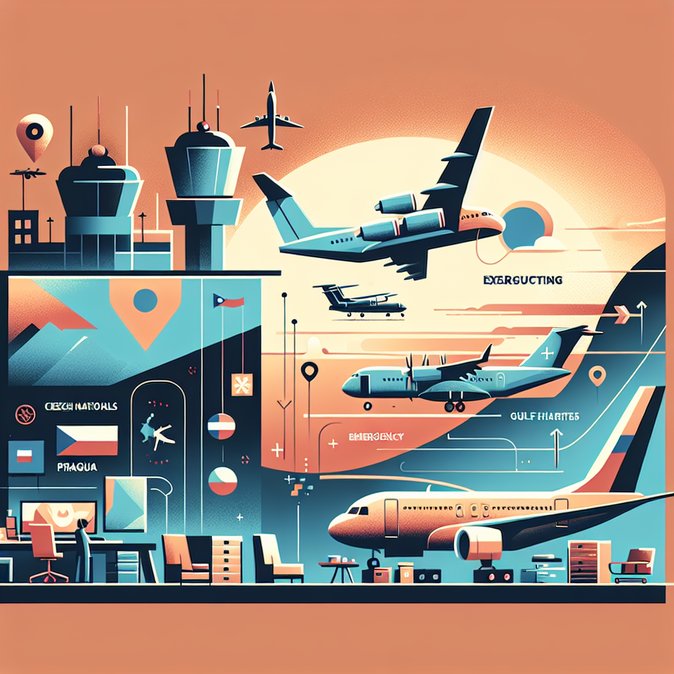
The Czech National Security Council approved an emergency air-bridge on Monday, 2 March, authorising the air force to send two Airbus A319s and a CASA C-295 transport to Sharm el-Sheikh in Egypt and to Amman in Jordan. Prime Minister Andrej Babiš said the move was necessary after the closure of Israeli, Emirati and Omani airspace left thousands of Czech tourists and business travellers stranded across the region. According to the Foreign Ministry, roughly 6,500 Czech nationals are currently registered in the Gulf, Israel and Jordan; many were on winter package holidays or short-term assignments when fighting erupted between Iran and Israel at the weekend. (yahoo.com)
Under the plan, travellers who have managed to leave Israel overland will board the military flights in Egypt or Jordan, while charter carrier Smartwings has been contracted to operate up to four civilian rotations from Muscat and Salalah in Oman once routing clearances are granted. The dual-track approach mirrors previous Czech evacuations from Sudan (2023) and Lebanon (2025), in which military assets handled the most acute cases and commercial operators repatriated larger tourist groups. Companies with posted staff have been told that evacuation costs qualify as an “extraordinary occupational expense” deductible under Czech labour law, provided receipts are retained. (yahoo.com)
For mobility managers the episode is a reminder that the Middle East remains a critical node in Czech travel patterns. Before the crisis, daily Emirates, flydubai and Qatar Airways services carried a growing share of Czech long-haul traffic, offering one-stop links to Asia and Africa. With those routes frozen, travel buyers are scrambling to re-book personnel via Istanbul, Frankfurt or Vienna. Freight managers face similar headaches: loss of belly-hold capacity on Gulf carriers has pushed urgent exports of medical devices and auto parts onto higher-cost road and rail corridors.
![Czech Government Dispatches Military Aircraft for Emergency Evacuations from the Middle East]()
While corporate travel teams revise contingency plans, individual travellers still have to navigate shifting visa and transit rules for Egypt, Jordan and alternate hubs. VisaHQ’s Czech portal can cut through that complexity by providing real-time entry-requirement updates, expedited e-visa processing and courier collection of supporting documents, all accessible at https://www.visahq.com/czech-republic/
The Foreign Ministry has urged all citizens abroad to enrol in the DROZD traveller-tracking system and to keep hard copies of passports, proof of onward travel and, where applicable, Egyptian or Jordanian entry permits. Security advisers recommend that travellers pack at least 48 hours of medication and maintain two independent communication channels as mobile networks in Israel have proven unreliable.
For multinationals, Monday’s decision underscores the importance of integrated crisis-response planning that combines consular channels with private-sector resources. Firms with large regional footprints are already reviewing “plus-one” routing strategies—ensuring employees always have at least one Schengen and one non-Schengen exit option—and updating kidnap-and-ransom coverage to reflect elevated risk scores issued by insurers since the weekend strikes.
Under the plan, travellers who have managed to leave Israel overland will board the military flights in Egypt or Jordan, while charter carrier Smartwings has been contracted to operate up to four civilian rotations from Muscat and Salalah in Oman once routing clearances are granted. The dual-track approach mirrors previous Czech evacuations from Sudan (2023) and Lebanon (2025), in which military assets handled the most acute cases and commercial operators repatriated larger tourist groups. Companies with posted staff have been told that evacuation costs qualify as an “extraordinary occupational expense” deductible under Czech labour law, provided receipts are retained. (yahoo.com)
For mobility managers the episode is a reminder that the Middle East remains a critical node in Czech travel patterns. Before the crisis, daily Emirates, flydubai and Qatar Airways services carried a growing share of Czech long-haul traffic, offering one-stop links to Asia and Africa. With those routes frozen, travel buyers are scrambling to re-book personnel via Istanbul, Frankfurt or Vienna. Freight managers face similar headaches: loss of belly-hold capacity on Gulf carriers has pushed urgent exports of medical devices and auto parts onto higher-cost road and rail corridors.

While corporate travel teams revise contingency plans, individual travellers still have to navigate shifting visa and transit rules for Egypt, Jordan and alternate hubs. VisaHQ’s Czech portal can cut through that complexity by providing real-time entry-requirement updates, expedited e-visa processing and courier collection of supporting documents, all accessible at https://www.visahq.com/czech-republic/
The Foreign Ministry has urged all citizens abroad to enrol in the DROZD traveller-tracking system and to keep hard copies of passports, proof of onward travel and, where applicable, Egyptian or Jordanian entry permits. Security advisers recommend that travellers pack at least 48 hours of medication and maintain two independent communication channels as mobile networks in Israel have proven unreliable.
For multinationals, Monday’s decision underscores the importance of integrated crisis-response planning that combines consular channels with private-sector resources. Firms with large regional footprints are already reviewing “plus-one” routing strategies—ensuring employees always have at least one Schengen and one non-Schengen exit option—and updating kidnap-and-ransom coverage to reflect elevated risk scores issued by insurers since the weekend strikes.