Austrian Airlines (AUA) became the first major Central-European carrier to withdraw completely from the Middle East after weekend U.S.–Israeli strikes in Tehran triggered tit-for-tat missile exchanges and the closure of several Gulf flight-information regions.
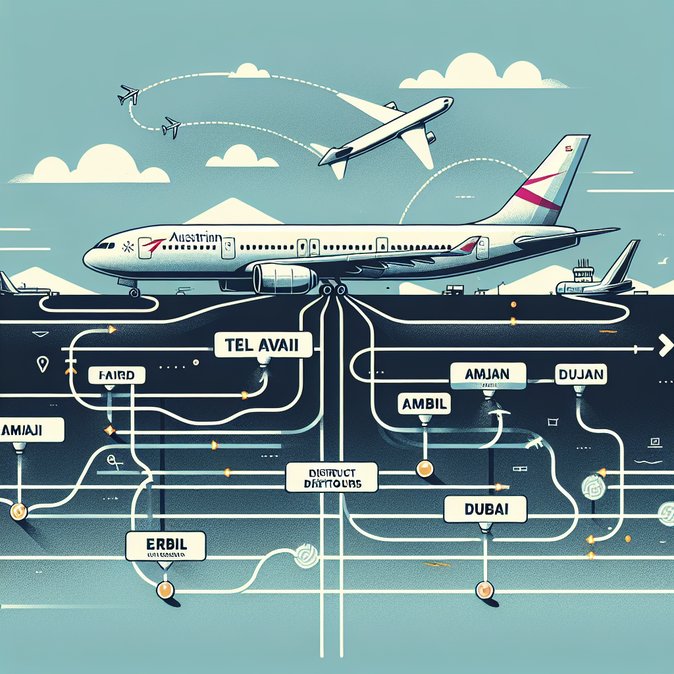
On Sunday, 1 March, the Lufthansa-owned airline extended the suspension of its Vienna services to Tel Aviv, Amman and Erbil through 8 March, pushed back the planned restart of Tehran flights to “at least the end of March”, and cancelled all Vienna–Dubai rotations until 4 March. At the same time, over-flight bans issued by Iran, Iraq, Jordan, Qatar, Kuwait, Bahrain and the United Arab Emirates forced AUA to reroute or cancel long-haul sectors that normally traverse Iranian and Iraqi airspace. The carrier said crews had been instructed to avoid the region altogether, adding up to two hours to east-bound sectors via the Caucasus or the Red Sea.
The decision strands hundreds of business travellers, oil-and-gas contractors and IT specialists who rely on Vienna–Dubai as a feeder to Asia. Travel-management companies are scrambling to re-book clients onto scarce seats via Istanbul or Athens, while corporates with assignees in Tel Aviv’s tech corridor have activated remote-work contingency plans. Risk specialists warn that most Austrian corporate travel-insurance policies lose validity once the Foreign Ministry issues a Level-4 advisory, shifting duty-of-care obligations back to employers.
![Austrian Airlines halts entire Middle-East network until 8 March amid regional air-space closures]()
For passengers suddenly rerouted through hubs like Istanbul, Athens or Cairo, shifting transit rules can create an extra layer of complexity. VisaHQ (https://www.visahq.com/austria/) helps travelers and corporate mobility teams secure the necessary transit or short-stay visas on short notice, offering real-time eligibility checks and express processing that can keep disrupted itineraries on track.
Cargo flows are hit as well: Austrian-produced pharmaceuticals destined for Gulf markets now move overland to Frankfurt, where Lufthansa Cargo still operates limited freighters via the Red Sea corridor. Vienna Airport operator Flughafen Wien AG estimates a revenue loss of €1.2 million per week while the suspensions last.
In a statement, AUA said it is monitoring the security situation “hourly” with Austria’s Foreign Ministry and the Lufthansa Group crisis cell. A dedicated helpline has been opened for rebooking and ticket refunds; however, the airline warned that re-accommodation on partner airlines may take several days because of bottlenecks at Istanbul, Athens and Cairo, the few hubs still accepting traffic to Israel and the Gulf.
On Sunday, 1 March, the Lufthansa-owned airline extended the suspension of its Vienna services to Tel Aviv, Amman and Erbil through 8 March, pushed back the planned restart of Tehran flights to “at least the end of March”, and cancelled all Vienna–Dubai rotations until 4 March. At the same time, over-flight bans issued by Iran, Iraq, Jordan, Qatar, Kuwait, Bahrain and the United Arab Emirates forced AUA to reroute or cancel long-haul sectors that normally traverse Iranian and Iraqi airspace. The carrier said crews had been instructed to avoid the region altogether, adding up to two hours to east-bound sectors via the Caucasus or the Red Sea.
The decision strands hundreds of business travellers, oil-and-gas contractors and IT specialists who rely on Vienna–Dubai as a feeder to Asia. Travel-management companies are scrambling to re-book clients onto scarce seats via Istanbul or Athens, while corporates with assignees in Tel Aviv’s tech corridor have activated remote-work contingency plans. Risk specialists warn that most Austrian corporate travel-insurance policies lose validity once the Foreign Ministry issues a Level-4 advisory, shifting duty-of-care obligations back to employers.

For passengers suddenly rerouted through hubs like Istanbul, Athens or Cairo, shifting transit rules can create an extra layer of complexity. VisaHQ (https://www.visahq.com/austria/) helps travelers and corporate mobility teams secure the necessary transit or short-stay visas on short notice, offering real-time eligibility checks and express processing that can keep disrupted itineraries on track.
Cargo flows are hit as well: Austrian-produced pharmaceuticals destined for Gulf markets now move overland to Frankfurt, where Lufthansa Cargo still operates limited freighters via the Red Sea corridor. Vienna Airport operator Flughafen Wien AG estimates a revenue loss of €1.2 million per week while the suspensions last.
In a statement, AUA said it is monitoring the security situation “hourly” with Austria’s Foreign Ministry and the Lufthansa Group crisis cell. A dedicated helpline has been opened for rebooking and ticket refunds; however, the airline warned that re-accommodation on partner airlines may take several days because of bottlenecks at Istanbul, Athens and Cairo, the few hubs still accepting traffic to Israel and the Gulf.